

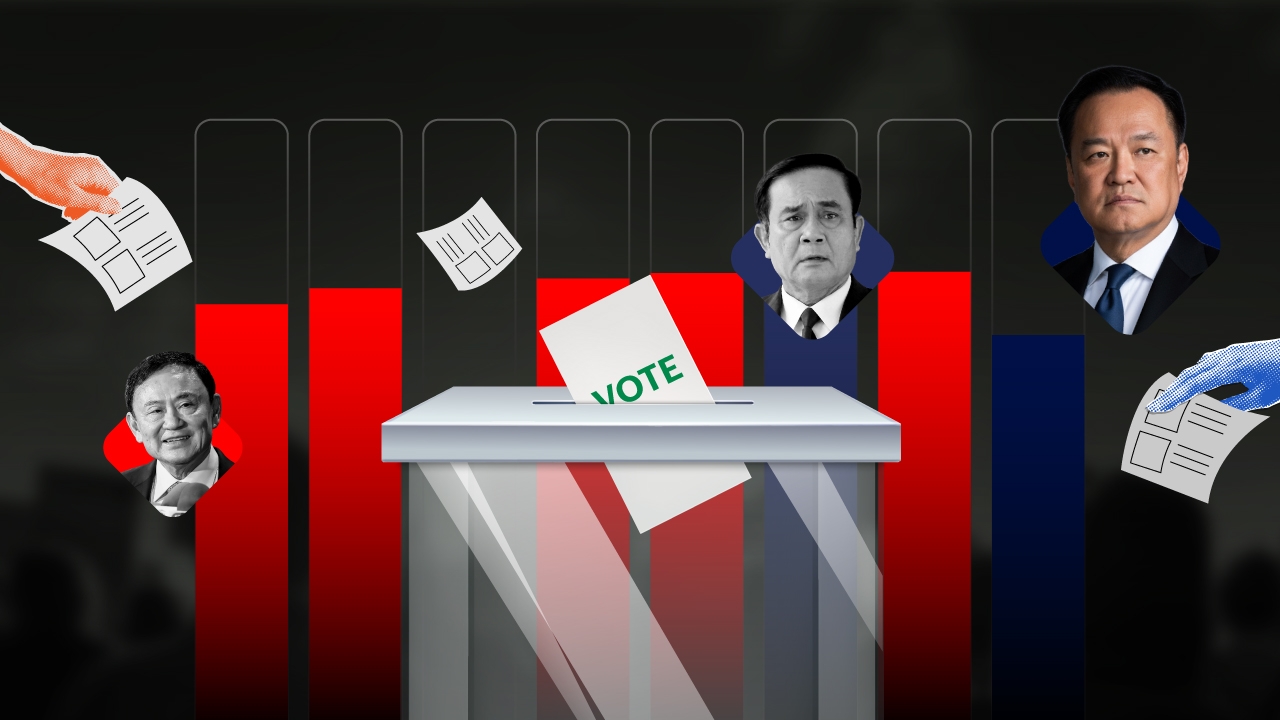
A review of voter turnout for House of Representatives elections over the past 25 years from 2001 to 2026, showing how many Thais participated each election year.
A review of voter turnout for the House of Representatives elections over the past 25 years following the 2026 election. The latest data as of 15:51 on 9 Feb shows that with 94% of votes counted, there were 52,922,923 eligible voters. Of these, 34,550,188 voted in constituency races, or 65.28%, and 34,489,548 voted in party-list races, or 65.17%, averaging 65.22%. How does this compare to previous elections in terms of voter numbers?

There were 42.7 million eligible voters, with 29.9 million voting, a turnout of 69.94%. The Prime Minister after this election was Thaksin Shinawatra from the Thai Rak Thai Party, which won a landslide 248 seats.
There were 44.5 million eligible voters, with 32.3 million voting, a turnout of 72.56%. The Prime Minister remained Thaksin Shinawatra from Thai Rak Thai, which won an even bigger landslide of 377 seats, forming a single-party government.
There were 44.9 million eligible voters, with 29.0 million voting, a turnout of 64.77%. This election occurred amid protests by the People's Alliance for Democracy, and opposition parties boycotted by not nominating candidates. Later, the Constitutional Court ruled the election void due to ballot boxes being placed incorrectly, with the initial plan for a re-election in October 2006. However, a military coup on 19 Sep led the Council for National Security to appoint General Surayud Chulanont as Prime Minister.
There were 44.0 million eligible voters, with 32.7 million voting, a turnout of 74.52%. The Prime Minister after this election was Samak Sundaravej of the People's Power Party, which won 233 seats.
There were 46.9 million eligible voters, with 35.2 million voting, a turnout of 75.03%. The Prime Minister after this election was Yingluck Shinawatra of the Pheu Thai Party, which won 265 seats.
There were 43.0 million eligible voters, with 20.5 million voting, a turnout of 47.72%. This election took place amid protests by the People's Democratic Reform Committee, which disrupted many polling stations, preventing voting in some places. The Constitutional Court later annulled the election because it could not be held nationwide on a single day. Political conflict continued and led to a coup on 22 May 2014 by the National Council for Peace and Order led by General Prayut Chan-o-cha. The National Legislative Assembly appointed by the NCPO then voted Prayut as Prime Minister.
There were 51.2 million eligible voters, with 38.2 million voting, a turnout of 74.69%. The Prime Minister after this election was General Prayut Chan-o-cha from the Palang Pracharath Party, which won 116 seats, coming second to Pheu Thai's 136 seats, but Palang Pracharath formed the government by gathering more coalition seats.
There were 52 million eligible voters, with 39.2 million voting, a record turnout of 75.22%. The Prime Minister after this election was Srettha Thavisin from the Pheu Thai Party, which won 141 seats, second to the Move Forward Party's 151 seats. However, Move Forward could not form a government due to lack of Senate support.
There were 52.9 million eligible voters. The latest update at 21:48 on 26 Feb 2026 from the Election Commission reports the following for the general election held on 8 Feb 2026:
1. Party-list election for House of Representatives
2. Constituency election for House of Representatives
Note: Data as of 25 Feb 2026 excludes votes from re-counts and re-elections. Differences in total voters between party-list and constituency ballots are due to some overseas ballots missing one of the two types.
The party that won the most seats is the Bhumjaithai Party, with about 193 seats. Anutin Charnvirakul is their prime ministerial candidate and they are currently forming the government.