

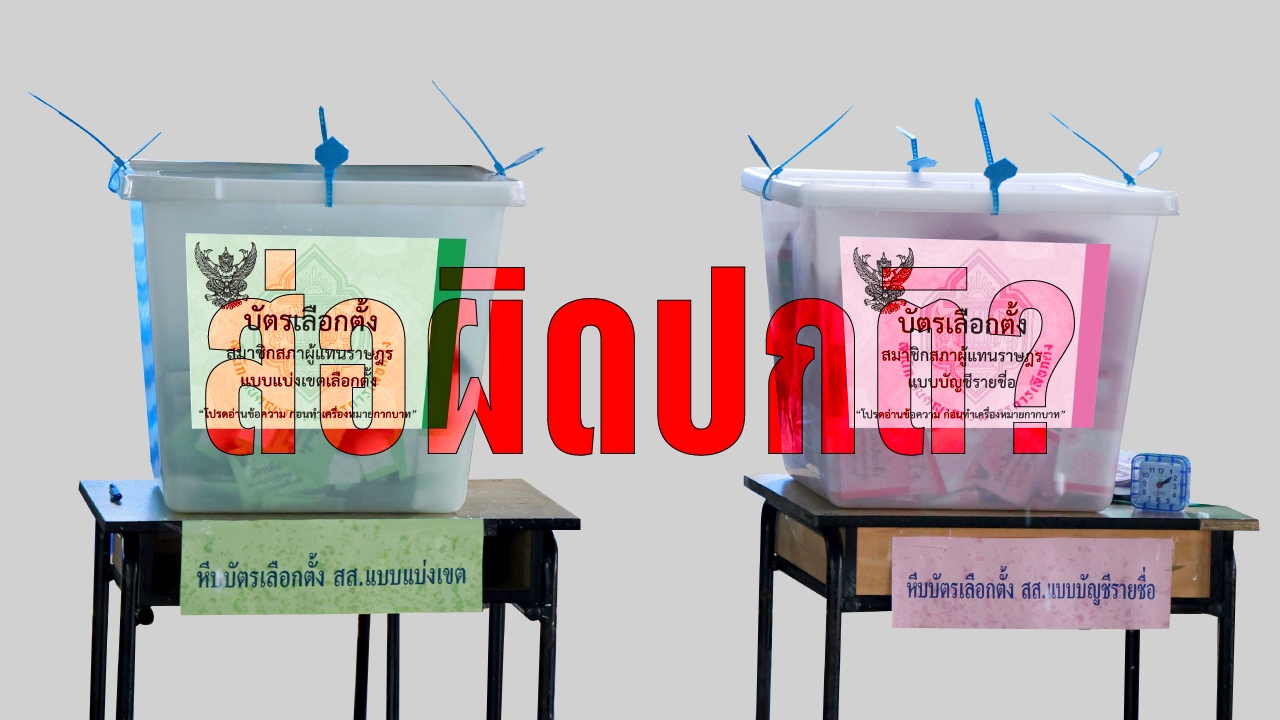
Sarinee highlights suspicious discrepancies in the number of voters for constituency MPs and party-list MPs in the 2026 election across all provinces. She questions whether the Election Commission manipulated the figures and insists those responsible must go to jail.
Today (11 Feb 2026) at 06:29 GMT+7. Sarinee Achavanuntakul, an independent financial scholar, posted a message onFacebookpointing out abnormalities in the number of voters for constituency MPs and party-list MPs based on official Election Commission website data, noting that the numbers differ across all 400 constituencies nationwide, with several provinces showing discrepancies by tens of thousands of votes. She questions whether the Election Commission manipulated the figures.

The fact that the "number of voters for constituency MPs" and the "number of voters for party-list MPs" nationwide, based on approximately 95% unofficial counts on the Election Commission's website, do not match in any province at all, is the clearest evidence she has ever seen that the central Election Commission likely "manipulated the votes" with near certainty. In other words, they did not display the vote counts as reported by polling stations nationwide, for the following reasons.
1. Everyone receives two ballots when entering the booth: one for the constituency MP (green) and one for the party-list MP (pink). Although it is possible officials might hand out only one ballot, this is highly unlikely and voters would likely protest if they did not receive both ballots.
2. After receiving the ballots, regardless of what a voter marks, once the ballot is cast it is counted in the "number of voters" total, whether the ballot is valid, spoiled, or left blank.
3. Therefore, the number of "voters for constituency MPs" must always equal the number of "voters for party-list MPs" at every polling station nationwide — over a hundred thousand stations. Her personal observations during the election confirm this; in the four polling stations she monitored, both numbers matched exactly and calculations were correct.
If discrepancies were due to human error, as the Election Commission often claims, such errors should be minimal — only a few votes out of millions nationwide, not discrepancies of dozens, hundreds, or thousands per district as seen in some provinces.
4. Early voting and out-of-district voting do not cause such discrepancies because every vote must be counted in pairs (green and pink ballots). Even if sent to the wrong district, they are sent as pairs. Thus, the two numbers must always be equal at each station.
(This is like the fundamental accounting principle that total assets must equal the sum of liabilities and equity.)
An Election Commission official informed her that about 100,000 voters overseas used postal voting (not at embassies), which might cause some discrepancies since the Commission receives envelopes from voters without knowing if both ballots are included. However, she believes this number is very small because overseas voting registration is complicated and voters are unlikely to "forget" to include a ballot.
5. Some have suggested that the number of voters for constituency MPs might differ from party-list MPs because some voters may not meet the 90-day residency requirement to vote for constituency MPs but can still vote for party-list MPs. However, if the Commission examined this, the number of voters for constituency MPs would be lower than for party-list MPs. Yet the two numbers are always equal on the Commission's website, both by province and nationally, indicating polling stations indeed issued two ballots to every eligible voter. . (Screenshot from the Election Commission's website at 6:00 AM on 11 Feb 2026 shows in red circles that the "number of voters for constituency MPs" nationwide is still 66,939 higher than for party-list MPs, an increase since the previous day's provincial counts at 8:00 PM.) 6. Meanwhile, the number of "voters in the referendum"
can reasonably be higher or lower than the number of voters for constituency or party-list MPs, due to factors such as some voters casting ballots for MPs but not participating in the referendum (which requires separate identification) or significant numbers of out-of-district referendum voters.

For these reasons, the number of voters for MPs is not compared to referendum turnout. 7. It has long been assumed that when the Commission reports percentages counted, such as 18%, 50%, or 95%, this represents the total real vote count from "all polling stations" once each station finishes counting and reports to the central Commission. The website and official briefings encourage this understanding. But if the Commission actually
"reports real numbers from each station,"
then the large discrepancies between the numbers of voters for constituency and party-list MPs by district and province shown on the website are unlikely, because these two figures should mostly be accurate at the station level, as explained above, regardless of how many stations (percentage counted) are included. This implies the Commission likely "manipulated" (manipulated)
the figures reported by polling stations. In other words, the numbers shown on the website and used by the media are probably not "the actual numbers" aggregated from each station. If the central Commission did not "manipulate" any numbers, the only explanation for these discrepancies would be massive election fraud at nearly every polling station in almost every province, such as polling officials secretly casting ballots (green or pink) without voters' knowledge. This is very serious but cannot be confirmed yet without the Commission releasing all station-level results nationwide. This indication is extremely serious if the Commission indeed
"manipulated" the numbers (and there are other clues, such as fluctuating website figures and moments when total MP votes or ballot counts exceeded the number of eligible voters, later adjusted to match — see example at https://www.facebook.com/share/p/17spdDZLaW/ ). However, the clue about discrepancies in voter turnout is the clearest evidence of manipulation across all districts nationwide. She calls for 1) a nationwide recount at minimum, 2) immediate release of station-level vote counts by the Commission, and 3) the media to investigate whether the Commission
"manipulated" figures reported by polling stations, why, and how. She personally believes the Commission officials involved should face prison.
Based on data Sarinee compiled, referencing the Election Commission website with 95% counted as of 20:30 on 10 Feb 2026, the five provinces with the largest discrepancies where constituency MP voters outnumber party-list MP voters are: Top 5 provinces where constituency MP voters exceeded party-list MP voters: 1. Phatthalung by 15,644 ballots2. Sisaket by 11,321 ballots3. Phrae by 10,379 ballots
4. Nan by 8,915 ballots 5. Chonburi by 7,894 ballots Top 5 provinces where party-list MP voters exceeded constituency MP voters: 1. Roi Et by 14,584 ballots
2. Sakon Nakhon by 8,955 ballots3. Nakhon Ratchasima by 8,446 ballots4. Trang by 6,149 ballots
5. Nong Bua Lamphu by 4,690 ballots
