

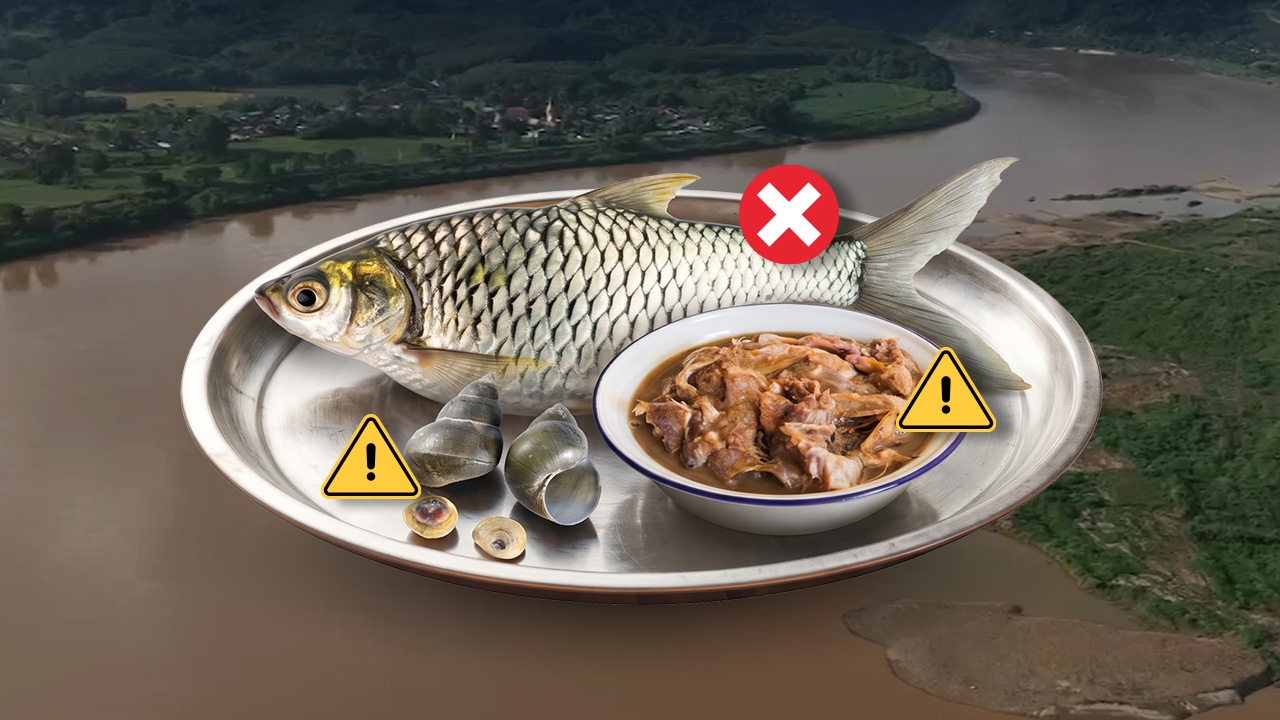
The toxic crisis in the Kok River shows fish flesh remains safe, but internal organs and shellfish should be avoided. Long-term concerns include ecosystem collapse, fish species loss, and impacts on local fisheries, forcing fishermen to stop fishing and face income loss.
/ "Kok River" flowing through Chiang Mai and Chiang Rai provinces. Yesterday (23 Nov 2023), the Department of Fisheries reported testing 300 aquatic animal samples, finding 10 species with pollutant levels exceeding standards: freshwater shrimp, apple snails, mystery snails, freshwater mussels, freshwater clams, climbing perch, walking catfish, yellow catfish, northern black fish, and high-fin barracuda.

Today (24 Nov 2023), further clarification was given: analysis by Naresuan University and the Office of the Science, Research and Innovation Promotion (OSRIP) revealed previous data mixed samples from the Salawin and Mekong rivers in Loei province with Kok River data, causing communication errors and misunderstandings about sample origins.
Testing of aquatic animals in Chiang Rai and Chiang Mai from April 2025 to October 2026 totaled 598 samples—327 from the Department of Fisheries and 271 from Naresuan University researchers—showing most fish flesh met safety standards.
Out of 132 fish flesh samples tested, 131 passed safety standards, representing 99%. One sample found contaminated in September 2026 tested within standards upon retesting in October 2026.
However, testing of other animal parts showed caution is needed with fish internal organs: out of 129 samples, 32 (about one-quarter) exceeded contamination limits. Among 7 shellfish samples, 2 exceeded standards, indicating varying contamination risks by species and body part.
Data from AI CARE Research Cluster at Naresuan University aligns with this, analyzing 259 accumulated samples from the Kok River basin, including 127 fish flesh, 125 fish intestines, and 7 shellfish/crabs.
Most fish flesh remains within standards and safe for consumption if thoroughly cooked. Of 127 flesh samples, 126 met standards with no mercury contamination above limits. One flesh sample showed lead above limits in August 2025 but is not from recent tests. Over the past year, including rainy seasons, all flesh samples met standards.
Fish intestines showed contamination concerns: in 112 samples from Chiang Rai, 26 (23.2%) exceeded lead limits, with the highest at 9.85 mg/kg—about 32.8 times the standard. Arsenic exceeded limits in 7 samples (6.3%), highest at 9.03 mg/kg—about 4.5 times the standard.
Among 7 shellfish and crab samples in Chiang Rai, one mystery snail exceeded arsenic limits by about 1.2 times. The 32 contaminated fish intestine samples out of 125 were found across multiple areas in Chiang Mai and Chiang Rai.
Authorities recommend consuming only fish flesh, always cooked thoroughly; avoid raw fish flesh and fish intestines. When making fish chili paste or dipping sauces, remove intestines and internal organs before cooking. Avoid mystery snails from Ban Sop Ruak area, where arsenic contamination was detected. For fermented small fish dishes (pla jom, pla daek, pla ra), remove intestines before cooking.

Thairath Online special news team discussed this issue with Asst. Prof. Dr. Suebsakul Kijunakorn, a lecturer at the Social Innovation School, Mae Fah Luang University, who has closely followed environmental issues in Chiang Rai. He said locals are not surprised by contamination news because both the Department of Health and provincial authorities have long warned against consuming fish internal organs and bottom-dwelling animals from the Kok and Mekong rivers, including Mae Sai district. The latest announcements confirm longstanding local concerns that "fish in the river are unsafe."
Regarding health impacts, no acute illnesses have been reported yet, as heavy metals accumulate gradually in the human body, requiring at least five years or more before symptoms appear.
The worrying issue is ecosystem collapse. Naturally, river water is turbid only during the rainy season and clear in the dry season, but since late 2024 until now, the Kok River has remained turbid year-round—a deadly sign for aquatic life. Sediment smothers spawning grounds, shelters, and feeding areas, causing fish populations to decline.

There are also impacts on livelihoods. Local fishermen along the Kok River have stopped fishing due to concerns about contaminants in fish and customers reluctant to buy, resulting in daily income loss. Many fishing boats sit idle, and the once lively fishing activity, day and night, has quieted noticeably.
Mr. Sanit Yoo-in, 62, a resident of the Kok Riverside community in Mueang Chiang Rai district, said he used to work in construction before turning to fishing in the Kok River as his main income, catching various species including catfish, climbing perch, white fish, and gourami, earning about 500-600 baht daily and keeping fish for household use.
When contamination was first detected, he still fished occasionally but became confused by conflicting information: some said fish were safe to eat, others advised against consumption. After 2-3 months, he stopped fishing completely due to worries over residue and lack of buyers. Now, he even hesitates to wash his hands in the river.
Sanit said previously almost every village near the Kok River had residents fishing regularly by rod or net, especially at night when boats were active. Now, hardly anyone fishes, and his boat, over 10 years old and freshly painted 1-2 months ago, remains docked awaiting the situation to improve.
About a month ago, he caught a catfish with abnormal whiskers and released it back, fearing contamination. He also noted that white fish and gourami are now rarely seen compared to before. At home, he has shifted to buying bottled water and farm-raised fish like Nile tilapia and catfish from markets instead of river fish.

Regarding income impacts, Sanit said his age and education (only grade 4) limit alternative job options. His children discourage hard labor, so he stays home to care for grandchildren. During the recent Loy Krathong festival, he tried making floating offerings for sale, but demand was low as people feared water quality and contact with the Kok River water.
"I want authorities to test and clearly certify which fish are safe or unsafe to eat. If some fish are unsafe, we can stop fishing them clearly; if some are safe, we can sell them. I want testing by species so villagers know which fish to eat and which to avoid," Sanit said.
Locals believe solutions to contamination in the Kok River should go beyond consumption warnings. The government must build trust by openly sharing clear, ongoing test results and implementing concrete measures to resolve pollution, enabling residents to live and work safely by the river without enduring prolonged economic hardship from this pollution crisis.