

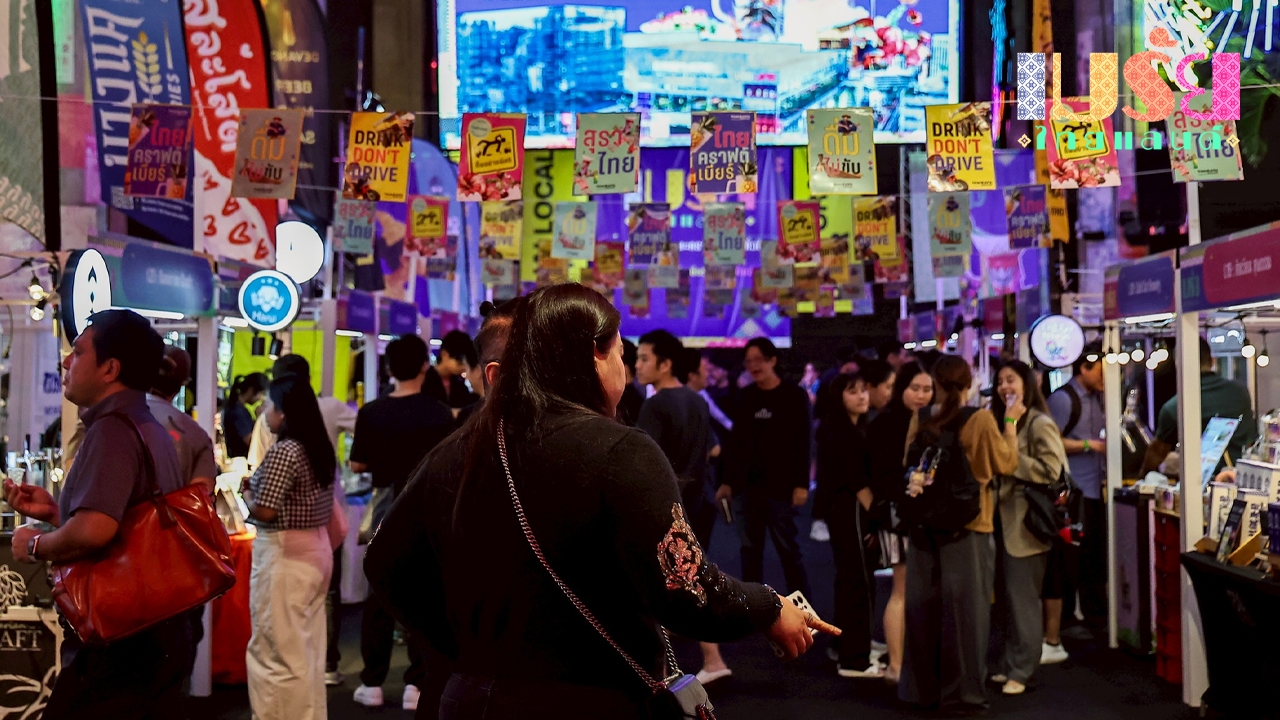
Three local spirits boost the community economy, paving the way for producers to revive traditional knowledge at the "Merai Thailand 2025" event. Local voices say, "When products meet standards, consumers can drink safely."
Following the enforcement of the Progressive Liquor Act, a law aimed at removing previous restrictions, small producers can now more easily obtain licenses to produce and sell alcohol. The law reduces factory establishment conditions and removes barriers that once blocked local entrepreneurs. Communities nationwide are beginning to recover, bringing formerly restricted traditional liquor-making knowledge into the legal system for the first time in decades.
This legal change not only opens new opportunities for small businesses but also creates space for local spirits to re-enter the market. Ancient recipes passed down in communities are now standardized products that generate jobs, distribute income, and increase economic value for grassroots producers. As a result, community spirits from many provinces are confidently entering the market and gaining recognition.

1. Lao Pae, Phrae Province
Kanyapak Omtong shared the origin of the community product "Lao Pae" from Phrae Province. She originally made illicit liquor, which was illegal. But when the government allowed legal production licenses, she formed a group to oversee production and applied for permits to ensure all steps comply with the law.
She explained that the key goal is to develop a diverse product line with unique flavors, encouraging consumers to drink responsibly and moderately. They started with a basic white liquor and expanded to create various flavors and scents, allowing multiple product types. She emphasized, "When products have standards, consumers can drink safely."

Kanyapak also revealed that legal liquor production greatly drives the community economy by creating jobs and income, and generating tax revenue legally. She hopes locals will no longer have to produce illegal goods, and that this also provides another source of income returned to the government through taxes.
Recently, "Lao Pae" from Phrae Province received a GI (Geographical Indication) certification, marking an important milestone for this steadily growing community spirit.

2. Gacha, Lampang Province
Ampawa Praemuang, owner of the local spirit brand "Gacha" from Lampang Province, recounted that her family has been making liquor for generations. She is the fifth-generation heir, but because production was illegal in the past, the third and fourth generations had to stop for over 30 years. In 2023, when Thailand implemented the Progressive Liquor Act, she decided to revive her family's knowledge, developing products legally while adhering to the principle,
"We want to build on the folk wisdom passed down through generations to create high-quality products."
She then proceeded to legally apply for production licenses following proper procedures.
Ampawa noted that "Gacha" plays an important role in the community economy, especially during times of low rice prices. She can add value by processing rice into products, providing villagers with additional income opportunities.
She concluded that Thailand has excellent foundations in raw materials and local wisdom, but often cannot capitalize due to various limitations. She believes that with more open laws and systems, Thai community products could grow significantly.
3. Sa To liquor, Agat Dee Bo Towa, Ubon Ratchathani Province
Thanawat Supason, representative of the "Sa To" liquor product from the Agat Dee Bo Towa brand in Ubon Ratchathani Province, said the brand aims to prevent "Sa To," a traditional Thai local spirit, from disappearing from the liquor family. They began developing the product to meet standards and be legally sold.
Thanawat revealed that Sa To is an important product for the community economy because many younger people are unfamiliar with this traditional spirit. Revitalizing Sa To helps preserve local wisdom and simultaneously adds value to the community.
These three local liquor areas reflect the results of legal reforms that give communities opportunities to develop their products properly and with standards. While the growth of the community liquor industry still depends on many factors—market, support, and consumer understanding—the efforts in each area demonstrate that local wisdom has the potential to become products that generate income and grow sustainably in the future.
26-30 November 2025 GMT+7
At EM WONDER & SPHERE HALL, 5th Floor @EMSPHERE: Google Map
https://maps.app.goo.gl/HrXykaxjMeKr6R2b9
#GettingThere
By private car: Parking available at the parking lot.
By BTS Skytrain: Get off at Phrom Phong Station, Exit 6. Walk along the skywalk to the EM Sphere mall side.
By MRT Subway: Get off at Sukhumvit Station, Exit 3. Walk up the skywalk, cross the intersection, and walk to the mall—about 900 meters.