

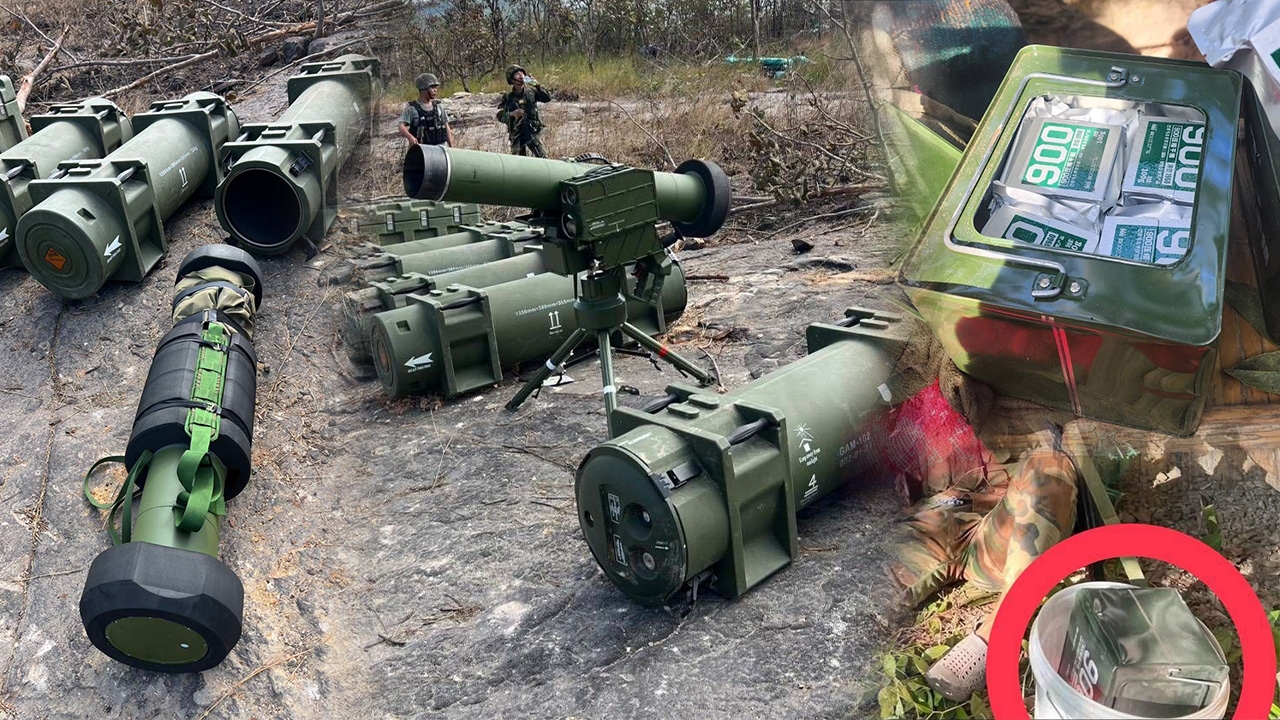
The cutting-edge GAM-102LR missile has appeared on Cambodia's frontline, prompting security units to ask: who is supporting it behind the scenes? Dr. Panithan analyzes that it may have come from the black market, involving redirected foreign aid and grey funds for its purchase.
Regarding the incident on 14 Dec 2024, the "Royal Thai Army" confirmed that Thai soldiers seized a large number of fifth-generation guided anti-tank missile systems, the GAM-102LR, of Chinese origin from Cambodian troops on Hill 500. This is a newly launched weapon introduced earlier this year,
which led security agencies to question how Cambodia, a country with widespread poverty, economic downturn, and shortages even of medicines in many areas, could possess modern military equipment worth millions of baht each appearing on the border frontline. Where does Cambodia’s budget come from, and are there "quiet" backers "quietly" who never appear publicly behind this?

Thairath Online's special news team discussed this with Associate Professor Dr. Panithan Wattana-yakorn, an independent scholar, expert in international politics and security, and former security advisor to several Thai governments. He revealed that the discovery of this newly launched weapon in early 2025 in a combat zone reflects several points. First, the modern arms market is quite open, deliveries can be very fast, and these weapons may not yet be formally commissioned.
The next point is that the acquisition of this weapon likely involved a “special channel” because the latest modern weapons of this type generally require official orders and long waiting times, especially for the arrival of “technicians” to set up systems, update software, and integrate operational systems into ground combat.
“In this case, it is an anti-tank missile with a longer firing range than many countries, including Cambodia's previous arsenal. Therefore, technicians or helpers may have assisted in integrating it into actual battlefield systems.”
The third point is the weapon's source, which Thailand's Ministry of Foreign Affairs must investigate further. It could come from state enterprise transactions, where producing and purchasing countries typically report officially to their parliaments. Additionally, many countries, including Thailand, have registered arms procurement with the United Nations, allowing tracking of imports, exports, and possession of heavy weapons.
China, the weapon’s origin, has repeatedly denied supplying weapons to Cambodia for attacks against Thailand or involvement in border conflicts. Regarding the GAM-102LR, no inquiries or explanations have yet been issued.
Another possibility is that it originated directly from manufacturers and leaked into the black market. This case warrants extreme caution from Thailand as it implies that there may be many other weapon types held by Cambodia unknown to us. Regarding training and control, private contractors or grey financial groups might be involved in assisting or supervising initial usage.
To uncover the truth, interrogations might focus on hired personnel or skilled individuals such as active soldiers, veterans, or civilian combatants. Thailand has already questioned some, but no clear information has emerged yet.

Regarding questions about “quiet” backers "quietly" who never appear publicly behind the scenes, Associate Professor Dr. Panithan finds this a notable issue. Cambodia’s weapon budget might come from foreign aid funds, from China, the US, Japan, or Western countries. These funds may have been intended for other purposes but were diverted by Cambodia for unauthorized use.
“Much suspicion centers on aid from the Ottawa Mine Ban Treaty coalition, where Thailand is pressing to question if these funds have leaked, pushing for an independent committee to audit fund usage and violations.”
Another possibility is the presence of grey networks with huge financial resources buying these weapons. For example, in the past, shoulder-fired rockets costing 200,000–300,000 baht were purchased using illegal funds. It is unclear whether these funds were given to Cambodian authorities for procurement or used to buy weapons for direct provision, but usually such transactions avoid official channels.
If this is the case, Thailand’s crackdown on grey money would greatly aid border conflict efforts and could be done quickly since it would involve fewer concerns over international relations. Cooperation with China or other nations could also be possible.
“If successfully implemented, the process would be rapid, shutting down grey money that Western countries estimate may exceed Cambodia’s official budget, clearly turning the situation around. Modern warfare can pivot on such factors.”
Associate Professor Dr. Panithan believes this weapon's presence may delay military operations because Thai troops must postpone entering certain areas. The use of tanks in flat terrain would be halted since they fall within the missile’s firing range, complicating border organization and safe zone establishment, which was previously expected to be completed before the New Year.
In the future, Thailand must adjust its approach to reducing threats from Cambodia because current methods are slow and limited. For instance, after bombing, infantry, special forces, and tanks cannot easily enter the area due to the missile’s range. New troop deployments might emphasize small, agile, powerful light weapons.
“We hope not to encounter other advanced weapons. If so, Thailand will face challenges such as high-level attack drones. Thailand will need air defense systems like the Patriot missile system. Although expensive, without it, large-scale civilian evacuations would be necessary each time. Developing mixed warfare forces, small guerrilla units, more ranger or special forces, and increased use of affordable, precise drones would provide significant advantages.”

The GAM-102LR is a fifth-generation ultra-long-range precision guided anti-tank missile system developed and produced by China’s Poly Defense, a subsidiary of Poly Technologies, first unveiled at the 2025 EDEX defense exhibition.
It features a multi-sensor optical system comprising three sensors: infrared camera, television camera, and laser rangefinder, delivering high-resolution imagery. It also includes a wireless data link to receive guidance information.
It can precisely navigate flight paths and target coordinates with an operational range exceeding 10 kilometers. Its tandem warhead can penetrate over 1,000 millimeters of armor, enabling it to destroy all types of tanks equipped with explosive reactive armor.
Key features of the GAM-102LR
1. Fire-and-Forget System
Once the target is locked, the operator can launch the missile without needing to guide it continuously, reducing risk to the shooter on the battlefield. It supports both lock-on before launch (LOBL) and lock-on after launch (LOAL) modes.
2. Man-in-the-Loop Control System
Although it is fire-and-forget, the operator can still control or adjust the missile’s flight path during its flight, enhancing flexibility and attack accuracy.
3. Network-Enabled System
The GAM-102LR can connect to a battle network to receive target coordinates from intelligence sources or other platforms, enabling beyond line-of-sight (BLOS) attacks where the shooter does not need direct visual contact with the target.
Regarding price, the Army Military Force page estimates each GAM-102LR missile costs approximately $112,000 USD, equivalent to about 3,530,240 Thai baht.