

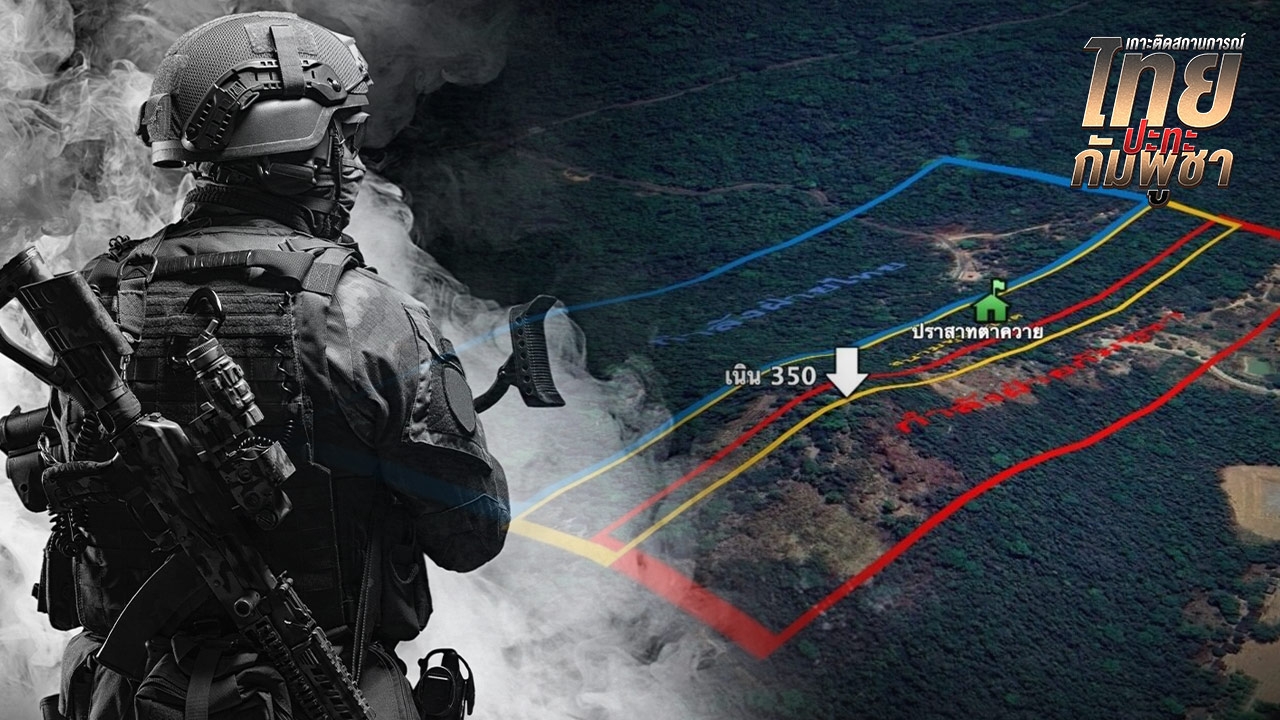
Decoding the fierce "Hill 350" battlefield with hopes to end the conflict before year-end and the potential to change the negotiation mediator. A former ranger reveals it is a crucial decisive point that must be captured, recommending tactical adjustments and a decisive cut to Cambodia's supply lines.
The Thai–Cambodian border situation continues with ongoing clashes across several battlefields. Yesterday (16 Dec), Thai soldiers successfully recaptured territory. "Chong An Ma" in Nam Yuen District, Ubon Ratchathani Province, was fully reclaimed. Similarly, this morning (17 Dec), troops recaptured Ta Kwai Castle in Phanom Dong Rak District, Surin Province, marking another battlefield secured. They raised the Thai flag and the national anthem was loudly played.
However, the 2nd Army Region reported the latest situation around noon today (17 Dec), stating that heavy fighting occurred in front of Ta Kwai Castle due to enemy attempts to advance. Thai forces followed operational plans and applied appropriate force to halt and control the situation, supported by gunfire to defend the area, secure routes, and prevent enemy reinforcements and supporting weapons. Operations continue under close command and control to maintain area security and troop safety.
Meanwhile, the Joint Thai-Cambodian Situation News Center revealed that in the area of "Hill 350" —a key strategic point near Ta Kwai Castle—intense fighting persists. The area remains contested during ongoing operations, resulting in two Thai soldiers killed in action whose bodies have yet to be recovered.
Similarly, the Facebook page"Army Military Force"reported that Hill 350 is heavily used as a defensive base and ambush point. Enemy forces have established multiple gun emplacements and bunkers, employing ambush tactics to continuously delay Thai advances.

To better understand the overall situation, the news team interviewed Mr. Korakot Kaeokaeo, a former ranger and veteran of many battlefields, 911 Commando Ranger Company, Pak Thong Chai Camp, who offered perspectives on strategy, military tactics, and the impact on future negotiations, emphasizing that “Hill 350” is more than just a high ground along the border—it is a decisive point that could determine the outcome of this conflict.
Korakot observed that Thailand planting its flag in the Chong An Ma area and at Ta Kwai Castle does not directly affect the current clashes, since both locations lie within Thai territory according to the 1:50,000 scale maps. Thai forces are merely asserting their rights over their long-held border land.
However, to truly turn the tide of this conflict in Thailand’s favor, it is essential to control all the high ground along the border. Currently, Thai forces have secured several key areas, with only Hill 350 remaining a strategic point still disputed and difficult to control.
“If we continue fighting with limited objectives like this, it will become a protracted guerrilla war like Cambodia’s, dragging on endlessly.”
Therefore, what Thailand should do now is to adjust military tactics to conduct full-scale operations, deploying small units to disrupt supply lines at Hill 350 and cutting off support routes from Cambodia’s rear to prevent weapons, food, and personnel from reaching the area. If supply lines can be effectively severed, Cambodian forces will weaken within a short time.
If the Thai military follows this approach, it is believed Thailand could secure all territory per the 1:50,000 scale maps by year-end. Without proper adjustments to supply logistics and tactics, the conflict is likely to drag on.
Regarding negotiations, Korakot believes now is not the right time, as Thailand has not fully regained its land. Negotiating now could imply acceptance of territorial loss. Talks should occur only after full control per the 1:50,000 maps is established, with clear insistence on using those maps as the basis to prevent future disputes.
Additionally, if the mediation role changes, it should be given to a more credible and widely accepted party than currently involved. Although Korakot does not specify an alternative, he trusts the Thai government understands which country or organization is best suited to mediate this crucial issue.
“I want the military to decisively change tactics—send forces behind enemy lines to stop their supply of reinforcements, personnel, and food to Hill 350. Only by adjusting this way can Thailand reclaim victory.”

Hill 350 is not a common geographic name but a tactical designation for a hill on the Phanom Dong Rak ridge near Ta Kwai Castle, Surin Province. It lies west of the castle, about 300 meters away. Its name comes from its elevation, approximately 350 meters above sea level.
Hill 350 is considered a vital strategic point because it is a "high ground advantage" with surrounding terrain averaging only 200-300 meters elevation, while this hill rises to 350 meters. Controlling it is like standing atop a tall tower, offering wide visibility, serving as an observation base, controlling the battle line, targeting, and easily intercepting enemy troop movements.
Because of this, "Hill 350" is not merely a disputed border area but a strategic location critical to the direction of the conflict both on the battlefield and in negotiations. Controlling this high ground means holding geographic advantage and controlling enemy movement, which explains why both sides fiercely contest it. Hill 350 is closely watched as a key factor likely to determine the outcome of the Thai–Cambodian border tensions going forward.