

The 2026 election has opened registration for constituency MPs across the country, with many parties using a "big family" strategy to compete for seats. Bhumjaithai controls 86 political families.
Today (27 Dec 2025 GMT+7), the Election Commission (EC) opened registration for the election of members of the House of Representatives by constituency, or constituency MPs. There are 400 constituencies nationwide, and various political parties have gathered enthusiastically to submit applications and draw candidate numbers.
Moreover, each party sent key leaders as representatives to target provinces, such as Bangkok, which has the highest number of MPs at 33. Most parties sent their top prime ministerial candidates as representatives, including Mr. Natthapong Rueangpanyawut, leader of the Prachachon Party; Mr. Yotsanan Wongsawat, candidate from Pheu Thai Party; and Mr. Abhisit Vejjajiva, leader of the Democrat Party.
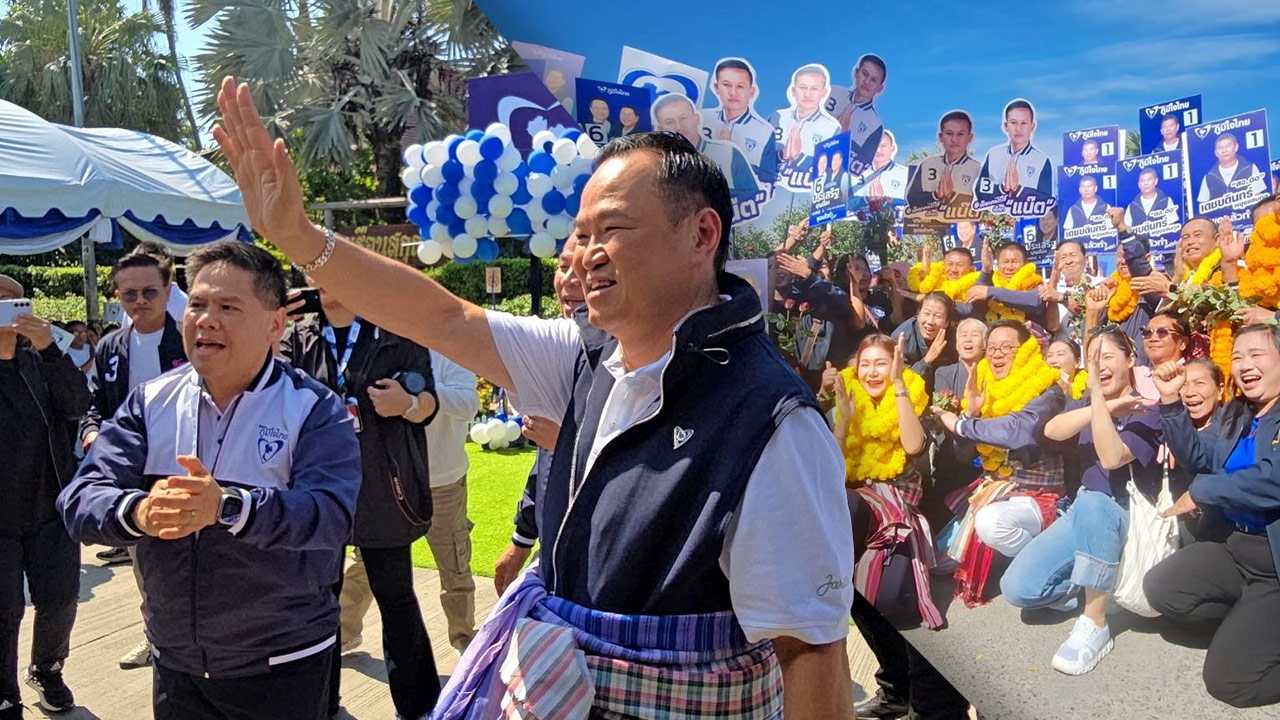
Meanwhile, Mr. Anutin Charnvirakul, the Prime Minister and leader of Bhumjaithai Party and their top candidate, visited to encourage MP candidates in Phra Nakhon Si Ayutthaya Province. In Chonburi Province, Mr. Suchart Chomklin, Deputy Prime Minister and Minister of Natural Resources from Bhumjaithai, went to register as a candidate. There he met Ms. Rakchanok Srinok, a well-known party-list candidate from the Prachachon Party, who was there to observe the process.

Assoc. Prof. Dr. Yutthaporn Isarachai, a political science lecturer at Sukhothai Thammathirat Open University, views the overall constituency MP registration today (27 Dec) as reflecting how parties strategically position candidates. The main target areas of each party are likely major provinces such as Bangkok with 33 seats, which is a primary target for the Prachachon Party and several others aiming to win seats, including Pheu Thai, Democrat, and new parties like Thai Kao Mai.
The provinces with the next largest number of MPs are Nakhon Ratchasima with 16 seats, likely a battleground between Pheu Thai, which traditionally dominates, and Bhumjaithai and Prachachon parties. Other large provinces include Chiang Mai with 10 seats, contested mainly by Prachachon and Pheu Thai, and Chonburi with 10 seats, where Prachachon competes with Bhumjaithai, which has formed alliances with powerful local families aiming to secure many MPs.
Regarding parties predicted to rank high in votes, Assoc. Prof. Dr. Yutthaporn believes Prachachon and Pheu Thai will focus on both constituency MPs and party-list MPs, while Bhumjaithai and Kla Party will emphasize constituency MPs more, with strategies varying by area.

The competition for constituency and party-list MPs uses different methods. For constituency MPs, political families, personal relationships, targeted campaigning, and local work are key. For party-list MPs, campaigning relies more on online media, mainstream mass media, and debate appearances.
However, not every area is dominated by "big families." The term refers to long-influential political family networks involved in local politics, local government organizations, national politics, and regional business sectors.
"A more appropriate term than 'big family' is 'political family,' which has long characterized Thai politics within a patronage system involving mutual dependence and influence. Currently, Bhumjaithai has incorporated over 86 such political families, reflecting its focus on leveraging political groups," he explained.
Political families that previously moved to the Palang Pracharath Party and Ruam Thai Sang Chart Party have mostly shifted to Bhumjaithai now. Kla Party has also gained political families from these two parties as well as some from the Democrat Party.
"In rural areas, unlike in Bangkok where social distance is greater and media is used for campaigning, personal relationships, promises, and mutual support are crucial. These factors build the candidates' credit locally," he added.

Data fromRocket Media Labreports that Thailand has 215 political families considered "big families" for the 2026 election nationwide. In some provinces, the same family members are affiliated with different parties. The largest number is in the Northeast region with 71 families, followed by Central and Bangkok with 60 families, South with 36, North with 22, West with 15, and East with 12. In the 2026 election,
Bhumjaithai has the most big families, totaling 86. Of these, 41 are original Bhumjaithai families, and 43 have moved from other parties, mostly from Pheu Thai with 13 families. Next are Pheu Thai with 70 families and Kla Party with 28 families. As for
Bhumjaithai, which has 86 big families, 41 are original party families, 2 are local politicians, and 43 have moved from other parties, distributed as follows: 13 families from Pheu Thai 10 families from Ruam Thai Sang Chart Party
3 from Palang Pracharath Party 2 from Chatpattana Kla Party
12 from Palang Pracharath Party 6 from Democrat Party