

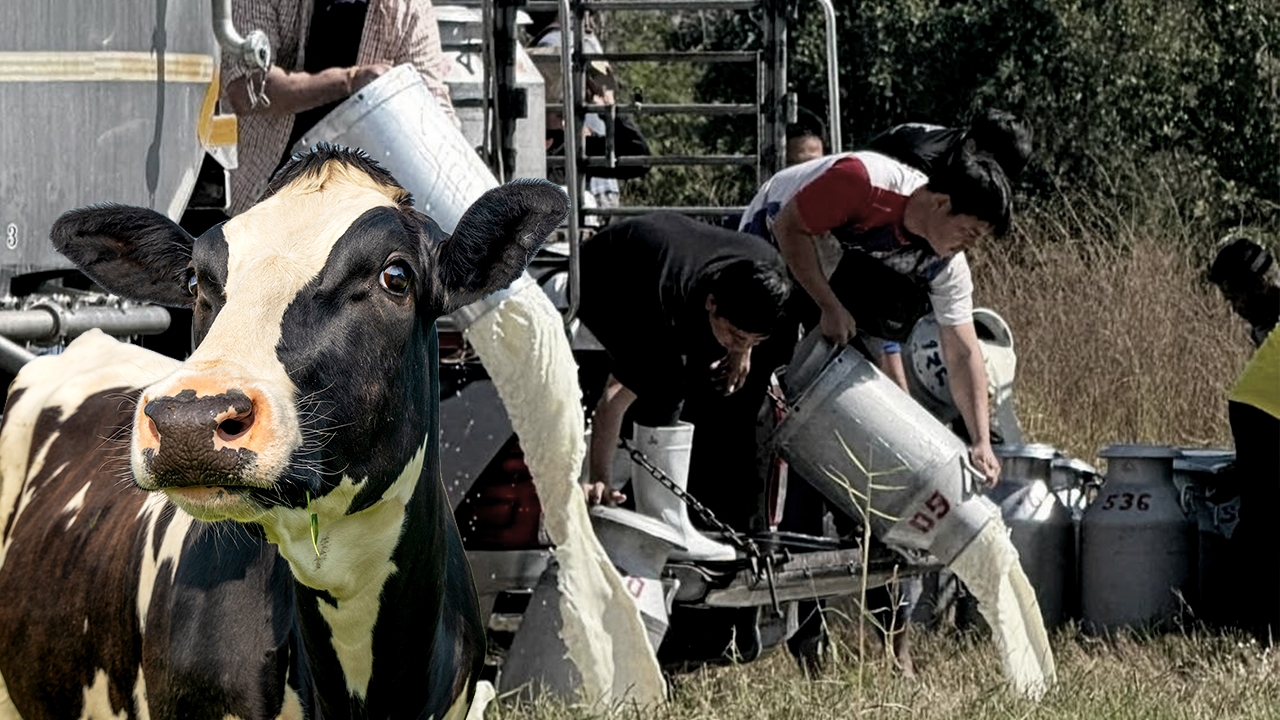
The vicious cycle of Thailand's dairy crisis: fluctuating costs lead farmers to gradually quit, deadlock in adding value to raw milk sales, losing out to imported products.
Images of farmers dumping raw milk due to market oversupply have become familiar. Recently, dairy farmers in Lopburi province collectively discarded over 40 tons of raw milk after failing to sell it. However, they later reached agreements to address the issue. Looking at the root cause of this longstanding problem, there has been a significant increase in imports of dairy products into Thailand.
Research from the Thailand Development Research Institute (TDRI) in 2025 on Thai dairy cows and products highlights that domestic and international demand for raw milk, milk, and dairy products continues to grow steadily.

There are two main channels for processing raw milk in Thailand:
1. Dairy cooperatives produce ready-to-drink milk, mostly UHT and pasteurized milk, primarily for domestic use, especially school milk programs, handling 1,843 tons/day over 260 school days annually, and exporting UHT milk to ASEAN markets.
2. Private dairy processing factories perform limited raw milk processing, mainly using excess milk as ingredients in beverages and food products. In 2024, Thailand exported 288,790 tons of milk and dairy products valued at 13 billion baht. The largest export categories by volume and value are fermented milk and yogurt, followed by non-concentrated and concentrated milk and cream, whey, cheese, and butter.

Supply factors: Strengths include ongoing improvement of dairy cow breeds suited to tropical climates, producing sufficient, quality raw milk. Medium to large farms group into cooperatives, enhancing cost management, production, and raw milk distribution efficiency.
There is development in animal feed formulas, grass cultivation, and silage, helping reduce feed costs and improve milk quality.
Weaknesses include a high proportion of small-scale farmers with high per-unit costs and limited bargaining power.
Feed raw materials like corn and soybean meal fluctuate significantly, greatly impacting production costs. Some farmers focus on maximizing milk volume per cow rather than consistency, quality, and lactation duration.
Opportunities include developing a data center on dairy farming and products to enhance farm management and competitiveness. Technologies in feeding, breeding, and automated milking can reduce labor costs and improve quality. Developing monitoring and disease prevention systems can reduce risks from animal epidemics.
Obstacles include labor shortages and an aging farmer population, leading to overreliance on household labor. Epidemic risks are increasing globally, especially in tropical countries. Environmental pressures such as methane emission reduction standards may increase costs, especially for small farms that struggle to adapt.
Demand factors
Strengths: Milk consumption is continuously rising, especially domestically. The government plans to increase per capita milk consumption from 18 to 25 liters by 2027, expanding the domestic market.
Weaknesses
Declining birth rates in Thailand cause a shrinking market for children's milk. The domestic market still heavily relies on the school milk program,
which depends on government budget allocations.
Opportunities
The dairy product market is diversifying, including milk for the elderly, health-conscious consumers, and functional foods. Developing differentiated, higher-value products like organic milk, low-fat milk, and probiotic milk is possible. Rising incomes increase consumer purchasing power. Neighboring ASEAN markets, with large child populations and growing milk consumption, present important export opportunities.
Obstacles include competition from alternative beverages like tea, coffee, and health drinks, plus imports of milk and dairy products from trade partner countries, pressuring the domestic market.
Market structure and competition mechanisms: Strengths include a sufficient number of dairy farmers, fostering competition and continuous adaptation. Some cooperatives are strong, helping farms manage costs efficiently. Numerous dairy processors compete by developing diverse products.
Weaknesses
Small farms cannot invest in automation, resulting in higher per-unit costs. Production of higher-value products like butter and cheese remains limited, making competition with imports difficult. High production costs hinder Thailand from competing with major global producers.
Opportunities
Trade liberalization has awakened Thai farmers to produce competitive products and opens export opportunities to ASEAN and neighboring countries. Upgrading production standards and milk quality enables access to premium markets, such as organic and functional milk. Demographic structures in the region (many children and aging populations) create opportunities to develop new products like health-enhancing milk, milk for the elderly, and medical foods.
Policy Recommendations

1. Production/Farming – Dairy farms (farmers and cooperatives)
Promote farmer group consolidation into cooperatives to achieve economies of scale, encompassing more small-scale farmers to improve their adaptation to risks and increase bargaining power amid volatile production costs.
Develop traceable farming systems to build consumer confidence.
Increase or enhance demand for fresh milk markets by focusing on quality, consistency, and lactation duration rather than maximizing milk volume per cow.
Promote sustainable, environmentally friendly farming, such as waste management and regenerative agriculture practices to reuse farm waste beneficially.
Enhance farmers' and operators' capacity to handle price volatility by strengthening cooperatives and fostering networking beyond raw milk collection. Key cost fluctuations include feed, labor, veterinary services, and energy.
Support development of new-generation farmers adopting technology and production innovations.
Expand cooperative networking to alleviate production cost volatility, manage cash flow, and handle increased output.
Support technological upgrades in production, breeding, feed systems, equipment, and milking machines by adapting advances from countries like Australia.
Upgrade farm management by applying digital technology to improve raw milk quality, reduce disease risk, and increase farmer income.
2. Raw milk and dairy product processing (cooperatives and factories)
Revise school milk quotas and purchase quotas for flexibility and alignment with reality, reducing market oversupply and milk purchase refusals that impact farmers' cash flow.
Increase diversity of milk and dairy products, such as functional and organic milk and health products, to add value and enhance competitiveness.
The school milk program plays a key role in stabilizing prices in the ready-to-drink milk market, while supporting nutrition and national food security.
3. Consumption and market expansion (consumers and related industries)
Promote domestic milk consumption for nutritional and health benefits, emphasizing the school milk program by enhancing promotion efforts.
Clarify the impact of import liberalization on powdered milk and dairy product prices and domestic milk purchases, explaining that imports benefit related industries, diversify products, and indirectly support domestic milk consumption without affecting raw milk procurement.
Facilitate trade liberalization and trade facilitation to increase opportunities for exporting Thai ready-to-drink milk and dairy products, especially to ASEAN markets where Thailand has geographic and logistical cost advantages.
Opening export markets supports trade liberalization, especially regionally, which is crucial for expanding Thai dairy exports. Regional markets are growing due to increasing populations, especially in key export countries with large child populations.

At the same time, Thailand's and many countries' aging populations present good opportunities to develop dairy products targeting the elderly, such as yogurt, health supplements, and medical foods that rely on milk as a key ingredient. Improving milk quality for these industries adds value to farmers.