

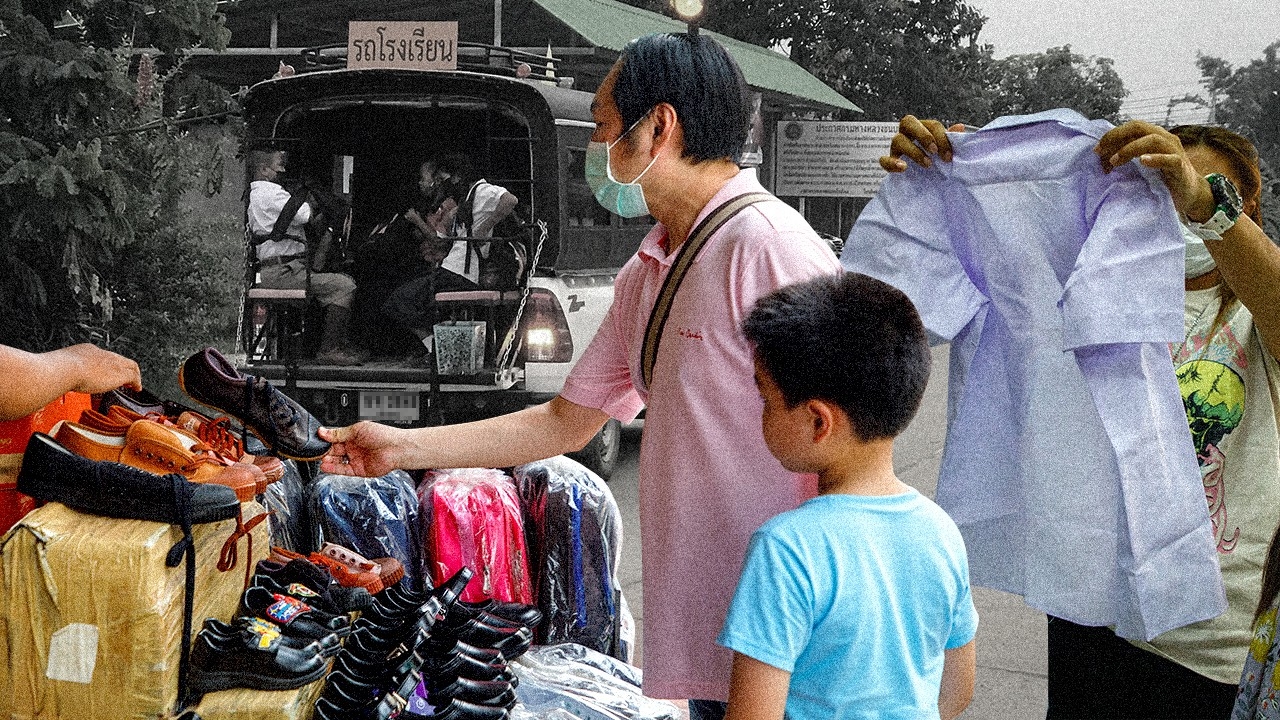
Thai education's claim of "free" schooling is not true; poor families must pay "hidden costs" such as clothing, supplies, and transportation, further disadvantaging vulnerable children and pushing them out of the system. Tags: [education, hidden costs, poverty, school dropout, Thailand]
.Tags: [] “Education”Tags: [education] is a fundamental right provided by the state to every child in Thailand throughTags: [education, rights] the “15-year free education program”Tags: [education program] in which the government allocates per-student subsidies and related expenses including tuition, books, learning materials, uniforms, and various educational fees from kindergarten through grade 12.Tags: [government funding, education expenses]
However, in reality,Tags: [] it cannot truly be called “free education”Tags: [education] because the allocated budget is still insufficient andTags: [education budget] there are “hidden costs”Tags: [hidden costs] that parents must pay out of pocket, ranging from several thousand to potentially tens of thousands of baht annually.Tags: [parental expenses, hidden costs]

Thairath Online's special news team spoke withTags: [interview] Teacher Jiw Thongpoon Buasri, project manager of the Street Teachers Project at the Child Development Foundation,Tags: [interview, education advocate] who has been deeply involved in education, fighting inequality and helping underprivileged children for over 30 years. She shared the changes she wishes to see inTags: [education reform, inequality] the “Thai education system.”Tags: [education system]
First,Tags: [] to truly implement free educationTags: [education reform] from kindergarten through at least grade 9, covering all expenses and eliminating hidden costs. Currently, the 15-year free education program allocates subsidies for various expenses, but in practice, the budget remains insufficient, causingTags: [education budget, free education] “hidden costs”Tags: [hidden costs] that parents must pay extra.Tags: [parental expenses]
The first category isTags: [] “learning materials,”Tags: [education materials] which receive an average allocation of 196–206 baht per term depending on grade level, but this is insufficient, especially today when students need modern equipment and electronic devices. Teacher Jiw mentioned cases where children dropped out because they had no tablet to submit homework to teachers.Tags: [learning materials, technology, dropout]
Next isTags: [] “clothing,”Tags: [uniforms] as Thai children must wear multiple uniforms including school uniforms, physical education, scout uniforms, and special outfits such as provincial costumes or religious practice attire. Although scout uniforms have been relaxed to allow wearing only hats or scarves, inconsistent teacher standards mean some children are not allowed to pass if their attire does not fully comply.Tags: [uniform requirements, education policy]
Besides uniforms, each child needs at least 2–3 pairs of shoes—school shoes, sneakers, scout shoes—not to mention various school bags. Some schools require purchasing all items from school suppliers, costing an additional 700–1,000 baht on average.Tags: [school expenses, uniforms]
“At the start of each term, parents often have no money to pay, especially since the economic impact of COVID-19 has reduced their incomes, severely affecting children long term,” she said.Tags: [economic impact, COVID-19, parental hardship]
Teacher Jiw believes the Ministry of Education, medium and small schools, and rural schools could help reduce these hidden costs by eliminating extra uniform requirements and not forcing purchases of expensive school-branded items.Tags: [education policy, cost reduction]

The next hidden cost isTags: [] “incomplete meal coverage.”Tags: [school meals] Currently, Bangkok Metropolitan Administration (BMA) schools provide mealsTags: [school meals, BMA] for both breakfast and lunch,Tags: [school meals] while schools under the Office of the Basic Education Commission (OBEC)Tags: [OBEC] only provide free lunch.Tags: [school meals] Thus, parents must pay for breakfast, an important meal.Tags: [parental expenses, meals] Additionally, there areTags: []
“transportation costs,”Tags: [transportation costs] which the 15-year free education program does not subsidize. Many children who pass entrance exams for distant schools must wake very early to travel on time.Tags: [transportation, education access] “For example, a child under the project lives near Phetchaburi New Road but passed the exam for a prestigious school near Sukhumvit. They must wake at 4 a.m. to catch the first bus, paying 12 baht per trip. If using the skytrain, the minimum fare is 47 baht per trip, nearly 100 baht roundtrip—hidden costs parents often cannot afford,” she explained.Tags: [transportation costs, education access]
Teacher Jiw shared the sad truth that last year at least 27 children supported by the Street Teachers Project dropped out of school. Although the project helped find scholarships and provided uniforms, it could not cover other hidden expenses.Tags: [dropout, education support]
Second, she wants to see all Thai children who wish to study have access to education.Tags: [education access]
Even if some children drop out mid-course, they should be able to enroll immediately in the Department of Non-Formal and Informal Education (formerly known as กศน.) without restrictions such as having completed certain prior grades—for example, applying for lower secondary without having finished primary school.Tags: [non-formal education, education access] Third, curricula should be flexible and individualized,Tags: [curriculum reform, flexibility]
matching children's aptitudes. For underprivileged or dropout children unable to follow regular systems, different curricula and assessments should be arranged. Some children who are not suited to basic curricula but have other skills, such as construction, should be allowed to use those abilities to qualify for equivalency exams.Tags: [curriculum flexibility, vocational skills] Factors causing Thai children to drop outTags: [dropout factors]

Teacher Jiw sees the first asTags: [] factors intrinsic to the child.Tags: [child factors] Adolescence brings significant physical and emotional changes, including hormonal shifts, which impact concentration, friendships, and increase risks of vices such as smoking and drug use.Tags: [adolescence, risk factors] Second, family environment and income play a role.Tags: [family factors, income] Some families earn only the minimum wage of about 350 baht per day, with a single breadwinner supporting multiple children, barely enough for daily food, let alone school expenses. Many children must help parents work but still face unpaid tuition fees ranging from thousands to tens of thousands of baht, ultimately dropping out.Tags: [poverty, dropout]
“In some cases we encountered, children live with grandparents receiving a 600-baht monthly pension and negotiate with the school to pay 100 baht monthly installments, but the debt remains and constant pressure affects the children greatly,” she said.Tags: [poverty, debt, education access] Children dropping out, especially underprivileged ones in slums, risk falling into illegal jobs, vices, and drug abuse since these occupations require no educational certificates. Reintegrating these children into education or vocational training is very difficult. Even working in general jobs may offer no welfare benefits, creating long-term problems.Tags: [dropout risks, social problems]
Teacher Jiw concluded that first, she wants teachers to visit the homes of truly poor children, especially in Bangkok, because many teachers currently conduct home visits by phone, missing the real conditions.Tags: [home visits, poverty]
Next isTags: []

even if they have only a few dozen students. These schools are usually community-based and can draw local residents as teachers for subjects like culture and agriculture. Closing small schools to merge them into district centers raises children's costs significantly and leads to dropout, eliminating crucial chances for children to lift themselves out of poverty.Tags: [community schools, education access, dropout prevention]