

Thailand is experiencing a geomagnetic storm impacting satellites and GPS; the storm's intensity has decreased to level G2, with ongoing effects requiring close monitoring.
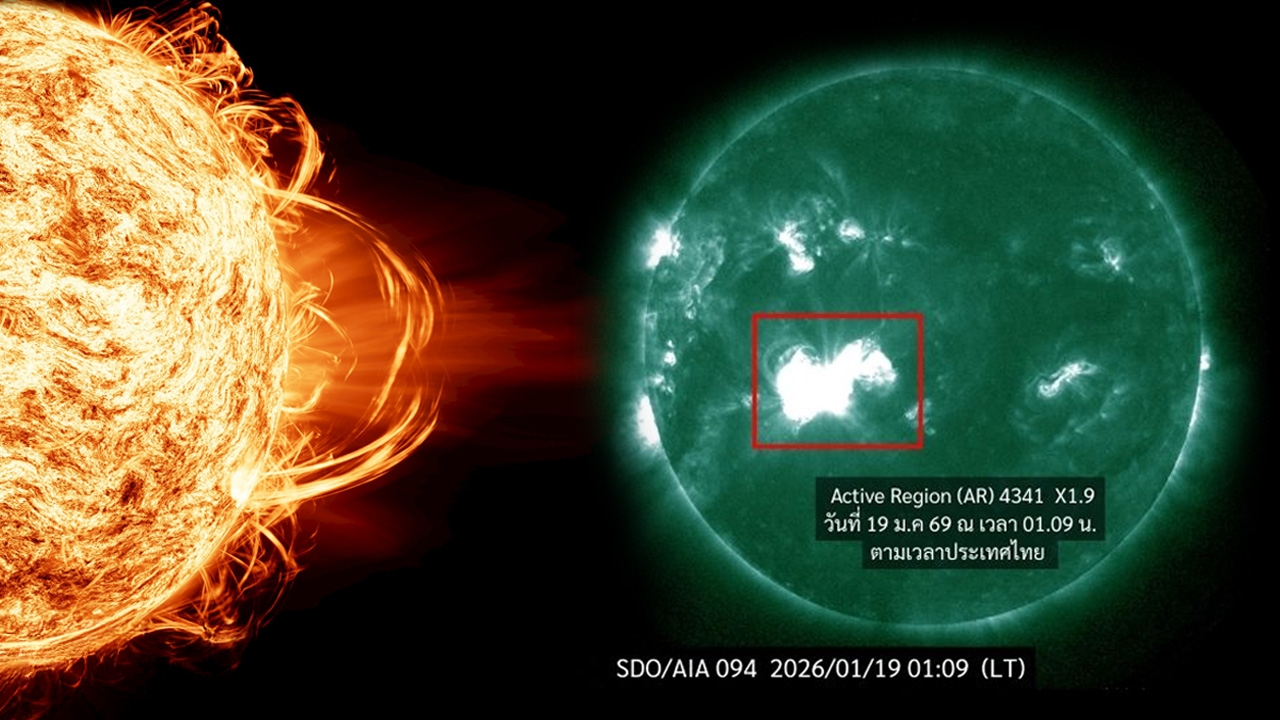
Today (20 Jan 2026), the Geo-Informatics and Space Technology Development Agency (GISTDA) reported that on 19 Jan 2026 at 01:09 Thai time, a solar flare erupted from Active Region (AR) 4341.
This flare released hot plasma and a magnetic field from the Sun in the form of a coronal mass ejection (CME) aimed at Earth. Along with a coronal hole emitting solar wind, this caused a severe geomagnetic storm. Space data and Earth's magnetic field measurements show Thailand is experiencing a G4-level geomagnetic storm.
Recently, Dr. Sithiporn Channamsin, spokesperson for GISTDA, told Thairath Online’s special news team that this geomagnetic storm is expected to last about 1–2 days if no new factors arise, and should end by midday on 21 Jan 2026.

Currently, Thailand is affected by the geomagnetic storm but not severely. Countries in higher latitudes like China, the United States, Japan, and Russia may experience stronger impacts.
Dr. Sithiporn explained that although G4 intensity does not directly endanger the public, it causes technical impacts on space technology and communications systems as follows.
1. Low Earth Orbit (LEO) satellites risk losing altitude and descending faster than expected:
Increased atmospheric drag causes satellites in low orbit—such as resource monitoring satellites or space stations—to slow and potentially lose altitude prematurely, requiring controllers to adjust their trajectories.
2. GPS navigation systems may experience inaccuracies:
Satellite positioning signals (GPS) may become inaccurate at times, affecting precision navigation, surveying, autonomous drone flights, and precision agriculture.
3. Aviation high-frequency radio signals may fade:
High Frequency (HF) communication used in commercial and military aviation may experience intermittent signal loss, requiring pilots and air traffic controllers to exercise extra caution.

Dr. Sithiporn also mentioned that aurora phenomena may occur soon. Normally visible near the poles, the aurora might be seen in some parts of the United States due to the solar storm. The aurora poses no harmful effects.
Solar storms occur periodically with intensity varying by time and season. Thailand recently passed the end of the Solar Maximum phase, when the Sun releases peak energy. This 11-year cycle is now in decline.

Dr. Sithiporn stated that storm severity is classified by the U.S. National Oceanic and Atmospheric Administration (NOAA) into five levels:
- G1 (Minor): Minor severity level
- G2 (Moderate): Moderate severity level
- G3 (Strong): Strong severity level
- G4 (Severe): Very severe level
- G5 (Extreme): Extreme severity level
Today (20 Jan 2026) at 15:10, the geomagnetic storm intensity decreased from G4 to G2.
Dr. Sithiporn concluded that Thailand values space weather forecasting and has developed alert systems and trained personnel to raise awareness of potential impacts. However, the public should remain calm as Thailand is not experiencing as severe effects as other countries.