

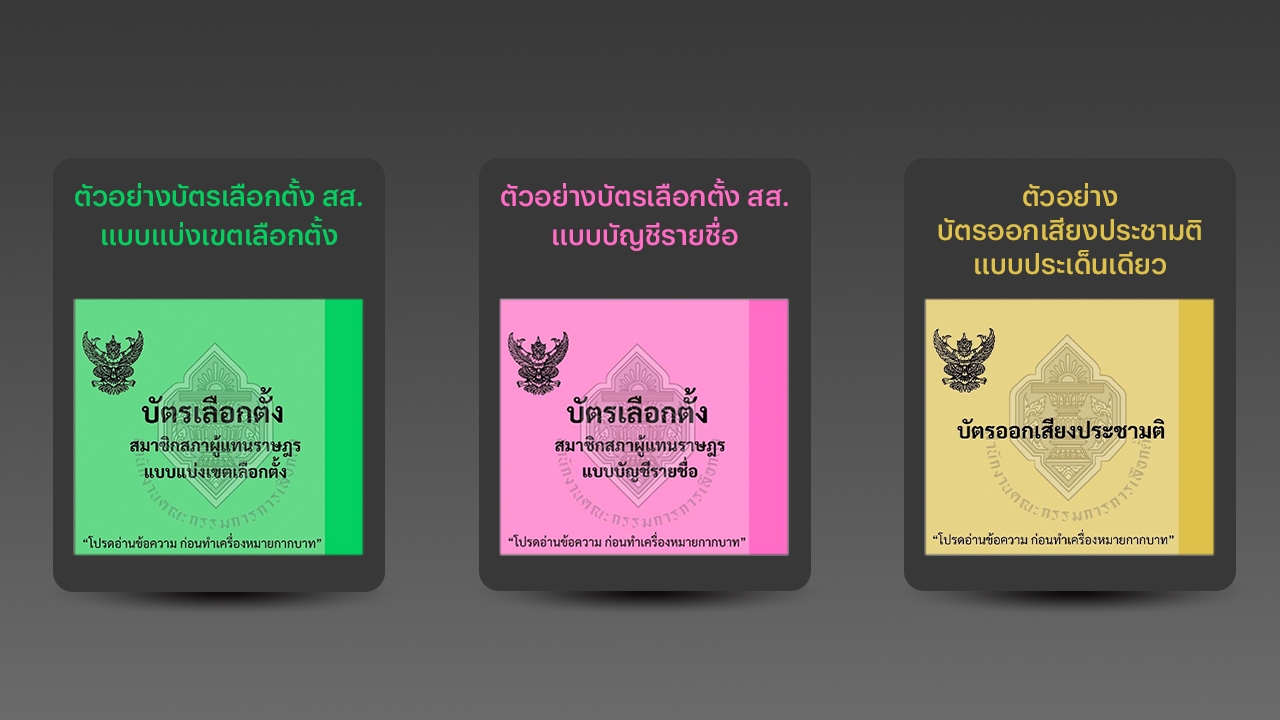
Before exercising your voting rights on 8 Feb 2026, everyone is invited to understand the significance of the ballot paper colors used for casting votes and why paper ballots remain in use worldwide.
While organizations around the world strive to become paperless by converting all documents into soft files for faster transmission to relevant individuals or agencies,
transparency is ensured because it can be verified through the digital footprint.
It also conserves forest resources by eliminating the need for paper pulp in paper production.
… but why does Thailand insist on using paper ballots at every election level—from local to provincial to national—especially in the upcoming 8 February 2026 election, which will have three different ballot papers?
Green ballot paper – to elect constituency members of the House of Representatives (MPs).
Pink ballot paper – to elect party list members of the House of Representatives (MPs).
Yellow ballot paper – for the referendum on amending the 2017 constitution.

This means that out of 55 million eligible voters, the Election Commission must prepare a total of 165 million ballots.
Why not use online voting or electronic counting systems at polling stations? Don’t other countries do this?
The key issue is transparency and accountability, which are central to a free and fair election.
Many developed countries have experimented with electronic or online voting systems but ultimately abandoned them, reverting to marking X on paper ballots.
For example,
Germany – The Constitutional Court ruled to cancel e-voting simply because "citizens must be able to verify election results visually" and returned to paper ballots.
Ireland – Although it purchased electronic voting machines for polling stations, it ultimately decided not to use them and has never implemented electronic voting at polling stations to this day.
Australia – Despite having the i-Vote online voting service to support disabled voters or those abroad, it ultimately discontinued it due to cybersecurity risks.
Canada, Japan, Belgium – Some local elections in certain cities use electronic systems, but national elections still require paper ballots.
India – As the country with the largest number of eligible voters in the world, it once tried Electronic Voting Machines (EVM) but has since added paper verification systems at polling stations.
United States – Each state has different methods and mechanisms for voting; states using electronic voting machines provide printed paper trails, and there is no nationwide online voting.
Currently, only Estonia and Brazil conduct elections without any paper ballots.
For Thailand, ranked 107th out of 180 countries with a Corruption Perceptions Index (CPI) score of 34 out of 100, if there is doubt about the security, integrity, and fairness of electronic or online voting systems, it is prudent to adhere to paper ballots.
Remember! On Sunday, 8 February 2026, from 08:00 to 17:00, you will receive three ballot papers, divided as follows:
Green ballot paper – to elect constituency members of the House of Representatives (MPs).
Pink ballot paper – to elect party list members of the House of Representatives (MPs).
Yellow ballot paper – for the referendum on amending the 2017 constitution.