

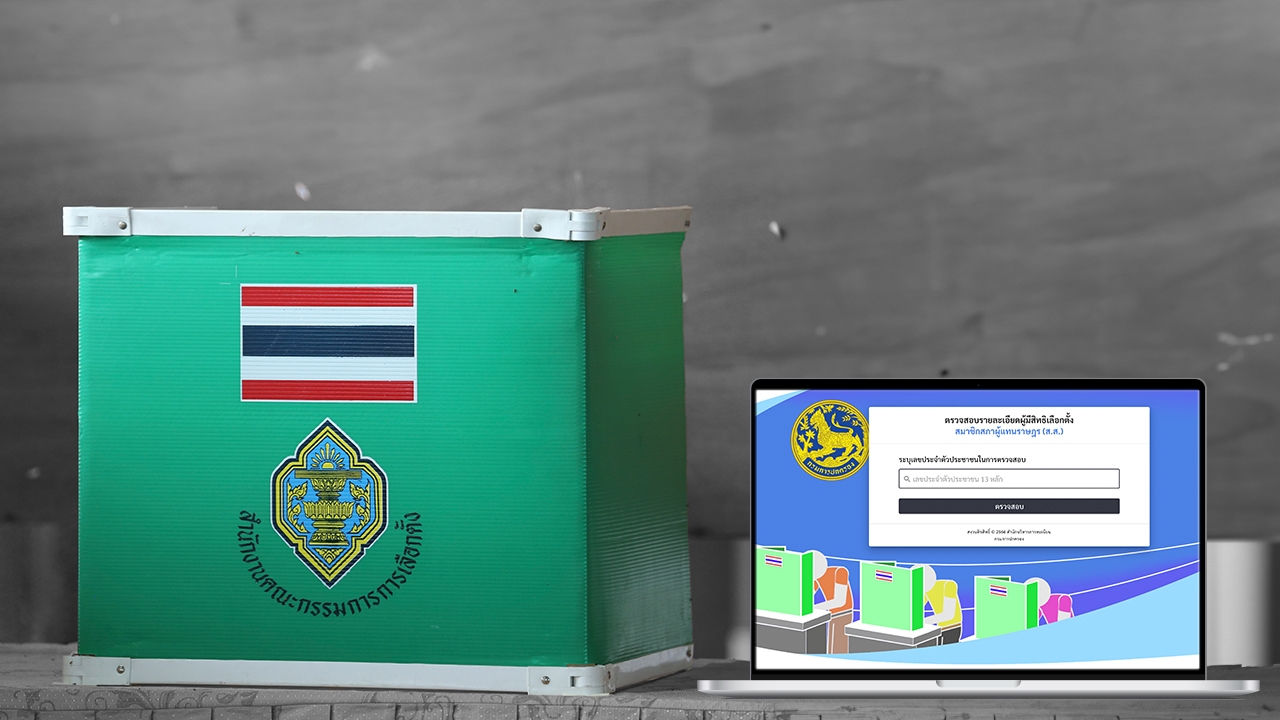
From the polar regions to outer space, neither distance nor location can block the right to vote. Distance and location are not problems if eligible voters have the determination to cast their ballots.
Voting and/or transporting ballots in various places around the world and even beyond Earth may vary in convenience or hardship, but distance and the difficulty of the location are not obstacles for eligible voters who have the will to vote.
Today, we look at the journeys of people and ballots that must cross snowfields, deserts, sail across islands large and small, or even transmit signals from "beyond Earth" to enable the election of representatives to govern and legislate in parliament. This is not just about "rights"; for many worldwide (including those beyond Earth)... it is responsibility, duty, and the dignity of deciding one's own future.

A distance of 400 kilometers is just the gap between Bangkok and Phu Thap Boek—neither difficult nor far. But 400 kilometers vertically, such as between Earth and the International Space Station, is somewhat harder to travel. Yet astronauts of various nationalities stationed among the stars above Earth's atmosphere have voted since 1997 via satellite communication systems... Of course, the ground team knows who they voted for.
From the skies to the extreme subzero temperatures of the Antarctic research center, where people from many countries work, study, and conduct experiments. When elections occur, countries that allow online voting are fortunate. But for those from South America, Australia, and South Africa, special polling stations are set up with boats carrying ballot boxes across icy seas to ensure timely delivery for counting. Due to the difficulty of distances around 15,000 to 20,000 kilometers, workers in Antarctica often must vote weeks or even a month before their nation's official election day.
Sending, passing, and sending again... In archipelago countries like the Philippines or Indonesia, residents of small islands must navigate their boats to the nearest polling stations before small planes take on the crucial mission of transporting ballots to central counting centers. If the weather is unfavorable, ballot transport may require some delay.
From hilltops to valleys, people in Nepal, Bhutan, and Peru know well that elections can be exhausting, especially for the llamas used to carry ballot boxes to helicopter landing sites for onward delivery to counting centers. Yet the hardships faced by people and animals alike are overlooked by those who cherish and want to protect their voting rights.
Elections in one country with ballots arriving from all directions is a reality for France, Italy, and the Philippines—countries known for having a vast global diaspora, with many citizens living or working overseas.
Meanwhile, military bases abroad of powerful nations like the U.S. and the U.K. see soldiers exercising their civic duties by voting at special polling stations organized by the armed forces. Transporting ballot boxes through storms or deserts depends on commanders’ management, with the key being that ballots arrive on time.
However, in many developing or underdeveloped countries, a minority whose circumstances are unfavorable to voting find their rights neglected, lost amid the currents and winds by default.
For Thais, it is very fortunate that the Election Commission promotes and supports voting rights both in advance from outside the kingdom and facilitates polling stations spread across all 400 constituencies in every province in Thailand.
As for which polling station each voter must attend, it begins with checking voter registration, which can be easily done through three channels before election day.
1. Check the voter notification letter that the Election Commission sends to your home.
2. Check online 24 hours a day at https://www.bora.dopa.go.th/ or via the Smart Vote application available on both iOS and Android.
3. Visit the district office, subdistrict administrative office, or local government office in person to check the list.
Once you confirm your name as a registered voter, you will receive important information about your polling station where you must vote for members of parliament—both constituency and party-list candidates—as well as the referendum on the 2017 constitution amendment, scheduled for Sunday, 8 Feb 2026.