

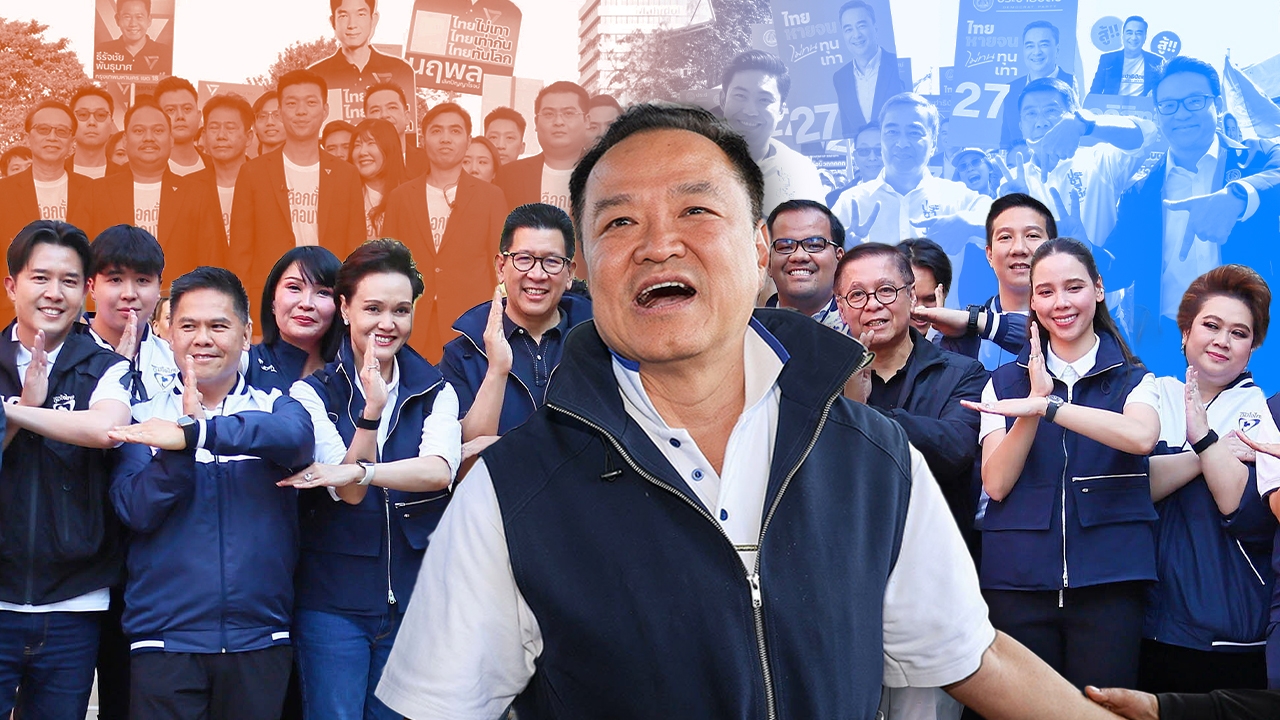
Analyzing the strategy of the Boon Rawd Thai party reviving the slogan “If You Don’t Choose Us, They Will.” Scholars see a failure to clarify the “them-us” distinction and a monopolization of patriotism, causing a backlash.
“If You Don’t Choose Us, They Will” This well-known political phrase played a key role in the 2013 Bangkok governor election between Mom Rajawongse Sukhumbhand Paribatra of the Democrat Party and Pol. Gen. Pongsapat Pongcharoen of the Pheu Thai Party, whose scores were so close that predicting the winner was nearly impossible. Before Mom Rajawongse
Sukhumbhandunveiled the card“If You Don’t Choose Us, They Will,” using fear of the opposing side as the main factor in voter decision-making, ultimately overtaking and winning in the final stretch with 1.2 million votes to 1 million. This phrase can be seen as a strategic voting tactic,
“strategic voting,” choosing a party or political group that may not be your favorite but aligns with your ideology to prevent “wasted votes” falling to opposing political groups or ideologies. Strategic voting has been used in various elections without directly using this phrase, such as the 2022 Bangkok governor election, where conservatives campaigned against Mr. Chadchart
Sittipunt.Most recently, in the 2026 election, this phrase has been revived by the
“blue camp.” On 26 Jan, Ms. Supamas Isarapakdi, Minister attached to the Prime Minister's Office and the chief Bangkok campaigner for Boon Rawd Thai, spoke out herself amid hopes to claim parliamentary seats in the capital for the first time. “This time, there are really only two sides: our blue side and the other. If you don’t choose us, they will. I urge everyone on our side—which may include various colors but certainly knows that choosing others will split votes, waste votes, and lose votes for sure. So I ask everyone on our side to choose Boon Rawd Thai so that the party can lead the blue side.”
This phrase was reinforced again by

Mr. Phiphat Ratchakitprakarn, the chief campaigner in the South, who framed it as a “patriotic vs. unpatriotic” issue, urging Thai people to choose the patriotic side and not the unpatriotic or to neglect in times of war. “I ask friends in 14 southern provinces that we should, must, or definitely decide who to choose. The military exists to protect Thailand's sovereignty, not for any other purpose.” However, it seems that reviving “If You Don’t Choose Us, They Will”
has not received the positive response expected and may have instead drawn votes from Boon Rawd Thai to other conservative parties. This prompted the party leader and prime minister candidate,
Mr. Anutin Charnvirakul, to refuse comment, saying, “I'd better keep quiet. No more. We need to build unity.” Meanwhile, Mr. Abhisit Vejjajiva, leader of the Democrat Party and original creator of the phrase, took the opportunity to criticize it as “misleading voters to choose the wrong party.” “Honestly, I think the Democrat Party has a strong chance to win Bangkok parliamentary seats from the champion.”
Including the second candidate, Mr. Korn Chatikavanij, the party’s deputy leader, who said that the past rhetoric “If You Don’t Choose Us, They Will” was between two clear opposing sides, 1 and 2, but now Boon Rawd Thai signals readiness to form a government with both red and orange camps.
“If the strategy is to prevent the orange side from forming a government, especially in Bangkok, you should not promote choosing the blue side because there’s no chance of beating orange. So if you are sincere with this strategy, you should advise which party to choose.”
“If You Don’t Choose Us, They Will” reflects back on the blue camp. Thairath Online’s special news team discussed this with Dr. Satithorn Thananishichot,
from the Faculty of Political Science at Chulalongkorn University, who said the slogan

still works but perhaps not in the direct form Boon Rawd Thai uses this election in Bangkok. It requires a clear analysis of who “they” and “we” are and why one should choose us over them. It’s evident that the phrase’s originator, the Democrat Party, can counter it by saying that “we” who should be chosen are actually the Democrats, as they have higher popularity and better chances of winning in Bangkok than Boon Rawd Thai. “This method requires understanding what people are really afraid of. In Bangkok, Boon Rawd Thai’s rising popularity is due to two factors: one, promoting professional workers, and two, appealing to those who believe in patriotism, who trust that Mr. Anutin and his team are not only patriotic but capable. However, the party has failed to reinforce the trust people have in Mr. Anutin and only uses the phrase ‘If You Don’t Choose Us, They Will.’ If voters fear the orange side, they should pick the blue side, but the party does not emphasize its strengths.” Regarding Mr. Phiphat’s emphasis on “patriotic vs. unpatriotic,” it is a similar mindset but communicated more effectively by clearly defining “we” and “they.” However, Boon Rawd Thai is not the only party promoting patriotism; other parties, including in the South, take this to an even more extreme level. In the South, Boon Rawd Thai faces challenges from the resurgence of the Democrat Party, not the People’s Party. “Each region requires different strategies. In the South, patriotism alone may not suffice to attract votes because here ‘they’ does not mean ‘orange,’ but ‘blue,’ which is out of context. People might think Democrats are also patriotic, so choosing blue or navy is equivalent.”
Dr. Satithorn believes Boon Rawd Thai will likely not continue pushing this approach due to the backlash, which has not created allies but foes and has not yielded positive results. “Strategically, it’s over. Expanding on it further would be harmful. They should close this chapter and shift back to promoting candidates and policies, which is already underway.” The orange camp’s solution: “Even if you choose us, they will come”
Regarding the People’s Party, which initially presented the election as a choice between“orange”or

“blue,” and whether to form a government as “If You Don’t Choose Us, They Will,” Dr. Satithorn sees that the People’s Party has moved beyond this point to position itself as the number one party that must win by a wide margin. Mr. Natthapong Rueangpanyawut, party leader and prime minister candidate, has set a target to win by 30-40 seats. “Although the fundamental competition remains between orange and blue camps for government formation, the People’s Party aims to be unchallenged as the number one by a sufficient margin to form a government without opposition. This fights against
‘Even if you choose us, if it’s not enough, they will come.’
Therefore, the message is to choose us as much as possible.”
Dr. Satithorn’s latest assessment on 29 Jan 2026 is that the People’s Party may maintain around 150 parliamentary seats, with potential for last-minute changes, so the situation warrants close attention.

