

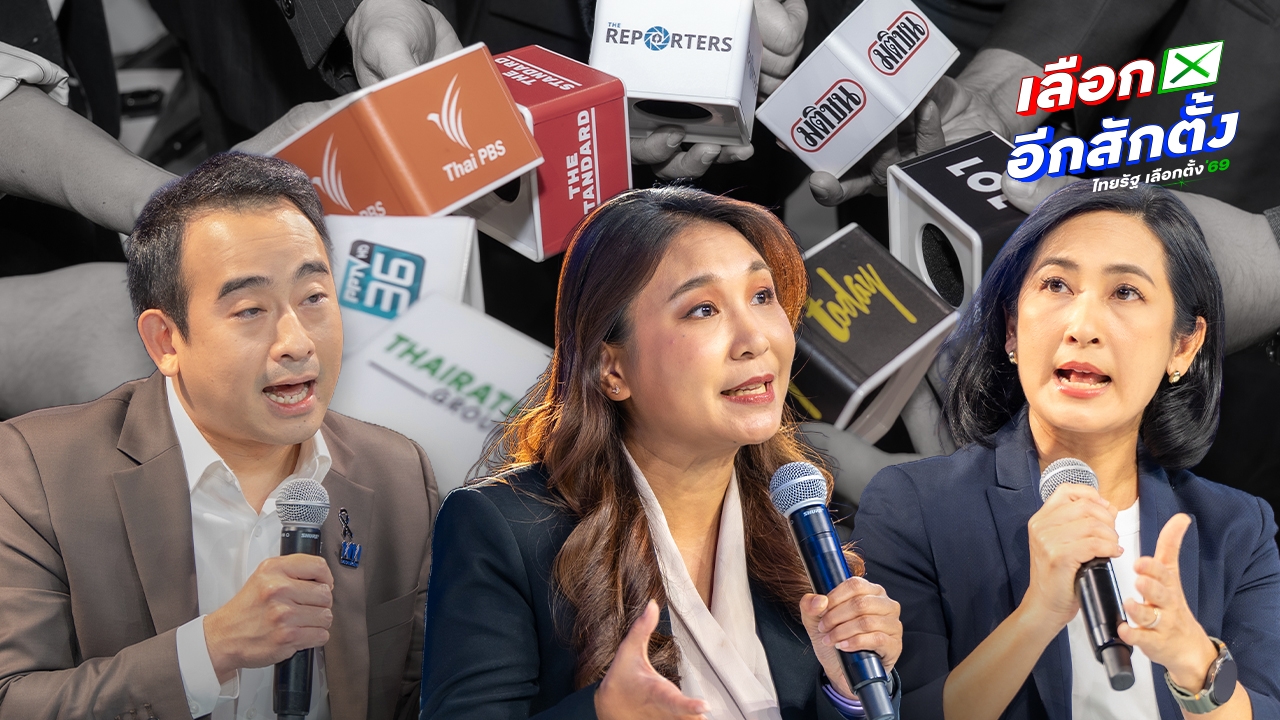
Three political parties debated their visions, responding to eight top editors on rescuing Thailand's economy amid difficult challenges related to economic growth, budgeting, and national confidence in the country’s future.
On 3 Feb 2026 GMT+7, Thai PBS, together with a national media alliance, hosted a major debate forum in the final stretch before the general election under the title "Answering 8 Editors’ Questions to Rescue Thailand’s Economy". Representatives from the main political parties included Dr. Karndee Liewpairon, Democrat Party's prime minister candidate; Dr. Paopoom Rojanasakul, Deputy Leader and economic team member of the Pheu Thai Party; and Sirikanya Tansakul, Deputy Leader and prime minister candidate of the Prachachon Party. They competed in presenting their visions and answered questions from eight major media editors amid the challenges of economic growth, budgeting, and national confidence.
The forum also provided space for the private sector and public to ask questions, reflecting real issues faced by those directly affected—from trade barriers, small business adaptation, to the quality of life for grassroots citizens.

Amid rising tariffs, global economic volatility, and the transition to the AI era, Thailand’s traditional economic model relying on exports, tourism, and foreign direct investment (FDI) is facing difficulties as GDP growth remains persistently low. The key question is how Thailand will design a new “engine” to break free from its old economic trap.
Dr. Karndee Liewpairon of the Democrat Party believes reviving Thailand’s economy must begin by setting a shared national goal, elevating tourism and education to high quality, alongside investing in human capital and digital infrastructure. He also emphasized promoting Thailand’s role as a global partner and economic safe zone to support reshoring production, aiming to drive GDP growth to 5% within four years.
, Sirikanya Tansakul of the Prachachon Party pointed out that Thailand’s structural economic problems lie in growth without added value and overreliance on external factors. Thus, attracting foreign investment should shift from quantity to quality, accompanied by technology transfer rather than mere production relocation. She proposed long-term reforms of the public and industrial sectors to build national capabilities, targeting consistent 3% GDP growth.
, Dr. Paopoom Rojanasakul of the Pheu Thai Party argued that Thailand should no longer be limited to the world’s manufacturing endpoint but must become a global supply chain hub amid shifting geopolitical power. The core is strengthening internal capacities, including data, law, infrastructure investment, and workforce upgrading. He stressed that past FDI attraction failed to yield real technology transfer, so policies should promote local content and advanced technology industries, aiming for 5% GDP growth within four years.
When asked about human capital development through upskilling and reskilling workers with tangible results, Sirikanya noted the current budget is only about 3 billion baht, scattered and insufficient. To truly elevate the workforce, at least 20 billion baht is needed to organize a “National Skills Upgrade Festival,” based on the principle that citizens choose skills, private sector provides training, and the government pays, driven by market demand.
, Dr. Paopoom emphasized that the private sector should lead in setting directions while the government facilitates and connects, promoting the concept of “Vocational Education Builds the Nation” to develop graduates who can immediately enter the workforce.
, Dr. Karndee believed upskilling and reskilling must shift focus from only young people to mid-career workers and capable seniors. The private sector should lead skill development so workers can be self-reliant without depending on their children, preparing for an aging society.

Given limited budgets and fiscal constraints amid widespread economic challenges, the key question is how to prioritize to ensure every baht spent truly changes the country’s direction.
Dr. Paopoom stated that government spending must not only be expenditure but must generate returns to the economy, highlighting the “Policy to Create One Millionaires Daily” which is designed to address multiple goals simultaneously—from expanding the tax base and increasing government revenue without raising tax rates, building economic data infrastructure, to stimulating spending.
, Sirikanya suggested policy prioritization should not be measured by investment amounts but by structural results. Investment in education and human capital should come first, followed by security and modern infrastructure such as electricity market liberalization to support the green economy, many of which can proceed without relying on budget.
, Dr. Karndee emphasized that the country’s most important infrastructure is human capital, especially public health and education systems. He noted that entering a low birthrate society makes mother and child policies necessary to maintain the country’s long-term competitiveness.
When the media asked about tax collection approaches for high-income groups, representatives from each party expressed differing views.
Sirikanya proposed reforming land tax with a “land consolidation” method and progressive rates, citing South Korea’s practice, to start with land holdings of 300 rai or more.
, Dr. Paopoom said the party’s approach is to improve efficiency in existing tax collection to use revenues to support low-income groups without raising rates or introducing new taxes.
, Dr. Karndee emphasized upgrading tax system efficiency, especially corporate tax, so the state can fully collect revenues.
Additionally, when asked about political instability and continuing projects from previous governments labeled as “opponents,” they were asked directly, “Will you object if the EEC project continues?”
Dr. Karndee clearly replied he does not object, viewing the EEC as a key hope to restore investor confidence and should be seriously continued.
, Dr. Paopoom said Pheu Thai is ready to consider policies based on fairness and prioritizing public benefit rather than political origin of projects.
, Sirikanya expressed a differing opinion, pointing out that the EEC has not met efficiency criteria due to issues in contract amendments and governance structure, thus should not be automatically continued.

Amid economic slowdown and political uncertainty, another major challenge for Thailand is restoring confidence among investors and citizens.
Sirikanya stated that economic improvement must start by restoring domestic and foreign investor confidence. The main problems are declining government efficiency, corruption, and opaque capital. Economic recovery requires citizens’ trust to spend boldly, pushing public sector reform and promoting a cycle roadmap, especially energy market liberalization and electricity trading, which can be done within the first 100 days and attract business investment funds.
, Dr. Paopoom proposed a three-pronged confidence-building approach: Open Government for transparency, Digital Government to enhance state efficiency, and AI Government to link data bases, upgrading transparent administration.
, Dr. Karndee pointed out that factors undermining confidence include opaque capital and Thailand’s image as a money laundering center, which hinders sustainable development. He called for raising “political ethics” standards and demanded politicians uphold clear ethical standards. Meanwhile, Thailand’s corruption index trends downward, necessitating transparency and public participation in oversight. The Democrat Party plans to develop a whistleblower platform to establish a serious political will-backed monitoring mechanism.

When asked about other countries' success in combating transnational crime and effective penalties, Dr. Karndee emphasized political ethics as paramount, requiring appointments in key positions to demonstrate vision and legal responsibility.
Sirikanya added that within the first 100 days, the government must urgently reopen high-profile cases to show seriousness, citing the collapsed Audit Office building case and noting Thailand currently faces a “legal war” with political instability and unpredictable futures. , ,
, Dr. Paopoom stated that fighting crime requires three elements: political will, penalties, and mechanisms, incorporating government digital systems to link data. He expressed support for constitutional reform, especially regarding the origin and powers of independent agencies currently detached from the people, affecting the stability of elected governments. He affirmed that Pheu Thai and Mr. Thaksin operate within legal frameworks.
When questioned about opaque capital, power interference in bureaucracy, the role of officials enabling this, and how the three parties would manage if forming a coalition government,

Sirikanya said that opaque capital is not a matter of mechanisms or laws but “political will.” She noted that government officials have been very slow to act and emphasized the state must have a “decisive leader” who dares to make firm decisions.
Regarding government formation, Sirikanya viewed the alliance of the three parties as a viable combination and stated that if the Prachachon Party leads government formation on 8 Feb, they are ready to immediately invite talks.
, Dr. Paopoom acknowledged that opaque capital has many dimensions requiring domestic and international cooperation, plus technology for detection and law enforcement alongside political will.
On government formation, Pheu Thai emphasized offering policy proposals without setting coalition conditions or pointing fingers, centering on public consensus.
, Dr. Karndee stressed that opaque capital is not only a crime issue but a national security threat directly affecting investor confidence. He called to elevate it as a “national agenda” and proposed establishing a security council focused on opaque capital and implementing asset seizure before prosecution to seriously disrupt criminal networks.
Regarding government formation, the Democrat Party clearly stated it would only join coalitions with parties of sincere political will and would not participate if the coalition included the Kla Party.