

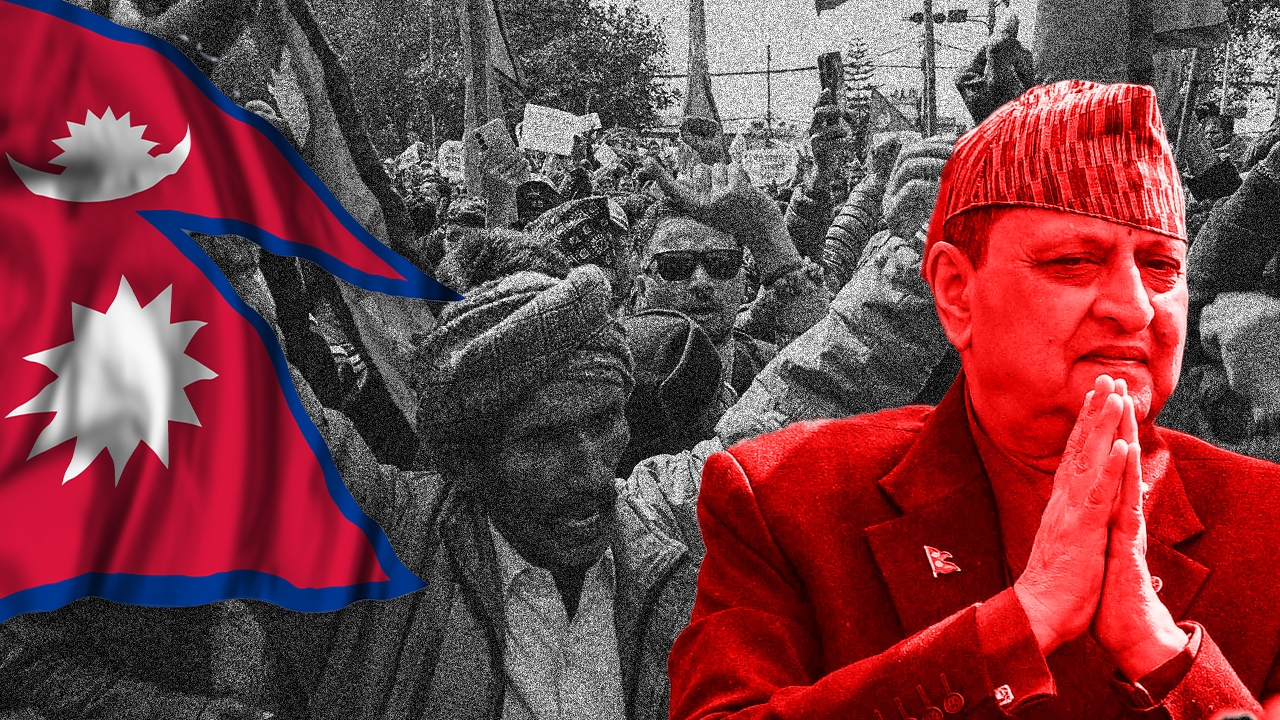
Nepal is at a pivotal crossroads, moving from a Gen Z uprising to calls of “Bring Back the King.” The country faces a crucial decision between progressing forward or returning to its previous system.
Shouts of “Bring Back the King” echoed once again on the streets of Kathmandu, Nepal’s capital, as thousands gathered to welcome former King Gyanendra Shah at Tribhuvan International Airport on 13 Feb 2026, following his visit to the country's western region. Supporters demanded the restoration of the monarchy abolished nearly two decades ago.
The 78-year-old former king waved from the sunroof of a car amid crowds waving national flags, throwing flowers, and shouting support slogans, while riot police maintained a tight presence. This scene symbolizes the resurgence of pro-monarchy sentiment in a country where citizens once overthrew the royal family through mass action. Though not new, this image resembles similar events from March last year, indicating that monarchist sentiments are not temporary but steadily returning.
The March protests marked the largest since 2023, demonstrating growing support for the monarchy’s return. Over 10,000 supporters gathered at Kathmandu airport to celebrate Gyanendra’s arrival.

Thousands also rallied in Nepal’s capital demanding a return to a Hindu monarchy and a Hindu state instead of a secular republic. The protests ended with two deaths and dozens injured following clashes with police.
Just months earlier, Kathmandu’s streets were ablaze with anger from youth challenging elites and politicians. Yet today’s crowds welcoming the former king reflect a sharply different mood. This contradiction highlights not only political ideological divides in Nepal but also raises important questions about whether the nearly two-decade-old path chosen is truly delivering the future its people desire.

Nepal, with a population of about 30 million, was under absolute monarchy for over 239 years before democracy took hold. Public dissatisfaction with royal authority and internal royal conflicts gradually eroded the monarchy’s legitimacy, culminating in its fall in 2008. This shift was not sudden but the result of prolonged political instability, civil war, and government failure to meet public expectations.
The main reason for calls to restore the monarchy stems from public disappointment with the nearly two-decade-old republic system. Although abolishing the monarchy in 2008 aimed to create an egalitarian democracy, many view the current system as failing to establish political stability, combat corruption, or resolve economic problems. This has led to demands for the monarchy’s return as a “unifying national institution and political balance,” recalling past hopes attached to the royal institution.
This situation unfolds amid political uncertainty, as Nepal has seen multiple government changes since abolishing the monarchy, with no administration completing a full five-year term. Additionally, the existing party system has yet to clearly address the development needs and aspirations of younger generations.

Before transitioning to a republic, Nepal was a Hindu kingdom with the monarchy as the central authority for over two centuries, since King Prithvi Narayan Shah unified various kingdoms and established modern Nepal in 1768 under the Shah dynasty. However, real power often lay with the Rana family, who held hereditary prime ministership and ruled with centralized authority.
A turning point came in 1951 when a democratic movement overthrew the Rana regime and allowed the first parliamentary democracy. Although the monarchy remained the state’s center, this marked the first crack in the absolute monarchy system.
However, democracy was short-lived. In 1960, King Mahendra dissolved parliament, banned political parties, and established the “Panchayat” system—a partyless governance model concentrating power in the monarchy. This system lasted nearly three decades amid growing public dissatisfaction.
Pressure erupted in 1990 when the mass “People’s Movement” forced King Birendra to abolish the Panchayat system and restore multiparty democracy under constitutional monarchy.
Yet conflict continued. In 1996, Maoist rebels launched a decade-long civil war aiming to topple the monarchy and establish a republic, resulting in over 17,000 deaths.
The monarchy was severely shaken on 1 June 2001, when Crown Prince Dipendra killed King Birendra and nine royal family members at Narayanhiti Palace in Kathmandu before dying himself. This shocked the nation and deeply eroded public faith in the monarchy.
Afterward, King Gyanendra, Birendra’s brother, ascended the throne in 2002 but faced public distrust. The situation worsened when he dissolved parliament and took direct control in 2005, sparking a major uprising in 2006 where citizens, political parties, and Maoist rebels united to pressure the king to restore parliamentary power.
Anti-monarchy momentum culminated in the Constituent Assembly’s 28 May 2008 vote to abolish the monarchy officially, declaring Nepal a "Federal Democratic Republic" with a president as head of state. This ended the Shah dynasty’s long rule and fully transitioned Nepal to a republic.
In 2015, Nepal adopted a new constitution establishing a federal democratic republic with a bicameral legislature and a prime minister-led government. However, the constitution dissatisfied some ethnic groups and heightened political complexity amid China and India’s competing influence supporting opposing political factions.
Since becoming a republic, Nepal has faced ongoing political instability with over ten governments and prime ministers changing within a few years. Chronic political conflict, slow economic growth, and corruption allegations have led many citizens to question the republic system, fueling current calls to restore the monarchy.

The latest political crisis erupted in 2025 when Nepal’s government blocked access to major social media platforms including Facebook, Instagram, WhatsApp, YouTube, and X. Though a trigger, underlying frustration had long built among Gen Z youth, who protested against a political system dominated by elites, rife with corruption, economic stagnation, and power structures excluding young people. Criticism of “Nepo Kids”—politicians’ wealthy offspring flaunting wealth online—further highlighted inequality and public discontent.
The protests escalated rapidly into the most violent in nearly two decades. Within two days, at least 77 people died, hundreds of buildings were set ablaze—including parliament and courts—and Prime Minister K. P. Sharma Oli resigned. This youth uprising not only toppled the government but also shook the legitimacy of the entire political order, ushering in a new era of uncertainty.

Although protests have targeted political elites, the current resurgence of monarchism reclaims space for what seems a “past” idea to return.
Some supporters now reimagine the king not as an absolute ruler but as a “symbol of stability,” a “national unifying figure,” and a “check on politicians.” The Rastriya Prajatantra Party, backing monarchy restoration, has become increasingly active, aiming to use the parliamentary elections as a platform to expand influence.
Two welcoming events for the former king within a year indicate that monarchist ideas have not faded from Nepali society but remain alive and are re-entering the political landscape meaningfully.

Despite rising monarchist support, the short-term prospects for restoring the monarchy remain limited. Most major political parties oppose it, and the former king has yet to clarify his stance.
The crowds’ return to the streets reflects a critical truth for many: the republic has yet to fulfill promises of stability, security, and economic future. Nepal today stands in a moment of uncertainty, where shaken hopes for the “future” cause a renewed look at the “past” that was once overthrown.
The monarchist resurgence coincides with preparations for the 5 March parliamentary elections, with monarchist supporters hoping to use the vote to expand their political base. Having secured about 5% of seats in the previous election, they aim to increase representation despite the considerable challenges to any official royal role restoration.