

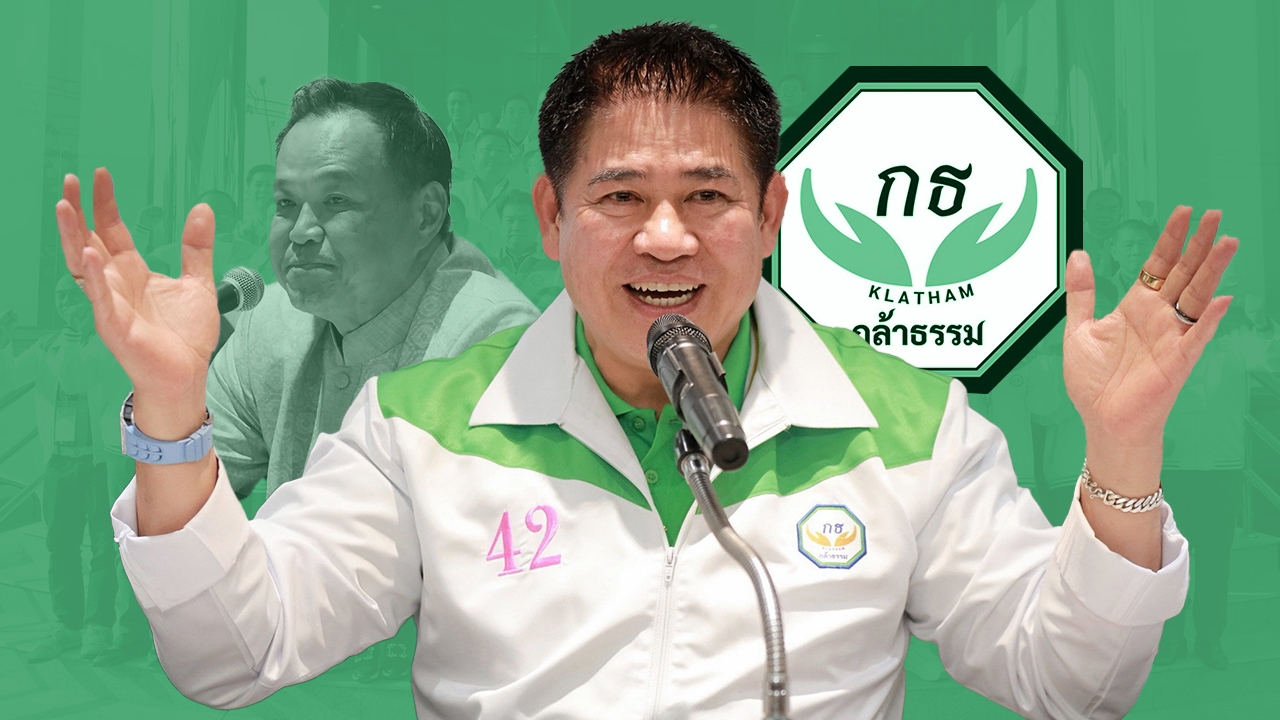
Watch "Thammanat" blocking the "Kla Tham" green snakes. Analysts believe it’s not a dead end yet; there’s still hope to negotiate joining the government. Reading Bhumjaithai’s strategy to deliberately block rising stars, fearing competition?
After the 2026 election The Bhumjaithai Party won the election with 193 MPs and is moving forward to form a government. The latest update today (26 Feb) reveals the face of the “Anutin Cabinet” is becoming increasingly clear and may already be certain that the "Kla Tham Party" will not join this government, despite holding the fourth most seats with over 58 MPs. There are reports they have conceded fully, accepting conditions not to control the Ministry of Agriculture and that "Thammanat Prompao" will not be included in the cabinet.
The exclusion of the Kla Tham Party from the government raises the question of whether this will cause a party split. Many view Kla Tham as a party with a strong local base. Without state power, factions within might break apart. Today (26 Feb), rumors circulated about the "green snakes" —Kla Tham MPs—numbering around ten potentially being bought off. However, Mr. Attakorn Sirilattayakorn, MP for Chachoengsao and Minister of Tourism and Sports, denied these rumors, affirming that everyone will stay united. MPs mentioned in the rumors have also come forward to deny them.
What lies ahead for the "Kla Tham Party" and how much chance remains to join the government? Thairath Online’s special team discussed this with Lt. Col. Dr. Jarupol Ruangsuwan, Deputy Director of the College of Politics and Governance at King Prajadhipok's Institute.

Lt. Col. Dr. Jarupol believes that even if pushed into opposition, the party won’t split. He trusts Lt. Col. Thammanat can still control his party members. However, they may have to endure being out of government for now. Politics is unpredictable and can change, with several opportunities to join the government. The situation must be watched closely until the royal endorsement clarifies the form of the Anutin government.
Regarding rumors that about "green snakes" from Kla Tham—around 10 MPs—might vote for Mr. Anutin and Bhumjaithai, he said such "snakes" usually expect rewards. Currently, it is unclear what benefits these groups would receive if this happened.
"If they vote and get positions or benefits that allow them to leave Kla Tham and join the government, it’s possible some might switch votes. But if they suddenly vote without getting anything in return, it seems unlikely."
Alternatively, some or all of Kla Tham voting for Mr. Anutin as prime minister could be a way to "build bridges" to the government side in case of future realignment.
Most political parties want to join the government. Kla Tham’s recent actions clearly show a desire to govern, unlike parties like Prachachon or Democrat that have declared clear opposition stances.

Lt. Col. Dr. Jarupol views Kla Tham as having multiple strategies to negotiate joining the government. This is normal for a growing party seeking state power and budgets to fulfill election promises. Without such connections, the party's growth in future elections could be limited.
If Kla Tham truly concedes to join the government, it is believed they will still secure ministerial posts, though fewer than originally desired and not top-tier ministries. Their strategy will determine whether they can negotiate for secondary ministries that allow policy impact benefiting both the public and future elections.
"Regarding Lt. Col. Thammanat himself, I believe he might step back from ministerial positions and let others represent the party, as he can still control the party overall."
Lt. Col. Dr. Jarupol said Bhumjaithai must allocate enough seats among its factions. Adding Kla Tham to the government and sharing ministerial posts might not be seen as worthwhile.
Given that Bhumjaithai and Kla Tham are viewed as direct competitors in upcoming elections, sharing a similar conservative, local-based style, excluding Kla Tham now may be a deliberate "cut-off" to prevent Kla Tham from growing into a serious rival in the future.

He noted political friendships are never permanent but are about negotiation and bargaining. Although Bhumjaithai and Kla Tham may not join the same government this term, there is unlikely to be outright hostility. The deliberate blocking of Kla Tham’s growth is plausible and likely a factor in keeping them out of government.
Blocking a party can be done by pushing it into opposition or by including it in government but assigning less influential ministries or controlling it via the prime minister’s policies, limiting its ability to achieve significant results.
Kla Tham is interesting because it stems from on-the-ground politics—directly engaging with local communities—which tends to be more sustainable than online-driven politics reliant on trends. Even negative publicity may not deeply affect local supporters. Kla Tham’s large number of constituency MPs and few party-list seats show its focus on strong local political bases, providing greater stability.
"I don’t think Lt. Col. Thammanat considers himself sidelined. He likely believes he can continue and still holds strong cards. Having many constituency MPs means the public connects with both the MPs and party longer-term. It’s likely a matter of timing, strategy, and opportunity whether they can join government."
If the two parties do not form a coalition, they are expected to compete fiercely in the next election, unlike in 2026 when rumors suggested some constituencies avoided competing against each other. This presents a challenge for Bhumjaithai in deciding whether pushing Kla Tham into opposition to compete intensely will benefit them or if keeping Kla Tham as an ally is more advantageous.
"Anything is possible in politics. We must watch closely how the prime ministerial vote unfolds. What has been analyzed might all come down to what happens on that one day."