

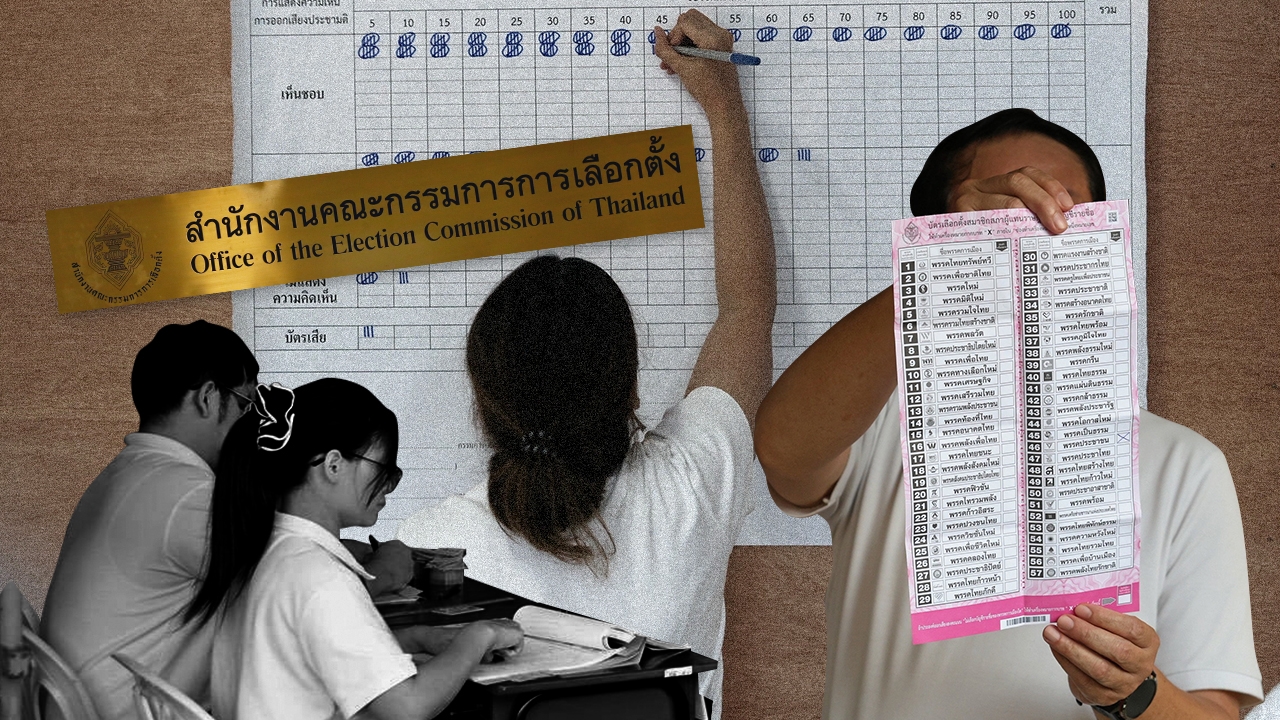
Analyzing the Election Commission's (EC) stance in opening a legal battle against the public by filing serious charges of “incitement and conspiracy” against politicians and civil society members over decoding ballot 69. Scholars view this as an attempt to silence critics, but the backlash highlights that their actions may not constitute offenses, indicating possible counter-legal actions under Section 157.
Regarding the case on 26 Feb 2024 GMT+7, the Election Commission (EC) assigned Mr. Kanchit Charoen-in, Deputy Secretary-General of the EC, to file a complaint with the Crime Suppression Division to prosecute six individuals who collectively photographed election ballots, ballot stubs, and attempted to decode the "QR codes and barcodes" on the constituency-based and party-list ballots during the re-voting at polling station 9, constituency 15, Khan Na Yao District, Bangkok on 22 Feb 2024 GMT+7. The individuals are:
1. Mr. Thammathir Sukchotirat, also known as Dr. Reuban, Director of D-Vote, Sripatum University,
2. Mr. Thanarat Kuwattanapan, CEO of Domecloud, expert in software and blockchain technology,
3. Mr. Chaipan Chawalawanichai, aka Teacher Chai, owner of the M.I.B Marketing In Black Facebook page,
4. Mr. Somchai Srisuthiyakorn, former Election Commissioner,
5. Mr. Parit Watcharasindu, spokesperson for the Prachachon Party and prospective party-list MP,
6. Mr. Songpol Ruangsamut, chief photographer at Spacebar.

The reported charges filed by the EC include:

The EC's complaint has sparked debate and questions about whether this is a legal offensive against political groups and the public. The six accused have responded, for example, Mr. Somchai Srisuthiyakorn, former EC commissioner, posted urging the EC not to withdraw the complaint because when summoned by police, it will be shown that the EC used their position to file false accusations and persecute citizens, leading to counter-complaints under Section 157 for official misconduct, civil lawsuits, and opportunities for courts to summon evidence such as ballot printing TORs, possibly resulting in further legal actions.
Similarly, on 27 Feb 2024 GMT+7, Mr. Parit Watcharasindu, spokesperson for the Prachachon Party, met with investigators at the Crime Suppression Division after being charged by the EC. He affirmed that his presence as an election observer was lawful and a right of citizens. On that day, several EC officials, including the Deputy Secretary-General, were present and showed no objection or warnings that he obstructed official duties.
They are ready to proceed legally. Regarding counter-complaints, it depends on whether the EC's claims are factual. If found false, Dr. Wayo Asawarungroj, Deputy Head of the Prachachon Party’s legal team, is prepared to take immediate action.

Meanwhile, Mr. Narinpong Jinapak, President of the Lawyers Association of Thailand, issued a statement noting that elections must be conducted openly and transparently, except that voting itself is constitutionally secret. Citizens installing cameras or photographing election management by the EC is a legitimate scrutiny of the EC’s work, not of the secret ballot, and does not obstruct elections or violate EC or voter rights.
Such actions are rights and freedoms protected by the Constitution, Article 25, paragraph one. They also align with state policy under Article 78, promoting public understanding of democratic governance and participation in national development, including oversight of state power. Thus, public scrutiny of the EC’s election management is constitutional and lawful.
Therefore, the EC filing charges is shameful, disrespecting citizens’ rights as sovereign owners and taxpayers funding the EC. It amounts to harassment and intimidation to instill fear in exercising oversight, using the law to silence the public.

Dr. Satithorn Thananishichote, Faculty of Political Science, Chulalongkorn University, said in an interview on the programNEWSROOMthat the EC may wish to uphold its legal standards. On the day of re-voting at Bangkok’s constituency 15, polling station 9, the EC director explicitly forbade photographing ballots, and officials were highly cautious. Thus, the incident is seen as a counteraction.
The team collecting evidence at the polling station aimed to prove that the voting process there was not secret, since the ballot stubs and ballots were all in the same area. If proven, this would contradict the constitutional Article 85 requiring direct and secret elections.
Regarding the charge of obstructing the election, Associate Professor Dr. Pichai Rattanadilok Na Phuket, Director of the Political and Development Strategy program at NIDA, believes that judging from the behavior of civil society and politicians observing, there was no obstruction since they stood outside the polling station, conducted parallel vote counts without shouting or disturbing officials. Photographing ballots during counting is allowed, as the law only forbids photographing ballots inside voting booths.
This case likely follows complaints from the ballot box encirclement incident in Chonburi, where the public lodged complaints and the EC responded with legal measures, causing the issue to subside with no further resistance. This suggests the legal silencing approach was effective. Thus, when the 22 Feb election occurred, this tactic was reused, though the EC seemed unsure of which offense to charge, resorting to multiple serious accusations. This backfired because one accused, Mr. Somchai, was not even present. Others also did not match the charges filed.
"This raises questions why the EC thought this way, unaware they might face counter-complaints. The attempt to silence will likely backfire," said Associate Professor Dr. Pichai.

He believes the lawsuits are clearly unfounded and the EC will face counter-charges under Section 157. However, it remains to be seen if the case will reach court or stall at police or prosecutor levels. If it goes to court, Mr. Somchai has pledged to use legal power to request EC election ballot data as evidence. There is also a chance police may not forward the case.
Similarly, Dr. Satithorn views that because the EC was uncertain about which charges to file, they selected severe laws like conspiracy for group action.He is confident none of the six feel intimidated or will stay silent; instead, their voices will grow louder.
"Instead of letting the process proceed normally, which the EC is trying to do by gradually announcing election results, organizing re-votes and recounts, and allowing media to photograph and scrutinize every step, the EC chose to sue citizens who want to monitor the process," he said.
Associate Professor Dr. Pichai believes suing instead of proving transparency stems from two major scenarios: first, that polling station officials acted in good faith with minor errors, in which case the EC would allow recounts; second, that many stations had serious irregularities and resist recounts.
Recently in Suphanburi, controversy arose when the Election Commission did not display ballots during counting. A recount showed hundreds of votes differed, raising questions if this happened only in one station or throughout the constituency. If the EC wants to prove sincerity, it should authorize recounts for the entire district.
Dr. Satithorn notes that since the EC has already certified 396 constituencies, recounts in those areas are unlikely. Instead, the process will move to "post-election challenges." If complaints or clear evidence arise, along with reports of irregularities fromelection inspectors,investigations may lead to issuing yellow or red cards.
Associate Professor Dr. Pichai adds that the rush to certify election results may be an attempt to divert public attention from electoral irregularities toward government formation, making subsequent scrutiny more difficult.
