

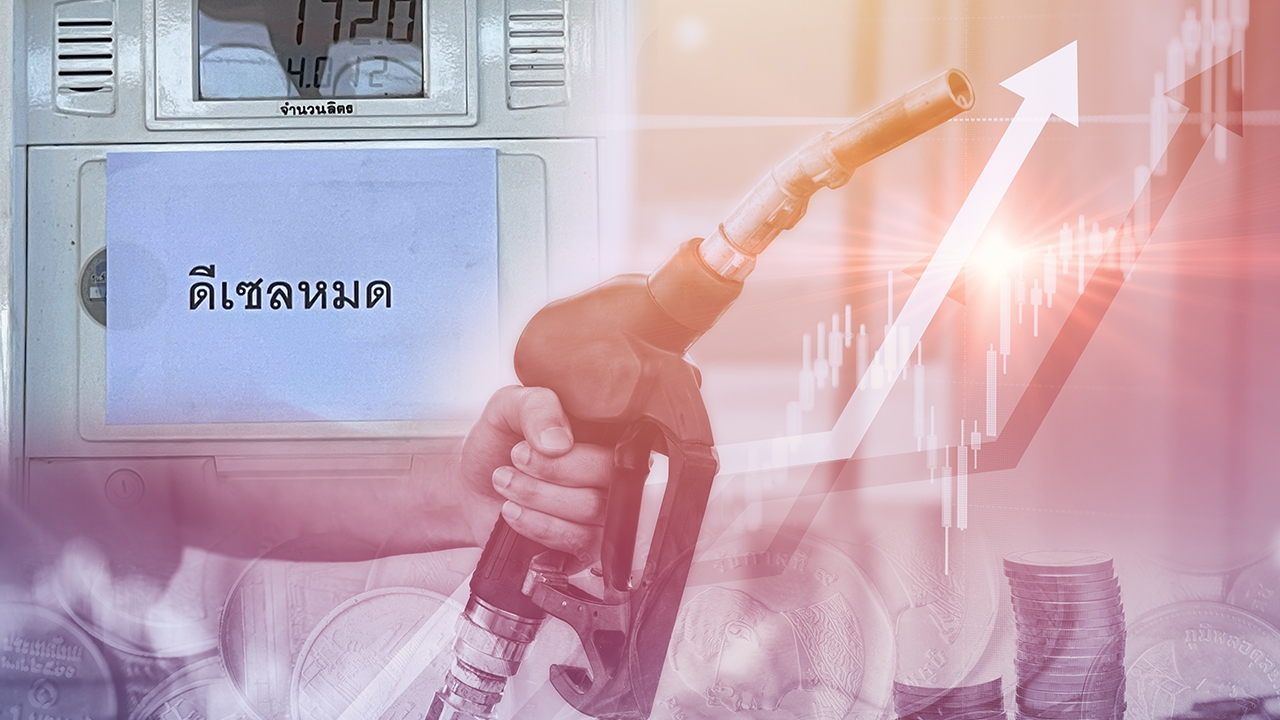
The Oil Fund is the hope to stabilize energy prices amid war. An academic reveals it is deeply in deficit and can only sustain support for a short time. This serves as a lesson for the government’s use of the fund during stable periods, recommending adjustments in price structure and increased reserves to build strategic strength. .
The conflict situation in the Middle East has impacted prices. of oil. has risen sharply worldwide, recently surpassing $100 per barrel, which Thailand is among the countries directly affected due to its high oil imports. Currently, the Oil Fuel Fund (OFF) subsidizes diesel to keep the retail price around 30 baht per liter.
Reports as of 9 Mar 2026 show the Oil Fund subsidizes diesel by 11.73 baht per liter, up from 9.57 baht on 6 Mar. The Oil Fund spends about 700 million baht daily on subsidies. This raises public questions and concerns about how long the Oil Fund can bear these costs.

Thairath Online’s special reporting team discussed this issue with Dr. Areeporn Asawinpongpan, energy policy expert at the Thailand Development Research Institute (TDRI). She explained that the conflict between the U.S., Israel, and Iran has certainly disrupted the global oil supply chain, as oil exports from the Middle East become difficult, and market fears of war push global oil prices steadily higher.
Although Thailand produces some oil, it is insufficient for domestic demand, with 80% imported, mostly from the Middle East. Without the government’s current Oil Fund subsidies, diesel prices—which are key for transport and business—would likely be around 40 baht per liter. Maintaining current prices helps mitigate impacts on citizens’ daily lives somewhat, though gradual price increases may be needed in the future.
"Almost all types of oil are affected, but diesel is particularly important for Thailand because it fuels transport, agriculture, and many sectors influencing product prices and citizens’ cost of living."

Regarding the Oil Fund’s daily 700 million baht subsidy for diesel price stabilization, Dr. Areeporn sees this as necessary and appropriate. Currently, Thailand has almost no alternatives, but this is also a lesson that the government in the past misused the Oil Fund by subsidizing diesel prices long-term during non-crisis periods, instead of conserving funds to support during real crises like now.
Dr. Areeporn added it is difficult to say how much longer the Oil Fund can sustain support since it is already in deficit. The government must find other measures to enable the fund to increase subsidies, such as issuing a royal decree for the Ministry of Finance to guarantee the Oil Fund. The fund has limits on compensation, but during crises, these limits may need raising or flexibility.

On the ideal oil price structure for Thailand to solve current issues, Dr. Areeporn suggests first that Thailand should not base prices on refined oil prices from Singapore. Because Thailand does not source oil from Singapore and shipping and insurance costs are added to that price, it should reference domestic refinery gate prices instead. Measures should ensure transparency and fairness regarding the refinery costs from Thailand’s six refineries.
Secondly, increase domestic oil reserves. Because it’s unpredictable when such crises will happen again. Since the Russia-Ukraine war, geopolitical conflicts have become more frequent, with oil being the first commodity affected.
During the Russia-Ukraine war, the Oil Fund provided long-term compensation, leading to long-term deficits. The government continued subsidizing diesel prices until recently, when subsidies were lifted and the fund briefly returned to surplus.
Regarding whether other countries face similar issues, Dr. Areeporn divides them into two groups: those that produce their own oil and thus face less supply disruption but are affected by global price fluctuations, and importing countries that face impacts similar to Thailand’s, depending on government support measures. Thailand must urgently find alternative oil sources faster than others.
"Today, the Oil Fund already runs daily deficits of several hundred million baht and likely cannot sustain much longer. However, subsidies must continue for now. This is a lesson for the Thai government to seriously reduce energy imports from abroad."

On 9 Mar 2026, Prime Minister Anutin Charnvirakul, Deputy Prime Minister and Transport Minister Phiphat Ratchakitprakarn, and Energy Minister Atthapol Rerkpiboon met to address energy problems.
After the meeting, Mr. Phiphat confirmed Thailand’s oil reserves remain at 95 days. The government plans to mitigate oil price impacts after diesel price caps end by closely monitoring global prices and managing diesel and gasoline prices. If necessary, price increases will be gradual to align with global markets but avoid sudden rises that burden citizens.
For industries facing oil shortages, businesses having difficulty purchasing from their usual suppliers can present purchase orders from the past two months to provincial governors or energy officials to secure normal oil supplies as before.
Minister Atthapol added the Ministry of Energy has implemented measures to enhance energy security, including requiring oil traders to increase mandatory reserves from 1% to 3% by 30 April, extending domestic reserves by 7 days. Additional measures include raising biodiesel blend from B5 to B7 by 14 Mar 2026, matching current palm oil production to reduce imports, and promoting E20 use by adjusting prices to incentivize consumers to choose E20 over E10.
Regarding electricity, the ministry secured alternative natural gas supplies bypassing the Hormuz Strait, increased gas production in the Gulf of Thailand, and raised electricity imports from Laos, totaling about two LNG shipments. They assured no electricity shortages and extended liquefied petroleum gas price caps through April and May.
The Ministry of Energy urges government and citizens to conserve energy by setting air conditioners to 26°C, maintaining engines for efficiency to reduce fuel consumption, and considering work-from-home policies while being mindful of impacts on businesses near offices.