

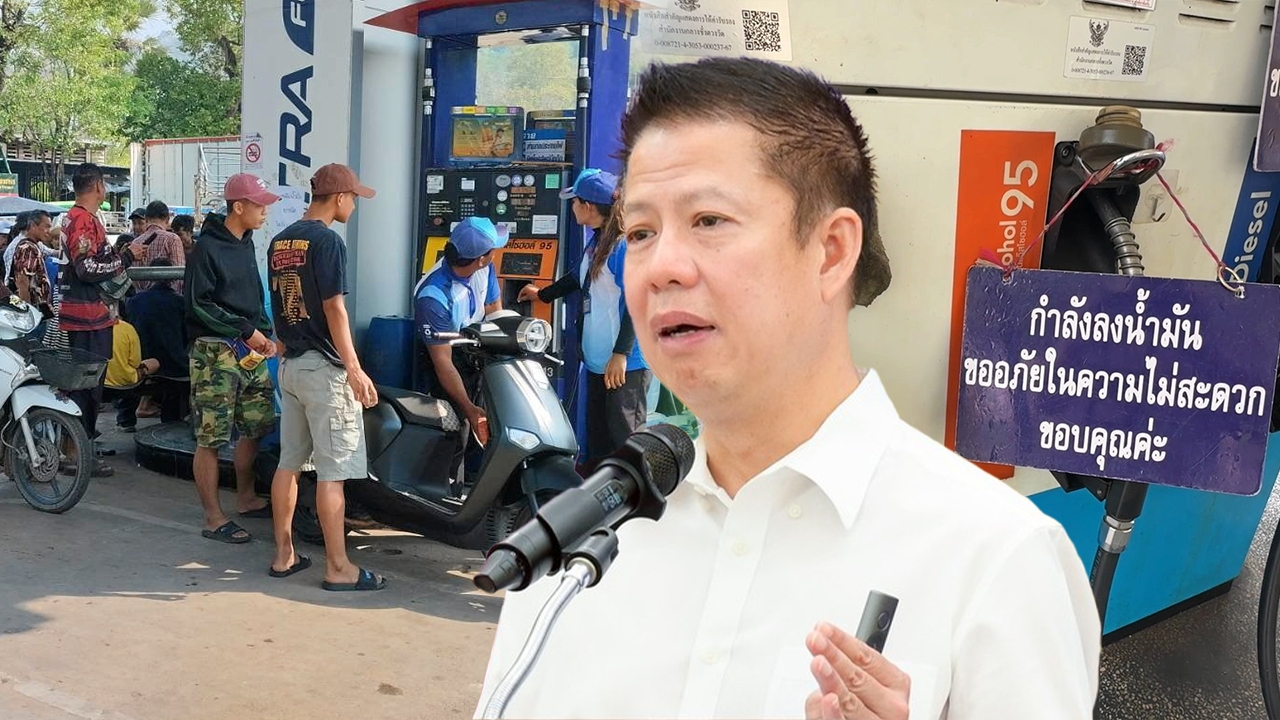
The Director-General of the Department of Energy Business revealed the underlying causes of fuel shortages at gas stations, citing a threefold surge in consumer demand overwhelming transport capacity and the lack of direct refinery purchase contracts by transient jobbers. He also updated that Thailand's oil reserves are sufficient for 95 days.
Amid the ongoing Middle East conflict impacting global energy security, today (11 Mar 2026), the Energy Research Institute of Chulalongkorn University, together with the Social Research Institute, the Institute for Sustainable Environmental Research, the Water Resources Research Institute, and the Transport Institute, organized an academic seminar. The seminar was titled “Thailand's Energy Security Amid Global Crisis: Decoding Risks Towards the Nation’s Response Plan.” The event was held at Chulalongkorn University.
Dr. Sarawut Kaewtatip, Director-General of the Department of Energy Business, explained that the renewed Middle East conflict, which erupted again on 28 Feb between the United States and Israel and Iran, he confirmed that Thai authorities have been proactive, holding ongoing meetings to develop response measures. Initially, there was no severe impact, but after 2 March, the conflict escalated, causing concerns over fuel shortages and price hikes. This led many people to rush to fill up and stockpile fuel, which is a natural reaction.
Regarding the problem of many gas stations running out of fuel, Dr. Sarawut explained that currently, refineries supply large fuel traders with long-term contracts, so these major brand stations do not face shortages. In Thailand, there are about 8,500 such stations out of a total 26,000.
The other approximately 16,000 stations are independent and cannot buy fuel directly from refineries or major depots. They must purchase through intermediaries or middlemen called jobbers, who are fuel traders under Section 10. These jobbers are divided into two types: those with direct contracts with refineries or depots, who usually do not face problems,
and another group, called “transient jobbers,” who frequently switch suppliers to buy where prices are lowest and then resell to independent stations. Typically, these do not have contracts and operate on spot purchases or one-off transactions. During crises like this, they encounter difficulties securing fuel to supply small stations.
Dr. Sarawut affirmed that fuel reserves are sufficient, but there may be occasional disruptions in transportation or logistics. Normally, each station receives about three tanker deliveries daily, each carrying 30,000 to 40,000 liters. However, when consumers panic and fuel demand triples simultaneously, stations must manage additional tanker deliveries, which may not keep pace, causing temporary shortages. The latest situation has improved compared to the previous week.

as of 9 March 2026, the country's oil reserves are sufficient to meet demand for at least 95 days, divided as follows:
1. Domestic oil reserves ready for use total 4,792 million liters, enough for 39-40 days. These break down into
2. Oil currently in transit, having passed through the Strait of Hormuz, amounts to 3,350 million liters, enough for 26 days.
3. Confirmed sourced oil awaiting shipment to Thailand (from routes outside the Strait of Hormuz, such as from the Americas and West Africa) totals approximately 3,700 million liters, sufficient for 30 days.
Dr. Sarawut disclosed that regarding the use of liquefied petroleum gas (LPG) in Thailand, half is used as raw materials, such as in petrochemicals, while the other half is used as fuel. Total LPG consumption is 10.4 million kilograms per day, divided into 6.13 million kilograms/day for households, 2.08 million kilograms/day for industry, and 2.22 million kilograms/day for transportation. Thailand's LPG comes from three sources: 1.
Production in the Gulf of Thailand to gas separation plants,
accounting for 60%, producing 9.57 million kilograms/day, nearly covering LPG fuel consumption. 2. From crude oil refineries,
about 6.34 million kilograms/day. 3. Imports from abroad,
used only when necessary. Currently, Thailand's total LPG stock nationwide is 171 million kilograms, divided into working stock of 88 million kilograms and legally mandated reserves of 83 million kilograms, sufficient for 199 days of usage. Thailand's oil cycle,
Dr. Sarawut explained that after crude oil procurement at 172 million liters per day, it is refined into about 151.32 million liters of finished products, divided as follows:
Diesel: 76.57 million liters/day,
Gasoline: 32.66 million liters/day, Diesel: 69.25 million liters/day, Jet fuel: 20.82 million liters/day,
Fuel oil: 6.34 million liters/day.
the Emergency Decree on Oil Shortage Prevention and Remedy B.E. 2516 (1973),

1.
Suspension of exports of four fuel types—gasoline, gasohol, base gasoline, high-speed diesel, jet A1 aviation fuel, and liquefied petroleum gas—except exports to Laos (a power supplier ally) and Myanmar (from which Thailand imports gas), as well as excluding off-spec fuels not sold domestically. 2. Increasing fuel reserve requirements by gradually raising mandatory reserves of finished products such as gasoline, gasohol, base gasoline, and jet A1 aviation fuel:
Currently: 6% crude oil and 1% finished products, equal to 25 days, By 31 Mar 2026: 6% crude oil and 1.5% finished products, equal to 27 days, By 30 Apr 2026: 6% crude oil and 3% finished products, equal to 32 days.
This measure will increase reserves by about 7 days, totaling approximately 102 days. 3.
Increasing biodiesel blending ratios in two diesel types:
Regular high-speed diesel from B5 to B7, increasing biodiesel content from 5% to 7%, reducing imported fuel volume.
B20 high-speed diesel with 19-20% biodiesel content as an alternative fuel for large trucks.
4.
Urgent meetings with refineries to secure alternative fuel sources, with the Department of Energy Business coordinating with Section 7 fuel traders operating service stations to ensure sufficient supply, continuous transport, and to address hoarding and opportunistic price hikes.
The Oil Fuel Fund (OFF) fixing diesel prices at 29.94 baht per liter for 15 days (until 17 Mar). Promoting Gasohol E20 use by widening the price gap between E10 and E20, encouraging consumers to switch to E20.