

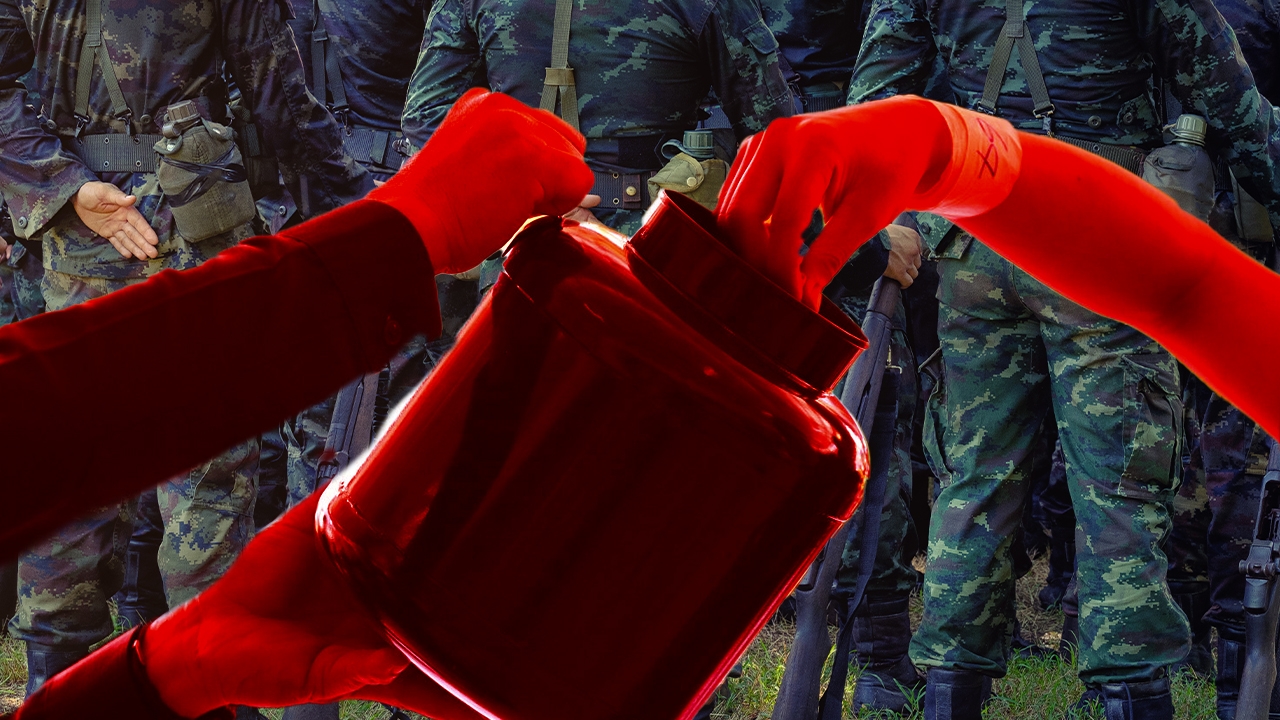
The mid-2026 military reshuffle presents a challenge for army leaders to resolve issues of violence against junior soldiers, considering solutions compared to foreign militaries.
The safety of personnel is an agenda that the new defense minister and commanders at all levels must concretely define in policy, equally important as the mission to protect national sovereignty.
With the mid-2026 military reshuffle revealed publicly yesterday (13 Mar 2026), the role of the new defense minister and all military commanders is under close scrutiny regarding how they will set policies and standards for caring for military personnel.
Amid ongoing reports since early this year about incidents involving military personnel within units, some news has included cases of physical abuse against soldiers.
The key question is not only about the placement of forces within the military power structure but also how future army leaders will clearly define standards to protect the lives, safety, and dignity of personnel.
When strictness must not cross legal boundaries.
Discipline is a fundamental foundation of the army, but the line between strict discipline and safety standards for personnel must be clearly defined and must not overstep legal limits.

In recent years, issues concerning disciplinary measures in military training units have periodically appeared in Thai media, often sparking debates about the appropriateness of punishment methods.
One of the recent incidents that drew public attention occurred at a military camp in Prachinburi province, where reports questioned the suitability of disciplinary measures applied to personnel.
Meanwhile, a few days earlier, some images and information about an incident inside a training unit in Nakhon Ratchasima province circulated on social media, attracting public interest; reports indicated there were fatalities and injuries.
Regarding these incidents,
however, all facts remain under investigation and consideration through the justice process by relevant agencies. Therefore, details must await official fact-finding according to legal procedures.
Although such incidents may result from individual actions, they signal systemic warnings, especially regarding standards for safety care and protection of personnel rights.
The boundary between discipline and safety.
Military training worldwide requires strictness because soldiers’ duties involve protecting the country's sovereignty, security, and safety.
However, a key principle of modern armies is that strict training must not cross lines that harm the life, body, or dignity of personnel.
Disciplinary measures exist to maintain order, readiness, and unit cohesion, but their application must comply with legal frameworks and the accountability of commanders.
When this boundary is questioned, an incident is not merely an individual or unit problem but a systemic issue that security organizations must prioritize.
Providing aid or remediation to those affected by incidents is important to alleviate the suffering of victims’ families.
However, remediation should not be seen as the end of fact-finding or legal accountability.
In cases involving death or serious injury linked to personnel, society expects full legal proceedings and transparent case updates so victims’ families can stay informed continuously.
Having a clear coordination system or communication of information to affected families is a standard of responsibility that major organizations worldwide emphasize.

Several countries have developed internal oversight and audit mechanisms within their militaries, including independent oversight bodies operating outside the chain of command to prevent actions that violate professional standards.
In the United States, military justice operates under the Uniform Code of Military Justice (UCMJ), which systematically defines offenses and trial procedures in military courts.
In the United Kingdom, the military has an internal complaint system called the Service Complaints System and an independent entity, the Service Complaints Ombudsman for the Armed Forces, to ensure fairness in handling personnel complaints.
In the Republic of Korea, the National Human Rights Commission of Korea has an expanded role in reviewing complaints related to military personnel rights.
Approaches from multiple countries reflect a shared principle: strong discipline must be paired with transparent, accountable oversight systems.
Personnel safety is the foundation of a strong military.
For the military, the key mission is to protect the country's sovereignty and security, but caring for personnel is equally important.
Whether regular professional soldiers or conscripts, all are vital human resources of the military and citizens entitled to equal legal protection.
A strong military is measured not only by its capability to defend borders but also by standards in caring for its personnel in terms of safety, human dignity, and fairness under justice processes.
Amid the mid-2026 military reshuffle, the new defense minister, commanders at all levels, and officers named in the transfers should collectively recognize that
protecting the safety and dignity of personnel must be clearly established as a policy agenda of the military and seriously overseen at every level of command.
When incidents affect the lives or safety of personnel, society expects straightforward fact-finding, full legal action, and appropriate public communication.
Ultimately, the strength of the military is not measured solely by its capacity to protect national sovereignty but also by its ability to safeguard its personnel’s safety and ensure justice.
A military that can strongly defend the land must also be one that can protect its own soldiers.