

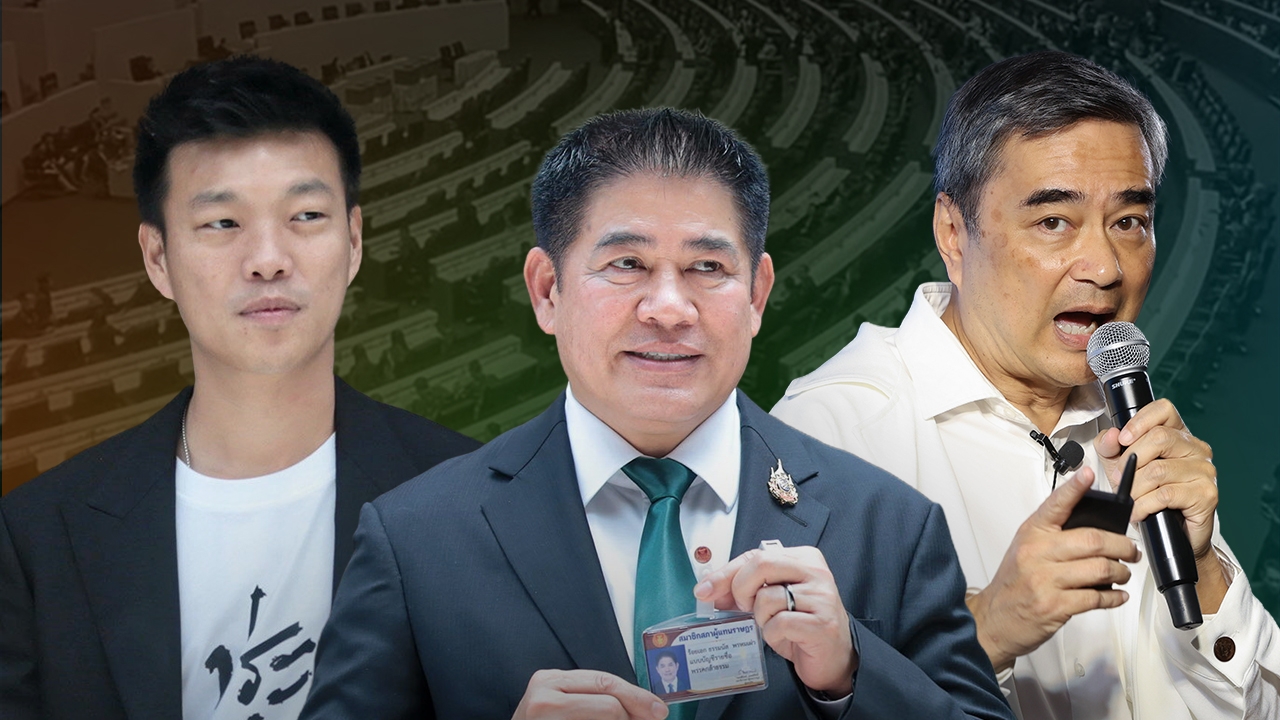
Checking the "opposition's" stance after the parliamentary speaker vote reveals an image of weakness and disunity, with possible overtures hoping to join the government? "Academics" view them as able to be strong even without full unity, believing they will work hard aiming for success in the next election.
Regarding the vote to select the "parliamentary speaker" and the first and second deputy speakers on 15 Mar 2026, the Prachachon Party, which has the most MPs and was set to hold the opposition leader position, nominated Mr. Parit Watcharasindhu, a party-list MP, as a candidate for parliamentary speaker to compete against Mr. Sophon Sarum, Buriram MP from the Bhumjaithai Party, a leading government coalition party with strong local ties in Buriram.
When it came time to vote for parliamentary speaker, major opposition coalition parties such as the Kla Party, with 58 votes, and the Democrat Party, with 22 votes, cast "abstentions." This raised questions whether this event reflected weakness and disunity within the opposition coalition, and some speculated it was a "gesture of goodwill" aiming to cross over and join the Bhumjaithai-led government in the future.

On 16 Mar 2026, Rear Admiral Thammanat Prompao, Deputy Prime Minister and Minister of Agriculture and leading figure of the Kla Party, explained that the party's decision to abstain was based on the view that no suitable candidate warranted their support, so they preferred to abstain. He emphasized this was a party consensus, not his decision alone.
Regarding questions if abstaining was a tactic to prepare for joining the government, Rear Admiral Thammanat said the Kla Party has principles, ideology, and its own stance, and is not politically maneuvering to join the government.
As for whether the Kla Party will propose a prime ministerial candidate, no official internal discussion has occurred yet. Concerning rumors about relations with Mr. Anutin Charnvirakul and the phrase "friendship never expires," Rear Admiral Thammanat said he has many friends, brothers, and sisters in life and adheres firmly to the principle of "never killing or betraying a friend."
Whether they will support Mr. Anutin for prime minister is a political matter separate from personal relationships.

Meanwhile, the Democrat Party, on 16 Mar, Mr. Pongsakorn Kwanmuang, spokesperson for the Democrat Party, posted a statement explaining their abstention was because the Prachachon Party made its nomination without prior consultation or consensus with other opposition parties, and it conflicted with the 2017 Constitution, which requires the opposition leader to be from a party without members holding speaker or deputy speaker posts.
They also viewed the nomination more as an attention-getting move than a serious bid to win. Hence, the Democrat Party chose not to participate in that process, affirming they will perform full oversight duties independently and are not anyone's satellite party.
Regarding overtures to join the government, on 17 Mar, Mr. Satit Wongnongtoey, deputy leader of the Democrat Party, told Thai PBS politically there is currently no "opposition whip," so no formal talks have occurred. The Prachachon Party informed them by phone "about" their nomination but did not request a vote. The party then agreed to abstain to show neutrality and confirmed this would not cause problems moving forward because clear opposition and government whips will be established.
"For the Democrat Party, there is absolutely no goodwill gesture. We are clear which side we are on and will fully perform our duties to scrutinize the government, beginning with the upcoming policy statement debate, for which we have prepared speakers."

Rear Admiral Dr. Jarupol Ruangsuwan, Deputy Director of the Political Science and Governance College at the King Prajadhipok's Institute, said that the major opposition parties abstaining from voting for the Prachachon Party's speaker candidate is understandable since there was no overall opposition party discussion. Typically, the government party is expected to win the speaker vote, so opposition parties rarely nominate serious candidates or only do so symbolically.
Regarding whether Kla and Democrat parties abstained as an overture to join the government, he considered this possible, noting no official prime minister vote or cabinet formation has occurred yet, and it's difficult in Anutin's first cabinet since coalition quotas have been allocated. Bringing in other parties could cost Bhumjaithai significant ministerial slots.
However, he did not rule out future possibilities: if Bhumjaithai breaks with Pheu Thai, Kla or Democrat parties could be invited to replace them.
"Thai politics cannot rule out any options, but analysis from many angles is needed. Some may see this as a goodwill gesture to join the government, but it could also be because they don't want to vote for the Prachachon Party due to differing directions."

Regarding views that this opposition may be the weakest due to lack of unity, differing stances, and allegations that independent agencies may be aligned with the government, reducing oversight effectiveness,
Rear Admiral Dr. Jarupol said it is important to separate "weakness" from "unity." He believes the opposition can be strong without full unity as long as they thoroughly perform oversight, even if each party's approach differs.
"The Democrat and Kla parties may not act like the Prachachon Party, but in their opposition roles, they will likely give their best to demonstrate their capabilities to the public. No one would trade this role for a bad image."
Compared to the previous opposition during former Prime Minister Thaksin Shinawatra's government, the Prachachon Party performed notably, and it is believed they will maintain that standard. Meanwhile, the Democrat Party,

with its history of experience and competence in opposition roles, is expected to work intensively this time. As for the Kla Party, if they truly serve as opposition, they will likely do so fully to build a positive party image. "Being in opposition is not only a disadvantage; it offers opportunities to showcase roles to the public. Previous parliamentary stars often came from the opposition rather than the government, which benefits parties in future elections." Regarding allegations involving
independent agencies,
Rear Admiral Dr. Jarupol said such suspicions exist but it may be unfair to make definitive judgments. He stressed initial trust in the country's system to carry out its functions. "Claiming they are on the same side and won't perform their duties is a suspicion, but making a firm conclusion is difficult and unfair to all parties." He concluded that as the government formation nears completion, no major surprises are expected since that would affect ministerial quotas. Yet, future adjustments remain possible and deserve close attention, as Thai politics can change at any time.