

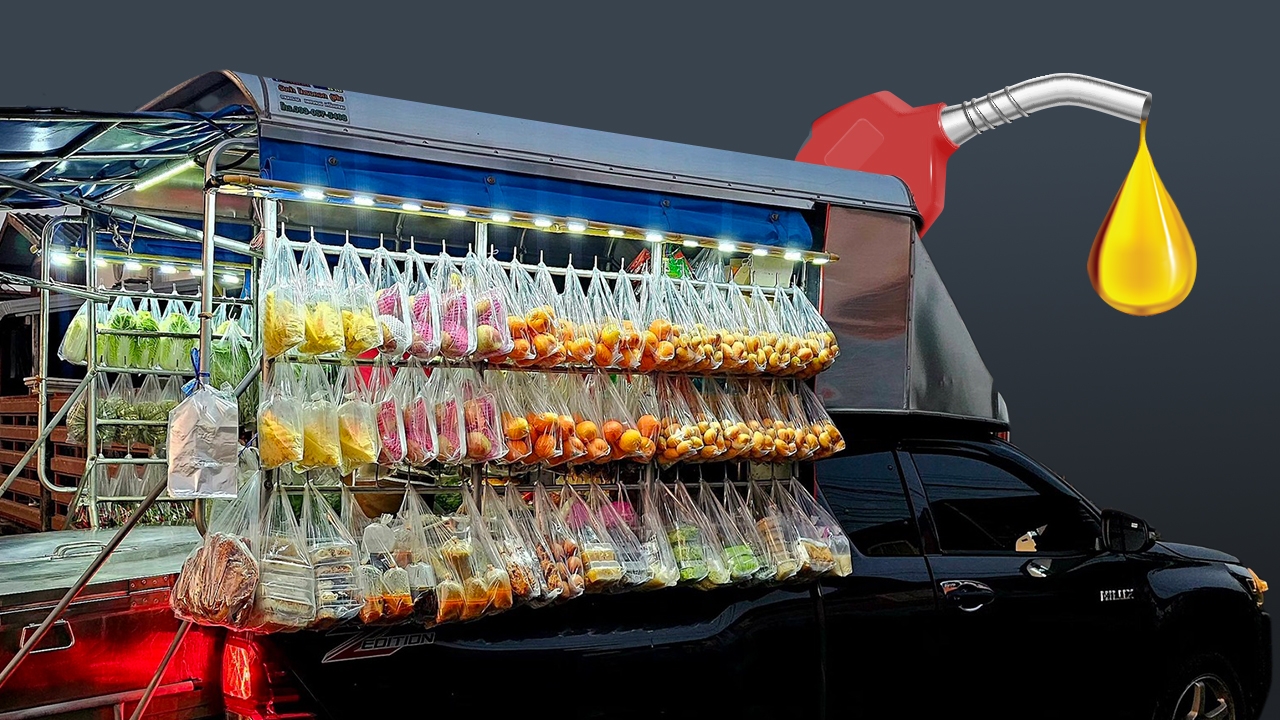
Viewing the oil crisis through the lens of mobile grocery vendors, the owner revealed the need to reduce travel distances and carry soaring costs for all types of goods, leading to shrinking profits and highlighting that the heaviest impact falls on the grassroots population.
Following the clashes between the United States and Israel and Iran, which have escalated since 28 February, shaking the Middle East region, a major global oil producer, with attacks on oil infrastructure and disruptions to shipping through the Strait of Hormuz, a route that handles 20% of the world's oil shipments, severely impacting the oil supply chain and causing extreme price volatility.
Thailand is among the countries directly affected, as one-third of its energy supply passes through this strait. The government responded by accelerating oil imports from other sources and subsidizing prices through the Oil Fund to prevent excessive hikes, assuring that Thailand has over 100 days of oil reserves.
However, the real situation is that at many gas stations, there is insufficient fuel available, leading to limits on fuel purchases between 300 to 1,000 baht, bans on bringing containers for fuel, and early closures due to depletion. People queue from early morning to refuel or drive to multiple stations in search of fuel.
Authorities explained this as a disruption in fuel distribution to the group of "jobbers," or middlemen, causing industries to miss scheduled fuel deliveries. As a result, transport vehicles and factories resort to competing for fuel at regular gas stations, driving demand up manyfold and causing delays in deliveries.

the fuel problem has broadly affected people's daily lives and living costs, raising transportation, shipping, and production expenses, which in turn has driven up prices of many consumer goods. One profession affected both directly and indirectly is the mobile grocery vendors, who must buy fuel and stock products to travel around selling, and they are among the small-scale vendors most directly impacted by this crisis.
Thairath Online's special news team spoke with Mr. Teerayut Ruenreng, owner of the 'Fast Grocery Vehicle' page, who revealed that his mobile grocery vehicle uses diesel, and recently he has struggled to find fuel because many stations run out or limit purchases to 500 baht per fill-up. This forced him to start refueling daily with 500 baht each time instead of the usual 1,000 baht every three days, to keep a fuel reserve in case he cannot find fuel on a given day.
Mr. Teerayut further explained that he normally travels nearly 100 km daily around Surin Province, divided into two rounds: the morning round, from 6:00 to 11:00 a.m., after which he rests, then the evening round, from 3:00 to 6:00 p.m. But during the oil crisis, if fuel is running low, he may not complete the usual route or might skip the evening round to save fuel for the next day's purchasing trip.
"If fuel is very low on a given day, I choose not to run the full usual route or skip the evening round to save fuel for the next day, because I don't know if I'll be able to find fuel to continue selling. In rural areas, gas stations often open at 5 a.m., but I have to buy goods as early as 1 a.m. If I buy goods but then can't get fuel to sell, it's a total loss."
The situation over the past week has significantly impacted income, forcing decisions between saving fuel to sell in the morning or selling in the evening. For example, if morning sales cover costs, the evening sales bring profit, but if fuel is saved instead, that day's sales yield no profit.
Additionally, when fuel prices rise, prices of various goods also increase, and they become harder to procure. Often, ordering goods from major wholesalers for home delivery results in incomplete or missing items, and buying from fresh markets is expensive, leaving no profit margin when reselling. Overall, operational costs rise, customers' purchasing power declines, and competition increases, especially with more fresh food stores and supermarkets opening in villages.
"Everything I buy to sell has gone up in price. For instance, a 5-kg bag of cabbage used to cost 60 baht, now it’s 100 baht. The vendors bringing them from Ubon Ratchathani, Roi Et, and Nakhon Ratchasima are also facing fuel transport shortages. Similarly, roselle prices have doubled—from 90 baht for 9 kg to nearly 200 baht."

Meat products such as pork have seen price increases 3-4 times. The wholesale market price is around 140 baht per kg, and selling at 150 baht per kg yields almost no profit, so he orders from major suppliers offering 110-120 baht instead. Meanwhile, chicken meat prices have also risen, averaging nearly 20 baht per kg. For example, upper wings used to wholesale at 80-85 baht but now are 90-95 baht; size 1 eggs wholesale at 120 baht have risen to 130 baht, with major suppliers increasing prices by 3-4 baht per tray. Costs for supplies like 0.5-kg plastic bags have also increased by about 3 baht.
Mr. Teerayut added there are shortages too; sometimes ordering 50 kg from a major company results in receiving only 10 kg, or ordering 50 trays of eggs yields just over 10 trays. These ongoing cost increases make setting retail prices difficult, especially since he sells items in 20-baht portions rather than by the kilo, so price increases deter buyers. He must keep prices stable to survive, accepting lower profits.
Moreover, as a mobile vendor traveling through villages, he clearly sees the crisis’s impact on farmers, who need fuel for tractors and other agricultural machinery. Currently, many stations prohibit refueling from containers, causing farming activities to halt. This March is also the final month for repaying Bank for Agriculture and Agricultural Cooperatives loans, reducing villagers’ purchasing power further.
Mr. Teerayut observed that previous governments have made grand promises to tackle fuel prices but without noticeable change. He believes there is no actual fuel shortage now but calls for better management to ensure each station has enough fuel. He stressed that farmers are the hardest hit as the planting and harvesting season approaches, yet they cannot refill fuel containers at gas stations, though most use the fuel legitimately and are not hoarding.
"Farmers in rural areas cannot afford to stockpile fuel to cause shortages. If villagers come with containers to request fuel, please sell to them, because tractors and small farm vehicles cannot reach the gas stations."