

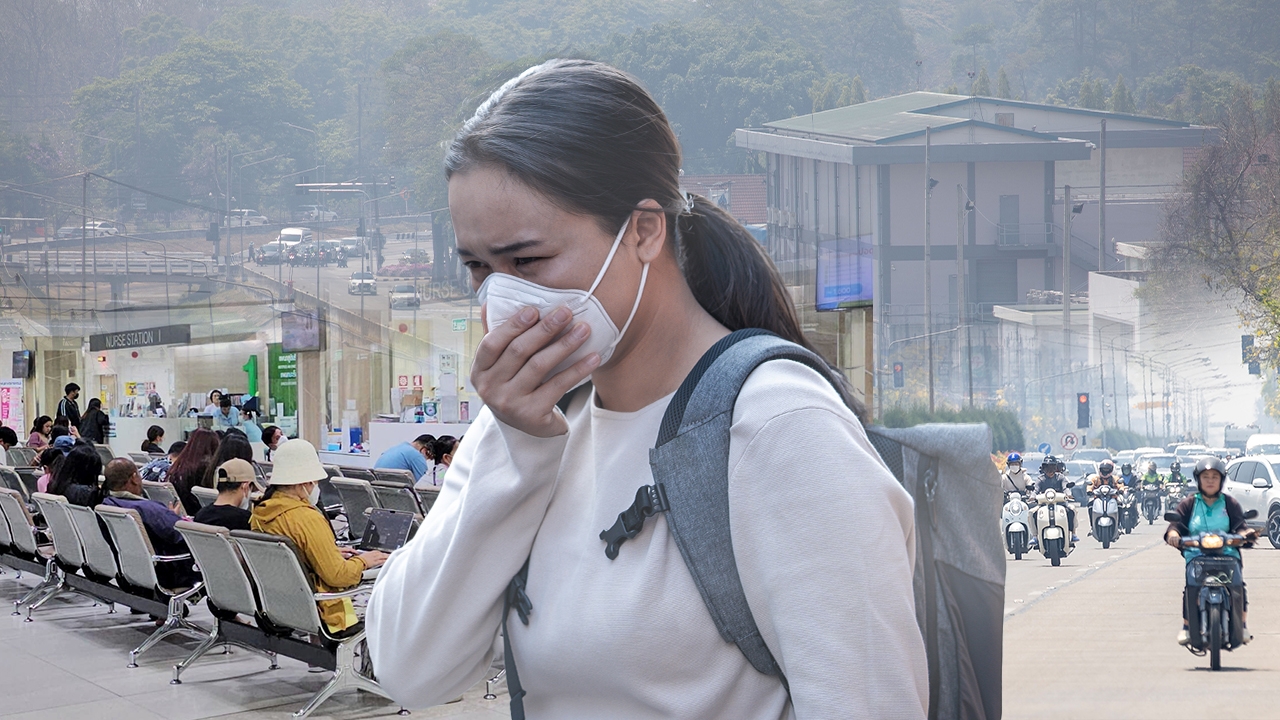
Warning to at-risk groups about Chiang Mai's toxic dust, with the Provincial Public Health Office revealing the latest cumulative patient statistics. Attention is focused on a possible increase after a week of peak dust levels, which ranked the city first in the world.
The PM2.5 dust situation in northern Thailand is critically severe. Today (1 Apr), reporters observed a white haze blanketing Chiang Mai city in the morning. Data from the IQAir AirVisual app measuring air quality in Chiang Mai municipality at 08:00 showed the air quality index (AQI) ranked worst globally for the fourth consecutive day at 235, indicating severe health impacts.
Thairath Online's special news team spoke with Dr. Waranyu Jamnopprasatporn, Chiang Mai Provincial Public Health Doctor (Chiang Mai PPHD). He discussed the situation regarding patients affected by the dust problem.

Dr. Waranyu revealed that patients affected by PM2.5 dust fall into two groups: The first group experiences acute effects, such as irritation and nosebleeds, many of whom do not seek treatment through formal healthcare systems, making exact numbers difficult to determine.
The second group is the four monitored diseases, which have a clear reporting system: chronic obstructive pulmonary disease (COPD), cerebrovascular and heart diseases, dermatitis, and conjunctivitis. According to environmental health data from the Chiang Mai PPHD, cumulative patient numbers for these four diseases during the first 13 weeks of the year, comparing 2025 and 2026 (1 Jan–29 Mar), are as follows:
1. Chronic Obstructive Pulmonary Disease (COPD)
Year 2025: 2,976
Year 2026: 2,223
Down 25.30%
2. Cardiovascular diseases
Year 2025: 31,666
Year 2026: 25,598
Down 19.16%
3. Conjunctivitis
Year 2025: 1,974
Year 2026: 1,412
Down 28.47%
4. Dermatitis
Year 2025: 137
Year 2026: 54
Down 60.58%
Dr. Waranyu pointed out that the latest data show a decrease in patient numbers for each disease compared to the same period last year. However, this may partly be because the PM2.5 dust peak arrived later than last year, possibly due to preceding rainstorms. Therefore, monitoring patient numbers this week and onwards is essential, as these diseases do not manifest immediately after dust exposure but usually develop symptoms 5–7 days later.
"Nonetheless, these figures are influenced by other factors, such as treatment processes for COPD patients, medication, preventive measures like using dust-proof nets or wearing masks, which have already helped reduce patient numbers. Also, these diseases are seasonal and triggered by different factors each season, with dust being one cause, so patient numbers typically spike in winter or during dust seasons," he explained.
Regarding severe diseases such as “lung cancer,” Dr. Waranyu noted it is not included among the monitored diseases because it is a long-term condition, and it cannot be definitively stated that PM2.5 dust is the direct cause.

The most vulnerable groups needing protection from dust problems include respiratory patients, those at risk of vascular diseases like diabetes and hypertension, young children, and the elderly.
Regarding Chiang Mai PPHD's measures, besides the Department of Disaster Prevention and Mitigation's alert system that sends warnings via SMS, the PPHD continuously updates dust conditions throughout the day—morning, afternoon, and evening—with advice on outdoor activities, precautions, and coordination with local leaders to broadcast announcements in communities, including flag color warnings.
Additionally, Village Health Volunteers proactively visit homes to issue warnings and guidance tailored to each group, focusing mainly on vulnerable and patient groups, with nearly 100% coverage already achieved.
If dust levels rise significantly this week leading to a notable increase in patients, the Chiang Mai PPHD doctor confirmed that the current healthcare system can still accommodate those needing hospital beds, such as asthma patients, who still have sufficient beds available. For stroke cases, there is also a fast-track system in place.