

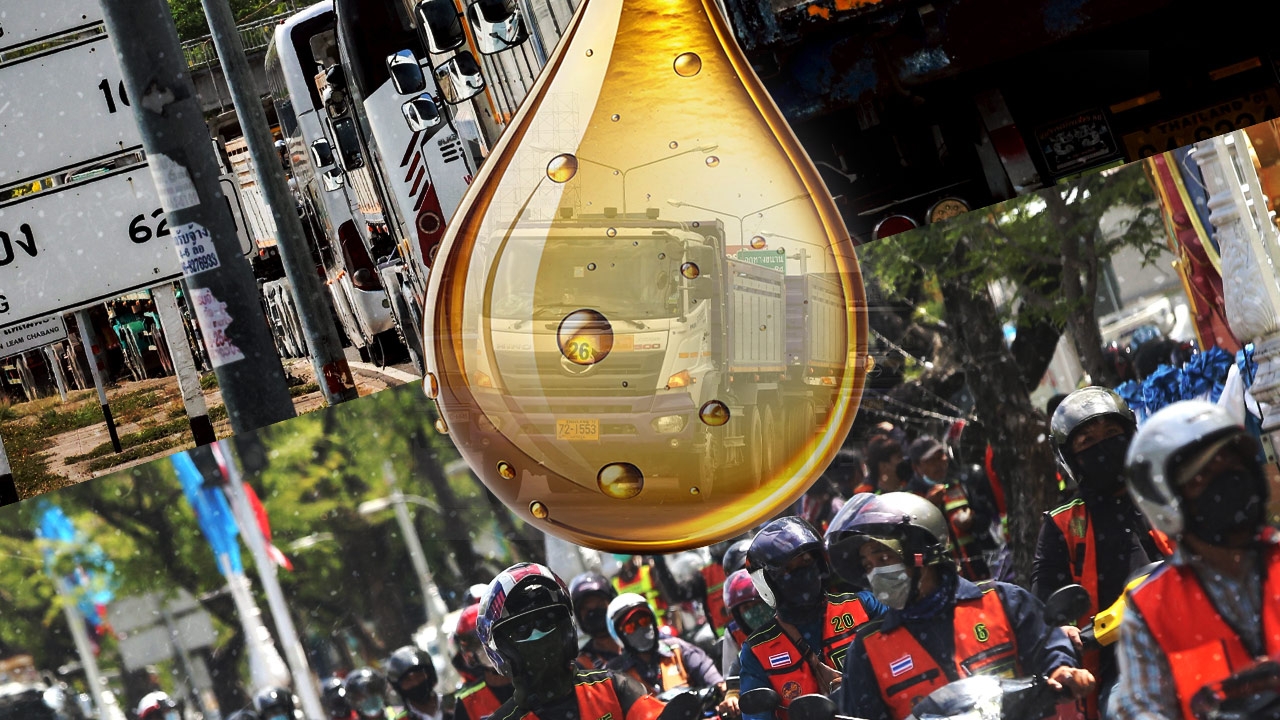
The government allocated 2 billion baht for transport relief registration. The Transport Federation views this as only a mitigation measure and warns of a risk of an oil shortage crisis in May after confirming delivery of 9 million barrels. They say hopes of oil prices returning to 30 baht per liter are dimming.
The energy crisis, triggered by the Iran war, has caused global oil prices to rise sharply and fluctuate wildly. One of the most directly impacted groups is "the transport sector." This includes both public transportation and freight transport.
On 16 Apr 2026, the Cabinet approved measures to alleviate the impact of rising fuel prices on the transport sector, covering public buses, freight trucks, and hired vehicles, with a total budget of approximately 2.06 billion baht. Registration is open online via the websitehttps://tss.dlt.go.th/or at transport offices nationwide from 16-19 Apr. After eligibility verification, payments will be made via PromptPay to support operations for 42 days from 20 Apr to 31 May, at the following rates:
1. Certain types of regular-route buses, such as categories 1 and 4 in Bangkok, will receive a fixed payment of 5,040 baht per vehicle, requiring at least 2,500 km operation; categories 2 and 3 receive 2 baht per km, capped at 700 and 500 baht per day respectively. Non-regular buses, like buses, minibuses, and vans, receive 5,000 and 3,600 baht per vehicle respectively.
2. Trucks, 10-wheelers and larger get 6,000 baht per vehicle with a minimum 4,000 km operation; smaller trucks receive 3,000 baht per vehicle with at least 2,500 km.
3. Hired vehicles, taxis receive 5,040 baht per vehicle, requiring installation and use of the DLT GPS NOTICE app and at least 2,500 km operation, while public motorcycles receive 840 baht per vehicle.

Thairath Online special team discussed this issue with Dr. Thongyu Kongkan, Chairman of the Land Transport Federation of Thailand. He said that online registration linked to PromptPay offers convenience and direct payment to legal entities or operators but noted potential issues with documentation and the short four-day registration period, which may cause some to miss out.
Regarding conditions like trucks 10 wheels or more needing to operate at least 4,000 km and smaller trucks 2,500 km within 42 days, he believes this is not problematic since regular operations usually meet these distances. Setting minimum mileage helps ensure aid goes to genuine operators currently providing services.
However, there are concerns about "subcontractors," who own vehicles but lack their own operating licenses and use others' licenses. They may need to coordinate with license holders to ensure any received aid is passed on accordingly.
He acknowledged the allocated funds are insufficient but believes the government's aim is initial relief, helping vulnerable groups and logistics operators.

Previously, the Federation proposed six months of compensation, but the Cabinet approved only 42 days. Several other proposals remain unimplemented, such as approval of a soft loan and reducing employee-employer contribution rates from 5% to 2% for one year.
Dr. Thongyu said the Federation urges the government to boldly restructure the entire energy pricing system in three areas:
1. Oil, establish a subcommittee for in-depth reform, stop referencing Singapore market prices, eliminate artificial costs, and create two systems: one for domestic consumption and one for export.
2. Electricity, cancel payments to power plants when not producing electricity.
3. Household gas, whether LPG or LNG, should have measures to provide assistance.
Going forward, it is crucial to watch whether the government will introduce additional energy measures after Songkran. If not, the Federation plans to meet on 25 Apr to decide on further actions, possibly including requesting a meeting with the Energy Minister.
Dr. Thongyu noted it is unlikely oil prices will return to pre-war levels because the volume of crude oil arriving in April totals 24 million barrels, while domestic demand is about 30 million barrels, or one million barrels per day. The situation is expected to worsen in May.
"For May, preliminary confirmed deliveries are only 9 million barrels, while refineries require 31 million barrels, which is clearly insufficient. So April is manageable because crude oil arrivals nearly meet demand, but the crisis may emerge in May. The chance of prices returning to 30 baht per liter, as previously capped by the government, is slim."

Dr. Thongyu disclosed that the Land Transport Federation of Thailand, comprising committees from 16 associations covering land, sea, and air transport, has been seeking ways to minimize impacts on the public by trying to keep transport rates as low as possible.
On 1 Apr, rates increased by 10%, and on 6 Apr, a further 10% increase was approved, with the condition of negotiating with employers in contract cases. Operators who can or cannot adjust rates should report back to the Federation. However, operators must also help themselves by tightening budgets, such as reducing empty return trips (backhaul).
"The 16-network associations nationwide coordinate so that if a vehicle runs south to Hat Yai, the return trip can carry cargo, even at a lower price, to help reduce costs."
They also employ technology such as GPS systems, Transport Safety Manager (TSM) systems, remote smartphone dispatching, and fleet cards usable nationwide for fuel.
"We are supporting self-help because continuously raising transport rates is not feasible as it affects prices of consumer goods that have already risen."