

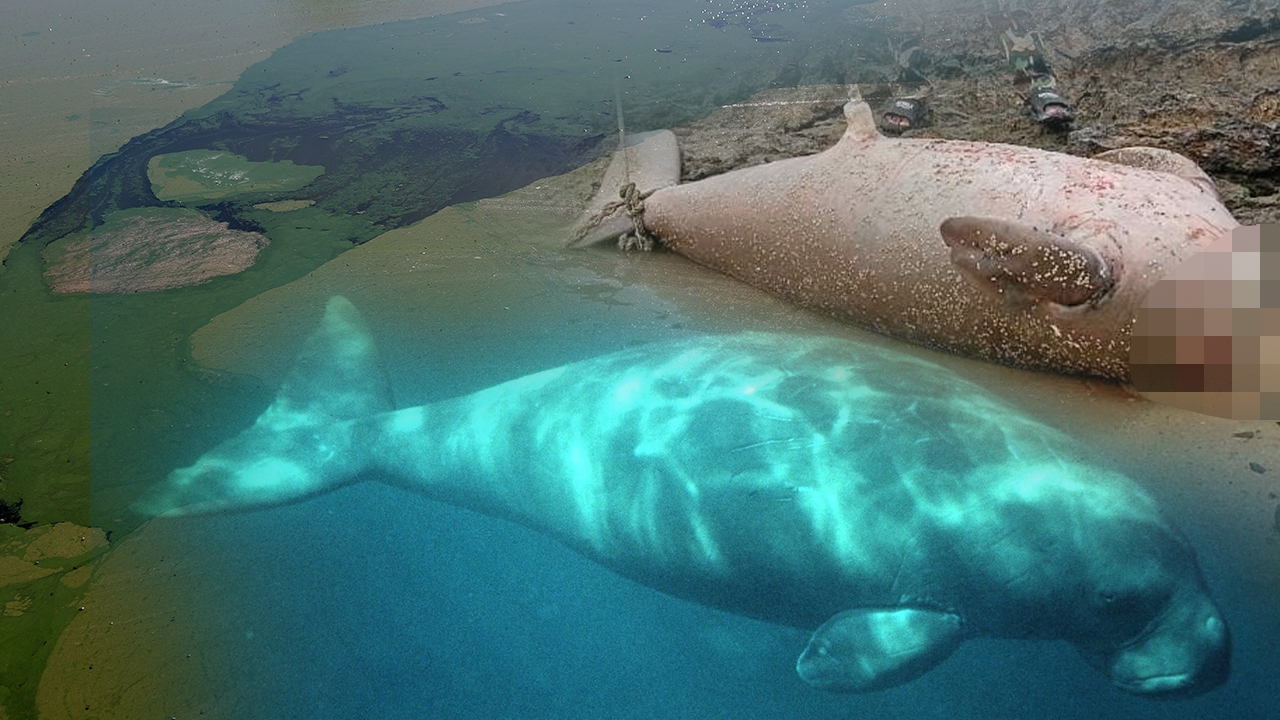
An autopsy reveals the "headless dugong" died from illness before someone cut off its head to take the tusks. A marine expert suspects two types of toxic algae may be responsible after pollution and global warming caused heavy blooms overtaking seagrass areas.
The tragic case on 9 Apr 2026 occurred when the Upper Andaman Marine and Coastal Resources Research Center found the carcass of a dugong stranded on a beach on Koh Yao Noi, Phang Nga Province. It was missing its head, with a rope tied around its tail to weigh the body down on underwater rocks. The nose part was cut off and left in the sea, raising suspicions that someone removed the skull and tusks as talismans based on superstitions.
However, laterthe autopsy resultsshowed the dugong had intestinal illness and could not eat. It was a fully grown male, 2.20 meters long excluding the head, weighing approximately 120 kilograms.
The veterinarian at the Siritharn Rare Marine Animal Rescue Center summarized the autopsy report, estimating the dugong died stranded before its head was cut off, as there were no bruises or blood congestion in the tissue. They believe the head was removed 2 to 24 hours after death since the cut edges were still sharp and not decomposed. It was not a case of hunting for the head, as there was no muscle breakdown or water in the respiratory tract, indicating the animal did not drown before dying.
It is assumed the person who cut the head was highly skilled, as the head was cleanly severed at the neck joint. The cut marks were sharp, suggesting the tool was long enough to cut a large head. There were also wounds on both sides of the chest, likely from using a hard object to hold the body steady for easier cutting. Authorities are urgently searching for the culprit to prosecute under the law.

Dr. Kongkiat Kittiwattanawong a marine and coastal ecosystem resource and environment research specialist at the Department of Marine and Coastal Resources (DMCR) and a long-time dugong conservation researcher, told Thairath Online’s special news team that the autopsy finding of an empty stomach and intestinal illness is currently under further disease investigation. Tissue samples have been sent for testing to determine if bacteria or specific toxins caused the illness.
There is suspicion that this may be linked to the seagrass —the dugong’s main natural food—declining, alongside an increase of blue-green algae blooms in the area, which may be toxic. Usually, an empty stomach in dugongs indicates they have been sick for over seven days. However, the mouth showed no physical signs preventing eating, so the focus is on natural toxins that might cause the dugong to stop eating and eventually die. This is still under study to confirm if there is a direct link to dugong illness.

Dr. Kongkiat further explained that two groups of toxic algae are suspected. The first is blue-green algae (cyanobacteria), which produce microcystins—potent liver toxins—and saxitoxins, which affect the nervous system. The second group is diatoms (single-celled algae), some of which produce domoic acid, a neurotoxin. Research on these issues in Thailand remains limited.
“All these factors require investigation to establish a connection between the toxins and this dugong case, which is currently only a hypothesis as the cause of illness leading to loss of appetite,” he said.
Dr. Kongkiat said these algae blooms result from increased nutrients, such as those from household wastewater flowing into natural waters, rising temperatures, and the disappearance of seagrass, which allows algae to grow in their place.
“To solve the algae problem, seagrass must be restored or increased in the area. Additionally, managing pollution and controlling wastewater will help mitigate the issue,” he added.

Over the past two years since 2024, seagrass degradation and loss have forced dugongs to migrate due to lack of food. Recently, there are signs of recovery though not yet complete. The Department of Marine and Coastal Resources is working to protect natural seagrass beds and accelerate restoration by enclosing areas to help balance the ecosystem sooner.
Meanwhile, new food sources have increased, encouraging dugongs to return to former habitats. In 2024, about a dozen dugongs were found in Trang Province; in 2025, approximately 50; and this year the latest survey shows over 70, including more mother-calf pairs, a positive trend. However, this recent dugong death highlights ongoing environmental threats needing further study.
Dr. Kongkiat pointed out that although this may be a natural illness, monitoring the frequency of such cases is important. If this is an isolated incident, it may not be concerning, but if cases increase, it could become a serious problem.

Dr. Kongkiat believes the removal of the dugong's nose left in the area was to remove excess parts of the skull so the perpetrator could more easily transport the head and later separate the tusks. However, he noted that hunting dugongs has greatly declined compared to before, when hunting accounted for more than 20-30% of deaths. Now, most cases involve scavenging carcasses and violating remains, as evidenced by actions taken after the dugong was already dead.
The problem is that although suspects have been identified, there is rarely concrete evidence to prosecute, such as catching them red-handed, which is very difficult. He suggests focusing on social processes, engaging younger generations and descendants to work on changing beliefs, which could be more effective in addressing the issue.