

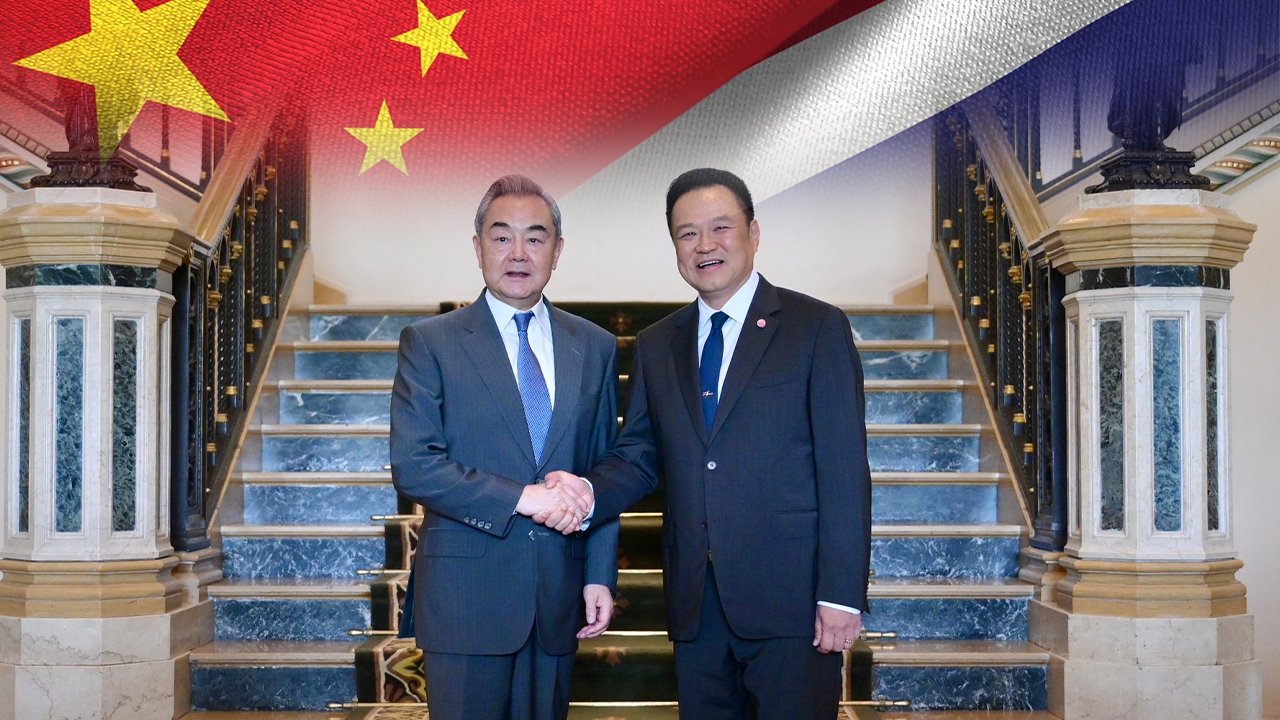
Decoding Wang Yi's visit to Thailand to quell border conflicts. Scholars warn that while two perspectives help pressure Cambodia, they remain untrustworthy. The ASEAN tour is seen as aimed at safeguarding interests, emphasizing China's influence balancing U.S. power rather than being fully reliable in intentions.
Today (24 Apr 2026) at 11:00 a.m., in the VIP room on the 2nd floor of the Thai Khu Fah Building, Government House. Mr. Wang Yi Member of the Political Bureau, Director of the Office of the Central Committee for Foreign Affairs of the Communist Party of China, and Minister of Foreign Affairs of the People's Republic of China, paid a courtesy visit to Prime Minister and Minister of Interior Anutin Charnvirakul during his visit to Thailand.
The spokesperson for the Prime Minister's Office revealed that during this occasion, both sides discussed key issues including elevating Thailand-China relations to a deeper strategic partnership, promoting the formulation of a "Joint Action Plan" aligned with both countries' development strategies, exchanging high-level visits, with China inviting the Prime Minister to attend the APEC Leaders' Meeting hosted by China in November 2026 and an official visit to China. Meanwhile, Thailand invited Premier Li Qiang to visit Thailand, which China has agreed to in principle and is arranging the schedule.

Regarding the Thailand-Cambodia situation, Wang Yi observed that relations between Thailand and Cambodia are trending positively and hopes for good developments soon. Thailand emphasized the importance of promoting mutual understanding and cooperation, enhancing security collaboration especially in combating transnational crime and scam gangs, and finally, advancing concrete cooperation through joint mechanisms and activities. Both sides agreed to develop cooperation beyond policy into practical action through cooperation mechanisms, meetings, and joint activities at various levels to achieve tangible and sustainable results.
This visit by the Chinese Foreign Minister covers three ASEAN countries: Cambodia, Thailand, and Myanmar from 22-26 Apr 2026, raising questions about whether China aims to push certain agendas or harbors hidden motives, especially as the world faces repercussions from the conflicts involving the U.S., Israel, and Iran.

Thairath Online's special news team discussed this issue with Assoc. Prof. Dr. Dulyapak Preecharatch, Faculty of Liberal Arts, Thammasat University. He views that Wang Yi's visit at this time reflects China's desire to maintain its role, influence, trade, and investment in the ASEAN region, including economic corridors and China's strategic initiatives connecting Cambodia, Thailand, and Myanmar. Previously, China had also visited Vietnam, and Laos which already has strong, longstanding relations with China. Secondly, there is a bilateral mechanism where China and Cambodia already hold meetings as part of a
"2+2 Strategy" covering defense and foreign affairs. Having met with Cambodia, China also took the opportunity to act as a mediator to ease conflicts between Thailand and Cambodia, while also respecting Thailand's interests. "After visiting Cambodia, Wang Yi came to Thailand to reaffirm China's role as a mediator and peacebuilder above the Thai-Cambodian conflict. It is believed China may pressure Cambodia not to provoke Thailand. While deeper details remain unknown, the trend suggests positive developments for peace."
Finally, this visit serves as a balance against the other superpower, the
"United States," especially as the Phnom Penh government has increased diplomatic engagement with the U.S. over the past year. Even in "Sihanoukville," where China has made massive investments, the port allows U.S. naval and cargo ships to dock, prompting China to maintain this power balance for future considerations. Regarding the Chinese Foreign Minister's stance, it appears positive. Looking back to last year when the

"Kuala Lumpur Declaration" was signed to settle the Thai-Cambodian conflict, witnessed by then U.S. President Trump, Thai Deputy Prime Minister and Foreign Minister Sihasak Phuangketkeaw and Cambodian Deputy Prime Minister and Foreign Minister Prak Sokhonn also visited China to engage China as a mediator between Thailand and Cambodia. "Wang Yi's intent from China's perspective is first to play a peace role and gain recognition of this role regionally. Second, China prioritizes its interests under the southbound strategy, penetrating the ASEAN market with significant investments. If Thailand and Cambodia's conflicts escalate or Myanmar's civil war continues, it would harm China's overall interests. Thus, this visit spreads diplomacy across three countries to ensure and protect China's influence in the region."
How China's visit affects the Thai-Cambodian border.
Positively, China may pressure Cambodia not to provoke Thailand. Regarding some military equipment Cambodia has yet to pay China for, Thailand could use this opportunity to persuade China not to transfer military codes or technology until payments are made, helping to block threats from Cambodia. However, Thailand should remain cautious because China supplies weapons and strengthens Cambodia, while Thailand does not have a clear strategic partnership with China, unlike China's intense bilateral ties with Cambodia in security and foreign affairs, possibly including other forms of assistance.
"We cannot trust China 100%. We might trust them to some extent but must also protect ourselves and engage other countries to build leverage for Thailand."
Combating scammers and enhancing cooperation.

"Chinese scams," which was one of the discussion points this time. Assoc. Prof. Dr. Dulyapak points out that combating Chinese scams is a main agenda for the Chinese government, primarily handled by the Ministry of Public Security responsible for cyber and transnational crimes. The Ministry of Foreign Affairs, led by Wang Yi, also has a role but is less central.
Therefore, this visit likely aims to promote overall international relations and possibly boost trade, investment, and diplomacy to strengthen China's role in balancing the U.S., alongside talks on transnational crime, though detailed discussions probably occur in meetings with relevant ministries and agencies.
Regarding whether Thailand can leverage this visit to promote other issues, especially trade and investment, Assoc. Prof. Dr. Dulyapak notes that Thailand and China have had an FTA for a long time. Thailand seeks to export agricultural products to China, requiring key deals driven by the Ministry of Commerce and others to increase Thai products in the Chinese market. However, China is also a competitor in some agricultural goods, producing certain products more cheaply and exporting them back to Thailand.
"The expectation is for brighter trade prospects, but while expanding into the Chinese market, Thailand must also find ways to protect its own markets."