

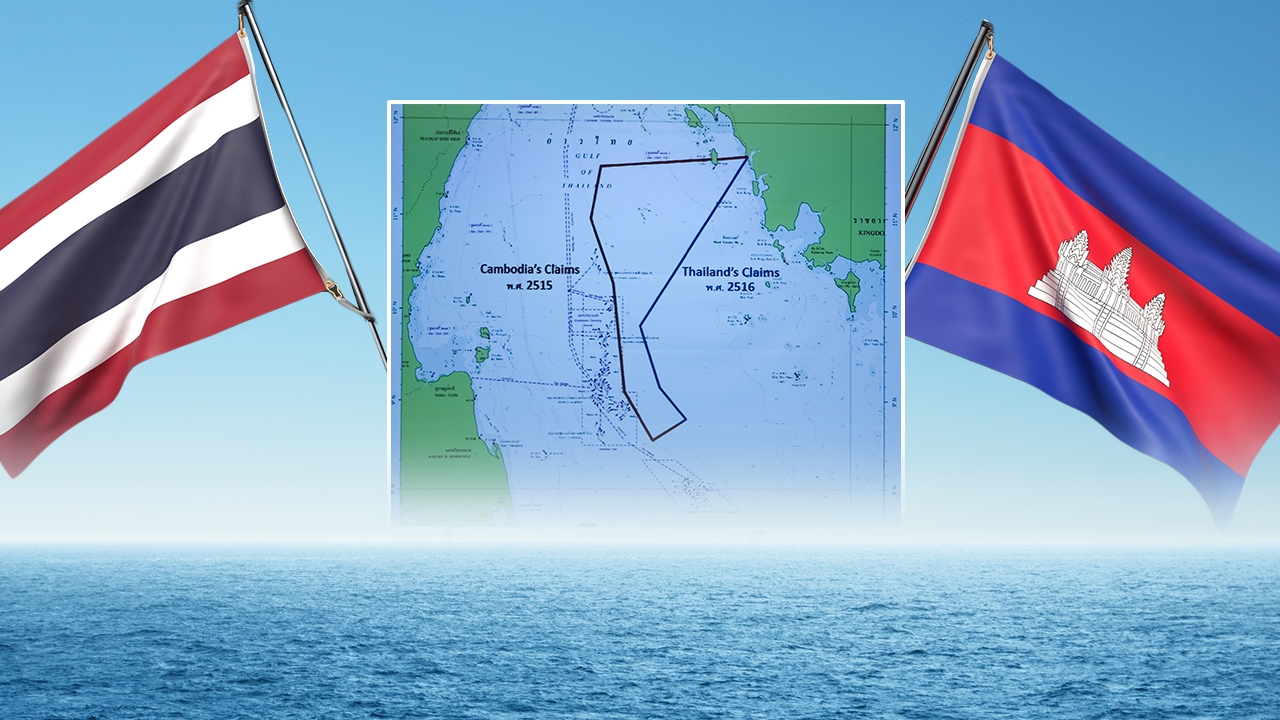
Analyzing Cambodia's strategy of using the UNCLOS compulsory conciliation mechanism to bring Thailand onto the global stage following Thailand's withdrawal from MOU44: is this beneficial or a strategic trap? Legal experts predict a swift conclusion but find the results difficult to assess.
On 23 April, the National Security Council (NSC) meeting resolved to withdraw from MOU44. Following government policy, the reason cited was that over more than 20 years there had been only five negotiations without a beneficial conclusion for either country. On the contrary, it caused maritime boundary disputes, leading to conflict and no path for joint development or resource management.
Yesterday (5 May), Samdech Hun Manet, Prime Minister of Cambodia, posted on Facebook regarding Thailand's unilateral withdrawal from MOU44, stating that Cambodia had no choice but to rely on international law and the United Nations Convention on the Law of the Sea (UNCLOS), especially the mechanism of “compulsory conciliation.” Under this convention,
most recently today (6 May), Anutin Charnvirakul, Deputy Prime Minister and Minister of Interior, responded to whether this was a positive development, saying that at least both countries will now operate under the same rules. Previously, they were using different standards. Since Thailand no longer has MOU2544, any future talks will require new rules to be established. There is still time for discussions, and the Ministry of Foreign Affairs is responsible for this matter.
Thairath Online special news team discussed this issue with Associate Professor Dr. Krisadakorn Wongwutikul, an expert in maritime law from the Faculty of Law, Thammasat University, regarding the next steps for Thailand and Cambodia, and whether using UNCLOS mechanisms will benefit or disadvantage Thailand compared to MOU44.

MOU44, or the Memorandum of Understanding between the Governments of the Kingdom of Thailand and the Kingdom of Cambodia concerning overlapping continental shelf claims (signed 18 June 2001),the Ministry of Foreign Affairs explains that it was a temporary agreement to resolve overlapping continental shelf claims by establishing a "Joint Technical Committee" (JTC) to negotiate based on international law. Negotiations were divided into two areas:1. The northern area (above latitude 11 degrees north): to negotiate
"maritime boundary delimitation" clearly. 2. The southern area (below latitude 11 degrees north): to negotiate the creation of a
"Joint Development Area" (JDA) to jointly utilize petroleum resources. The key principle was
“to negotiate both issues concurrently and inseparably.” Meaning if the parties cannot agree on sharing oil benefits, the boundary line won't be settled; likewise, if the boundary line is unresolved, oil extraction cannot proceed. MOU2544 was only a negotiation framework. If the committee reaches agreement, the final result must be formalized into a "treaty" approved by Thailand's parliament under the constitution to be legally binding. UNCLOS mechanisms Thailand cannot refuse,
Compulsory Conciliation is a dispute resolution method codified in Annex V of the 1982 United Nations Convention on the Law of the Sea (UNCLOS 1982), conducted by a "Conciliation Commission" consisting of five members: each disputing state appoints two members, and they jointly select a chairman from a pre-existing list of maritime law experts, within 3–4 months. This mechanism allows either disputing party to unilaterally initiate the process, requiring the other party's cooperation. In this case, Cambodia has the right to begin conciliation immediately, and Thailand must participate.
If Thailand refuses this mechanism or third-party involvement, it must argue that the Conciliation Commission lacks jurisdiction. There are conditions for this; if the commission is found to lack jurisdiction, Thailand and Cambodia would return to bilateral negotiations.
However, if Thailand accepts this mechanism or the commission rules it has jurisdiction, proceedings similar to a court occur, including evidence hearing, document review, site visits, legal argument hearing, and must complete the report within 12 months. Such dispute resolution is non-binding, unlike court judgments.
Thus, when the commission issues recommendations, Thailand or Cambodia may accept or reject them. If both parties agree, it forms a basis for further negotiation.
This mechanism has been successfully used once before, in the dispute between Timor-Leste and Australia, where the commission ruled it had jurisdiction despite a treaty stating disputes must be resolved by negotiation only.

In simple terms, the Conciliation Commission tends to rule it has jurisdiction, even if the parties intend to resolve disputes normally or through negotiation. For Timor-Leste and Australia, the commission delineated maritime boundaries and recommended benefit-sharing methods. Both countries negotiated based on these recommendations and ultimately concluded a maritime boundary treaty. UNCLOS 1982: Does Thailand gain or lose compared to MOU44?
Regarding concerns whether UNCLOS mediation benefits or disadvantages Thailand compared to MOU44, Associate Professor Dr. Krisadakorn said
it is difficult to assess.
At the same time, this mediation mechanism has the advantage of a clear 12-month deadline and differs from courts or arbitration by considering factors beyond legal provisions, such as historical evidence, political and geographical factors. “We cannot predict the final maritime boundary; it may differ from current claims by Thailand or Cambodia. Maritime law uses Maritime Delimitation principles focusing on equity—not equal division—but considering factors like coastline length, proportionality, and presence of islands along the coast.” Moreover, the Conciliation Commission can create special procedures; for example, if Thailand and Cambodia lack trust, a "Confidence Building" mechanism employs diplomatic techniques to restore relations before talks resume.
If the commission issues recommendations accepted by both countries leading to successful negotiations, a treaty will be created to delineate borders, maritime areas, continental shelf, and exclusive economic zones.
Regarding resource use, this differs from the "Joint Development Area" in MOU44, which involves joint development and profit sharing without a fixed timeframe. This could become a long-term cooperation, similar to Thailand-Malaysia. Once boundaries are clear, each country can exploit resources within its own territory.
Possibility of International Court if Mediation Fails,
If the Conciliation Commission issues recommendations but Thailand or Cambodia reject them, could the dispute proceed to the International Court of Justice, the International Tribunal for the Law of the Sea, or arbitration?
Associate Professor Dr. Krisadakorn said this is unlikely. UNCLOS requires each party upon joining to choose dispute resolution methods, and both Thailand and Cambodia have reserved the right not to use courts or arbitration.

This stems from the belief that boundary issues are sensitive and best understood and protected by the countries themselves, so third parties are undesired. However,
“compulsory conciliation” is binding in name; if either party raises an issue, UNCLOS prevents states from interpreting laws arbitrarily. “UNCLOS aims to protect its system by allowing a mechanism even if courts or arbitration lack jurisdiction—this is the Conciliation Commission.”
Cambodia’s Preparations? Responding to Thailand’s MOU44 Withdrawal,
Associate Professor Dr. Krisadakorn sees Thailand’s withdrawal from MOU44 and use of UNCLOS mechanisms as perhaps not the best dispute resolution path, since negotiation would be preferable. Yet, political conditions currently prevent further dialogue, and many want the dispute resolved rather than endlessly prolonged. At the same time, Cambodia may have sought UNCLOS procedures, anticipating Thailand’s internal pressure to cancel MOU44, as Cambodia ratified UNCLOS only recently in January, despite joining in 1983. “We must assess whether ending the dispute quickly without bilateral talks benefits the country more. We also cannot expect the boundary line Thailand claims to be upheld by the commission. Public perception and confidence in the dispute resolution process differ from legal issues and require government management.”
