

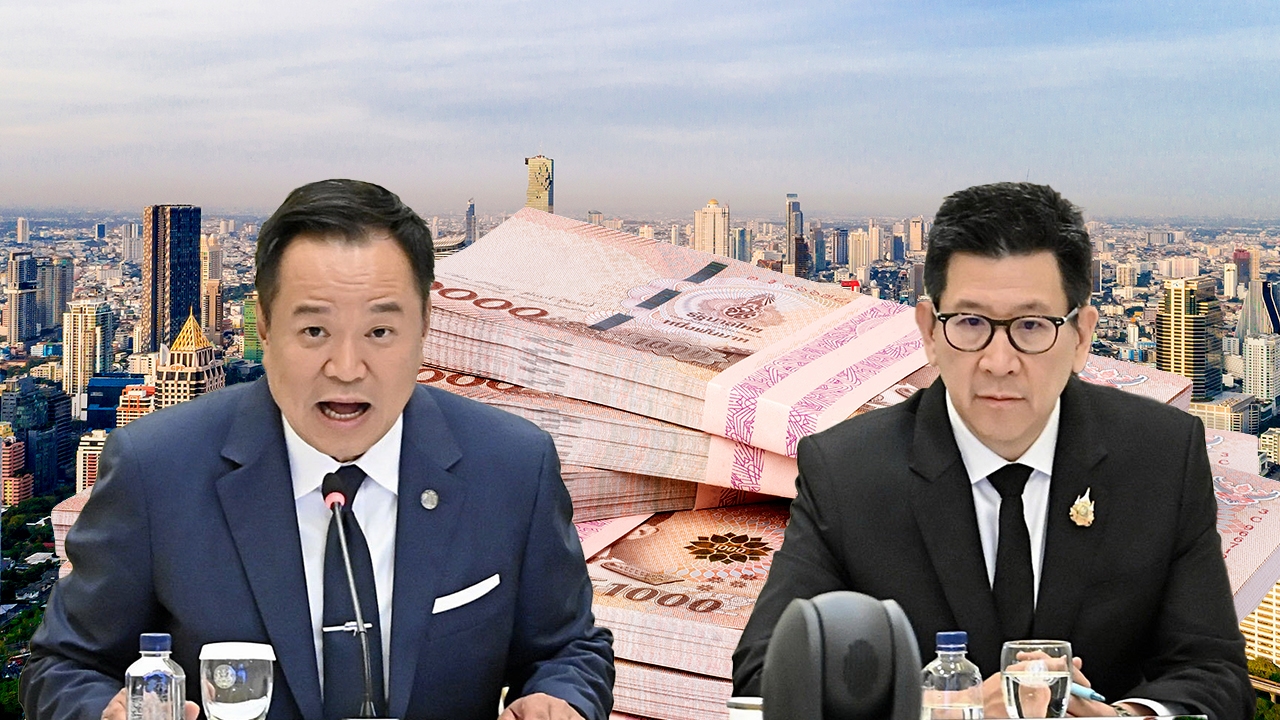
Analyzing the value of the "400 billion baht loan" helping Thailand overcome the debt ceiling crisis. Economists view the results as disproportionate and warn of a dead end if a new economic storm hits, suggesting that focusing on necessities could cut the budget by over half.
On 5 May 2026, the Cabinet approved a draft “400 Billion Baht Loan Decree” or the Royal Decree granting the Ministry of Finance authority to borrow 400 billion baht to address the energy crisis and facilitate the country's energy transition, ensuring economic and energy security amid Middle East conflicts. The funds will be allocated to two main plans:
1. Providing assistance to ease the financial burden on the public, farmers, and businesses with 200 billion baht. Examples include the “Thai Chua Thai Plus” project assisting 30 million people with 1,000 baht monthly for 4 months, operating similarly to the half-half scheme but with the state covering 60% and citizens 40%, plus topping up state welfare cards, reducing electricity costs for the first 200 units to no more than 3 baht, and support for farmers and SMEs.
2. Restructuring Thailand's energy sector with 200 billion baht. Transitioning from fossil fuels to renewable and alternative energy to reduce foreign energy dependence, supporting electric vehicles, and developing human resources.
Deputy Prime Minister and Finance Minister Anek Niti Prasertpracha said the loan decree will help stabilize the short-term economy, and energy restructuring will lower costs for businesses and households, enhance energy security, and attract investment, thus solving structural problems while alleviating public hardship.
The government's 400 billion baht loan will focus on short-term domestic borrowing, gradually drawn as approved projects proceed.
The next steps include publication in the Royal Gazette and presentation to Parliament on 14 May 2026, aiming to complete project approvals by 30 September 2026 and loan disbursement by 30 September 2027.

The government revealed that as of the end of February 2026, outstanding public debt totaled 12,595,731 million baht, or 66.09% of GDP. The loan decree will raise public debt to 68.18% of GDP by the end of 2026 and approximately 69.88% by the end of fiscal year 2027, still within the 70% debt management framework.
Previously, the Finance Minister told foreign media during the IMF-World Bank Spring Meetings 2026 in Washington, D.C. (13-18 April 2026) that Thailand is ready to raise the debt ceiling from 70% of GDP if necessary, with projections of a possible increase to 75%.
On 7 May, Bank of Thailand Governor Vithai Ratanakorn stated that the 400 billion baht loan decree is expected to stimulate economic growth by 0.6% resulting in overall economic growth of 2.1% this year. Previously, with a 300 billion baht loan, growth was projected at 1.5%. For 2027, growth is expected at 1.6%, down from an earlier 2% forecast due to this year's higher base.
Inflation is expected at 3.0-3.1% this year, up from a previous 2.9%, and 1.4% next year, slightly down from 1.5%. April 2026 inflation was 2.89%, consistent with BOT forecasts of occasional rises to 4-5% before easing in Q2 2027.

Thairath Online Special Report Team Interviewing Dr. Nanarit Pisalyabut Economist and Senior Researcher at the Thailand Development Research Institute (TDRI), discussing the economic impact of the large 400 billion baht loan, its benefits and concerns, and the future burden as public debt nears the ceiling.
Dr. Nanarit points out that the loan targets two main goals: mitigating impact and stimulating the economy, and energy restructuring. Theoretically, during crises, support for vulnerable groups or stimulating growth below potential GDP—forecasted at 1.6% for 2026 versus a 2.7% potential—is justified, as is investing in energy restructuring as a long-term necessity.
. . . However, although the intent aligns with theory, practical weaknesses exist. Dr. Nanarit suggests borrowing only what is necessary and using funds precisely, potentially cutting the loan by more than half
if budget efficiency improves. First, on impact mitigation, the vulnerable groups and others the government aids may be overly broad.
Regarding the definition of “vulnerable groups,” this should mean the poor who, without government support during crises, would suffer severely and lose their dignity. The National Economic and Social Development Council recently estimated 3.4 million such people, while state welfare cardholders number over 13 million.
Additionally, subsidies to farmers, SMEs possibly numbering millions, and electricity cost interventions for 23 million households using under 200 units exist.
“While these groups are affected, some can manage independently, so this budget use lacks efficiency and could be significantly reduced.”
Second, economic stimulation, such as the Thai Chua Thai Plus program, though theoretically suitable when growth is below potential, differs now as crises occur nearly annually since COVID-19, including floods, the Trump tax, and the Iran war, raising fiscal risks from textbook stimulus approaches.
“Textbook approaches assume crises end after government support, allowing economic and fiscal recovery over a decade. Currently, crises are continuous. Stimulating as per theory risks high debt nearing the 70% ceiling.”
Dr. Nanarit suggests focusing aid on genuinely needy individuals using digital or AI tools for screening. Economic stimulus may be unnecessary or minimal.

Third, energy restructuring, is necessary as the global future direction, but requires maximizing efficiency, such as verifying benefits from solar subsidies—whether citizens or large businesses profit and if citizens can sell electricity back to the state.
Also, businesses capable of adopting clean energy themselves or benefiting via lower electricity costs and reduced carbon emissions, improving trade, may not need government subsidies.
“The state should invest in infrastructure essential for clean energy transition that private sectors cannot provide, but not subsidize all projects merely labeled 'green.'”
Regarding the Thai Chua Thai Plus stimulus, Dr. Nanarit notes most participants, though impacted by economic crises, do not qualify as “vulnerable groups.” For effective government intervention, stimulus should encourage investment rather than cash handouts, which, though slower, yield fuller results.
Furthermore, with ongoing crises, there is risk of severe future emergencies requiring higher spending.
An example is the “Half-Half Plus” program at the end of 2025, implemented due to low growth, but months later, the Iran war crisis emerged. Without that program, the government might have had funds to stimulate now. “This clearly shows the need to assess necessity and future crisis risks, as the next 2-3 years are uncertain.” Loan Value Versus Debt Ceiling Burden
Dr. Nanarit reveals that besides the 400 billion baht loan raising public debt, the Iran war also slows economic growth.
Theoretically, debt repayment options are few: cut spending, or if not possible,
increase revenue, such as raising taxes, though politically unpopular and difficult. Another approach the government has suggested is raising the debt ceiling to 75%, which may be the easiest path.

“Raising taxes is harder than expanding the debt ceiling because future taxpayers who bear the debt are not yet born or cannot vote.” Regarding the BOT's 2.1% GDP growth forecast, up from 1.6%, this remains low. Considering Thailand's GDP of about 20 trillion baht, injecting 400 billion baht—at least 200 billion directly, or 2% of GDP—should theoretically boost growth by 2%, not just 0.6%. “GDP growth of only 2.1% suggests the policy is ineffective at stimulating the economy, or perhaps ineffective altogether. Academic consensus indicates economic stimulus has limited impact in the current era.”