

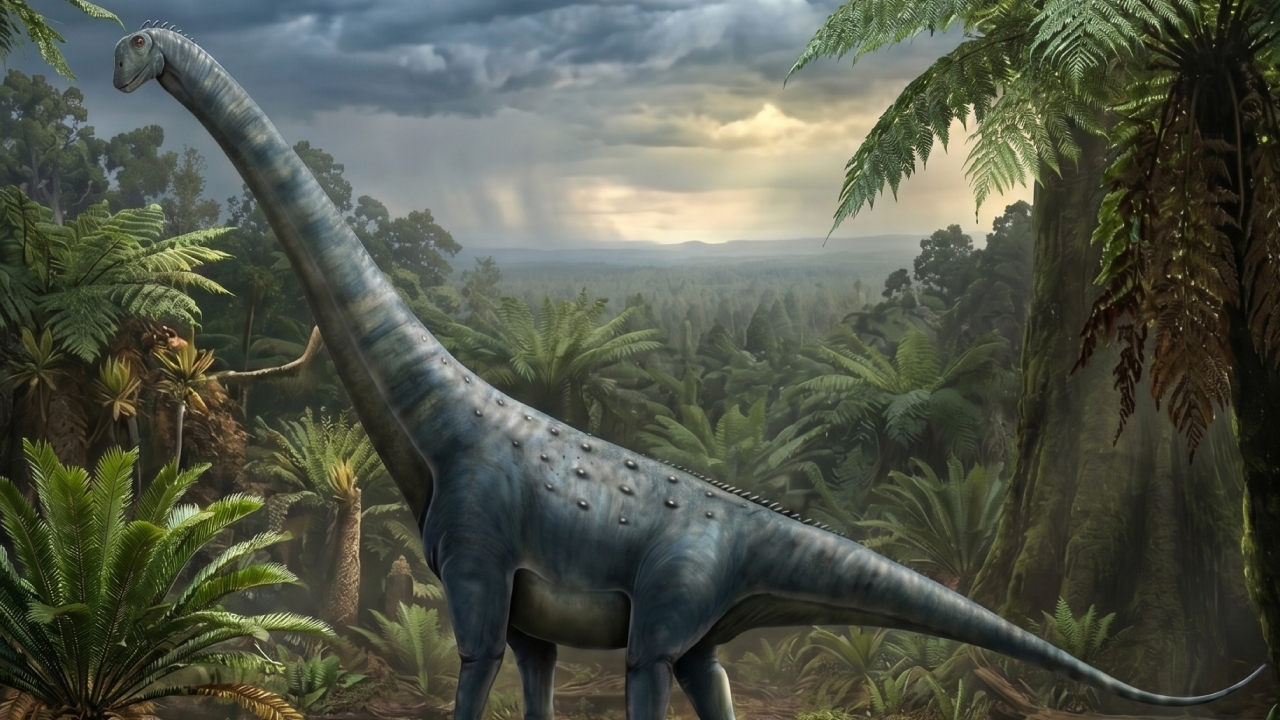
Tracing the journey and getting to know “Naga Titan Chaiyaphumensis,” from a chance discovery to Thailand’s 14th new dinosaur species. This long-necked herbivorous dinosaur measures 27 meters long, weighs 26 tons, and is the largest ever found in the ASEAN region.
When Thailand announced good news about a “dinosaur” a new species, the 14th named, called “Naga Titan Chaiyaphumensis,” which is a long-necked herbivorous dinosaur, a “sauropod,” measuring 27 meters long, weighing 26 tons, the largest ever discovered in Southeast Asia.
“Naga Titan Chaiyaphumensis” is named after the word “Naga,” which means the serpent king in Thai belief, and the word “Titan,” meaning giant, combined with the discovery site in Chaiyaphum Province. It dates back 100-115 million years to the early Cretaceous period.

Mr. Preecha Saithong, Deputy Director-General of the Department of Mineral Resources and spokesperson for the department, told Thairath Online’s special news team that the discovery happened by chance in 2016 when Mr. Thanom Luangnan, a local resident of Ban Phanang Suea, Nong Bua Rawe District, Chaiyaphum Province, was fishing by a public pond owned by the municipality. He stumbled upon a rock resembling the large animal's skeleton parts, which sparked suspicion that it might be dinosaur bones, prompting him to notify the authorities.
According to the Fossil Protection Act of 2008, when someone reports a suspected fossil discovery, the department must investigate and complete the process within seven days. Upon inspection, the bones were confirmed to be dinosaur remains, making headlines at the time. It was found that the bones near the pond had been unearthed over ten years earlier during pond excavation by a backhoe, but were buried under soil at the pond’s edge and unnoticed until Mr. Thanom’s discovery.

The bones were then collected through a process that declared the area a research and study zone. Teams of officials, academics, and researchers collaborated, using scientific extraction methods to separate bones from rock. Many large bones could not be moved for examination, so a temporary laboratory was set up onsite with support from local businesses in Chaiyaphum.
Notable bones included the upper thigh bone of the hind leg, measuring over 200 cm long, and the upper bone of the right front leg, measuring 178 cm. Other bones were similarly large. Over three years, more than 20 bones were recovered, including pelvis, upper hind leg, and ribs. These bone sizes helped estimate the actual dinosaur’s size.
“About 20 bones were found in total. Missing parts may have been carried away by water, eroded, or decomposed. The remaining bones are the hard parts.”
These bones were then compared with existing databases to identify the species. Initially, there was speculation it might be the same as long-necked dinosaurs found in China or Argentina.

“Initially, it was thought to be the same species as those long-necked dinosaurs in China or Argentina. If so, Thailand would have to use the previously discovered names, such as calling it Argentinosaurus from Chaiyaphum Province. But our research team found it didn’t match any known species.”
Upon confirming it was a new species, the research team prepared a report for publication in a scientific journal, undergoing peer review and revisions until acceptance. The finalized report led to the official announcement of the new species.
Next steps include registering the fossil and declaring it national heritage, alongside plans to develop local exhibition spaces.

Thailand first found dinosaur bones in 1976 at Phu Wiang District, Khon Kaen Province, namely “Phuwiangosaurus Sirindhornae,” a long-necked herbivorous sauropod. Since then, more dinosaur and fossil discoveries have followed, culminating in the 14th named species. Paleontology helps us understand Earth’s history.
“Think of it like a jigsaw puzzle. Originally, Earth’s crust was the supercontinent Pangaea where all continents were joined—Africa and South America fit together perfectly. Fossils help confirm if these lands were once connected. Today, tectonic plates move with heat, pressure, subduction, and collisions, separating continents. For example, northeastern Thailand’s plateau formed from land collisions near Phetchabun Province.”
Moreover, fossil discoveries can promote and elevate Thailand in various ways. First, in tourism, by creating learning sites that attract visitors, generate community income, and potentially gain designation as a “UNESCO Global Geopark,” recognized internationally for geological significance, like in Satun and Nakhon Ratchasima provinces.

Second, they contribute knowledge to academics worldwide. In 2022, Thailand hosted the 6th International Paleontology Congress, including field visits to fossil sites, and plans to host the 3rd Asia-Pacific Regional Paleontology Conference in 2027.
“Global and Asian scientific forums often come here because Thailand is a leading fossil discovery site in Asia. Dinosaurs are a highlight, but other fossils like freshwater and marine mollusks and corals also help date rock layers.”
Third, fossils inspire various products, especially local wisdom adaptations like dinosaur-patterned fabric weaving, trilobite batik, and other products generating income for local communities.
Mr. Preecha concluded by saying other dinosaur fossils currently under study may represent Thailand’s 15th or 16th new species. Intensive surveys at Phu Wiang National Park have found sauropod remains possibly larger than Naga Titan. He encourages the Thai public to stay tuned.