

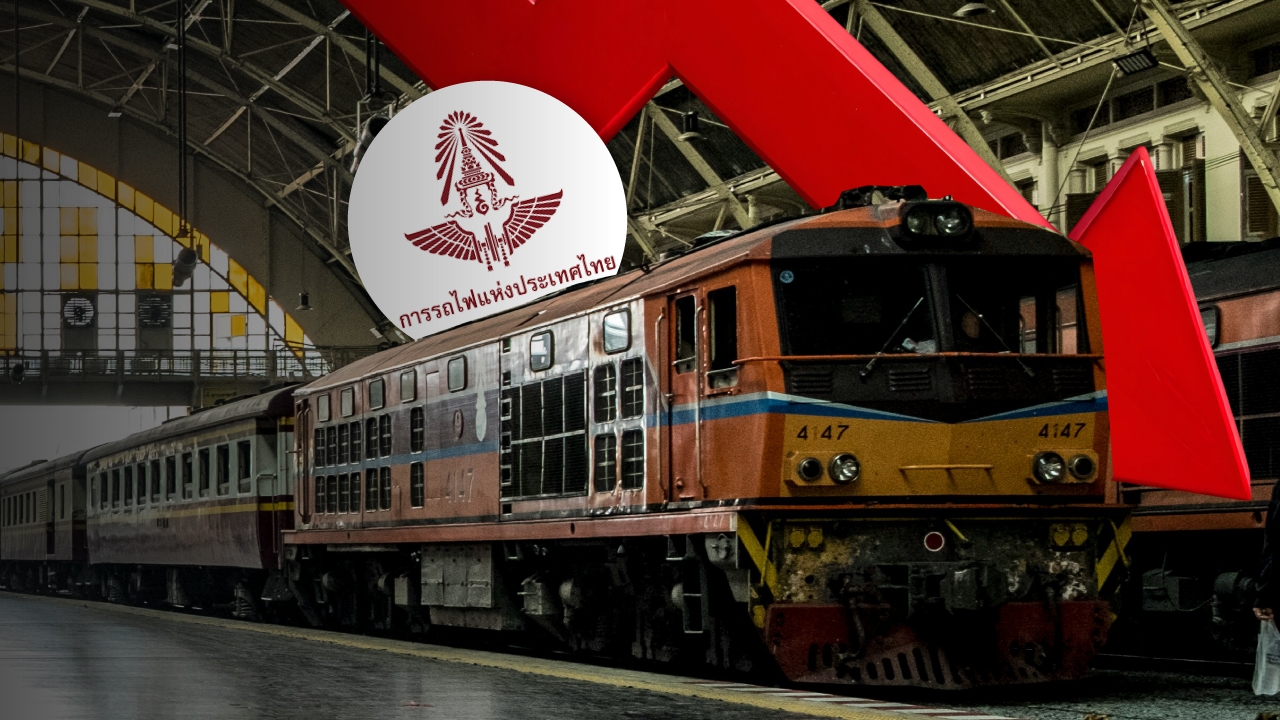
"Thai Railways" faces ongoing accumulated losses and is a state enterprise with very high cumulative deficits. Data from the Ministry of Finance states losses exceed 300 billion baht, excluding annual interest payments of several billion baht.
The main cause of Thai Railways' losses stems from high core operating costs such as fuel expenses, maintenance costs, and personnel expenses.

At the same time, it has been unable to adjust service fares to match actual costs, passenger numbers, and changing travel behaviors. Data from the railway side indicates that accumulated debt also arises from running operations per government policies, under which the government is obligated to compensate for losses according to the State Railway of Thailand Act, B.E. 2494 (1951).
However, since 2009, the railway has not received loss compensation from the government, leading to liquidity problems. Consequently, the railway has had to borrow funds guaranteed by the Ministry of Finance, incurring interest costs of around 4 billion baht annually.

According to reports from auditors and the State Railway's financial statements, expenses over the past three years are as follows:
In 2023, approximately 33,000,000,000 baht.
In 2024, approximately 44,000,000,000 baht.
In 2025, approximately 41,000,000,000 baht.
The four main expense categories identified are:
1. Depreciation and amortization.
2. Employee benefits expenses.
3. Transportation operating expenses.
4. Maintenance expenses for locomotives and rolling stock.

Regarding staffing, the railway currently faces a significant shortage of operational employees, while also incurring high overtime costs.
The Cabinet has yet to implement rules allowing a 5% staff replacement rate of retirees, meaning hiring 5 new employees requires 100 retirements first. Currently, the railway employs 8,300 staff, down from 18,000, resulting in insufficient personnel who must work holidays and overtime.
To adjust staffing levels appropriately for railway operations, a recruitment plan focusing on urgent safety positions over five years (2025–2029) totaling 2,850 positions was submitted to the Ministry of Transport in early October 2025.

For 2025, 1,260 positions.
For 2026, 465 positions.
For 2027, 341 positions.
For 2028, 419 positions.
For 2029, 365 positions.
It is forecasted that by 2029, the railway will have a total workforce of 11,521 employees.
(Data from the State Railway of Thailand)