

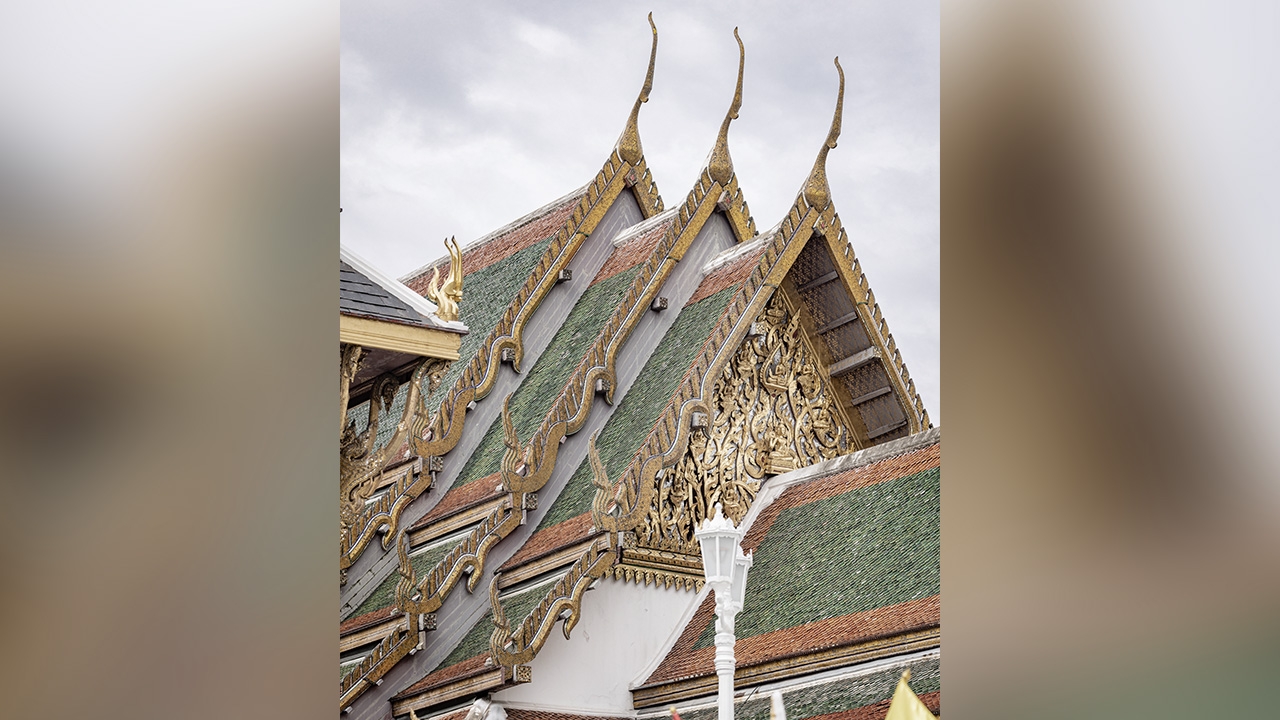
The Bureau of the Royal Household announced royal permission for the public to pay respects to the late Princess Bajrakitiyabha Narendiradebyavati, Krom Luang Rajsarinisiri Phat Mahawachararatchathida, at the Phiman Rattaya Throne Hall after the completion of the 15-day royal merit-making ceremonies, held daily.
Historically, the Phiman Rattaya Throne Hall is located to the south of the Dusit Maha Prasat Throne Hall and connected by the Muk Kasan corridor. King Rama I (Buddha Yodfa Chulaloke the Great) ordered its construction simultaneously with the Dusit Maha Prasat Throne Hall.
Phiman Rattaya is a white-painted brick and mortar throne hall, elevated on a high base, with pillars supporting the roof all around. It connects to Dusit Maha Prasat via a long hall called "Muk Kasan," stretching southward. The throne hall features three-sided balconies on the east, west, and south sides, surrounded by columns. Its three-tiered Thai-style roof is tiled with glazed tiles and adorned with chofahs, bai raka, and hang hong decorations. The pediment is carved with the image of Brahma riding a swan. The door arches are decorated with glass-inlaid gold leaf in floral and traditional Thai patterns.
The origin of Phiman Rattaya dates back to a significant event in King Rama I's reign in 1789 CE (year 2332 BE), when lightning struck the front facade of the Amarinthraphisek Maha Prasat Throne Hall, causing a fire that severely damaged the roof, upper structures, and the left side of the palace.
Following the fire, King Rama I graciously ordered the demolition of the damaged structures and the reconstruction of the royal palace. He did not replicate the original design entirely but adjusted some architectural elements. He also commissioned the construction of a new throne hall behind the main palace and named it "Phiman Rattaya."
The Royal Chronicles of the Rattanakosin Era, during Rama I's reign, record: "The previous palace was as grand as the Sanphet Maha Prasat of the old capital, with longer front and rear halls than the side halls, and the rear hall extended inside to the left and right walls. The new palace was built forward, with four halls equal in size and height to the Suriya Amarin Throne Hall of the old capital, with the four main corners raised and adorned with Garuda figures replacing previous decorations. An inner rear hall was added, matching the old palace's dimensions, and was named Phiman Rattaya. The left wall was rebuilt as before. The roofs of the palace, halls, and Phiman Rattaya were covered with tin, as before. Upon completion of the lacquer and gold leaf work, the new palace was named Dusit Maha Prasat."
For over two centuries, Phiman Rattaya Throne Hall has played an important role in royal ceremonies and traditions of the Thai court. It was once used as the king's residence when residing at the royal palace complex; King Rama III stayed there for up to a year during palace renovations.

Later, during the reign of King Rama VI (Vajiravudh), the hall was used as a gathering place for the royal family and inner court officials to receive ranks and royal decorations.
After the passing of King Rama VIII (Ananda Mahidol), his royal cremation ceremony was held at Phiman Rattaya Throne Hall. Since then, it has been used continuously for royal bathing ceremonies and for lying in state of kings and royal family members.
Despite its longstanding role in royal funerary rites, Phiman Rattaya had never before been used as the site to enshrine the body of any royal family member.
However, during the funeral rites of Princess Bajrakitiyabha Narendiradebyavati, Krom Luang Rajsarinisiri Phat Mahawachararatchathida, her body was enshrined at Phiman Rattaya after the royal bathing ceremony. This marked the first time in the hall's history it served as the enshrinement site for a royal family member, representing a significant chapter in both the history of the Thai royal court and the Phiman Rattaya Throne Hall.