

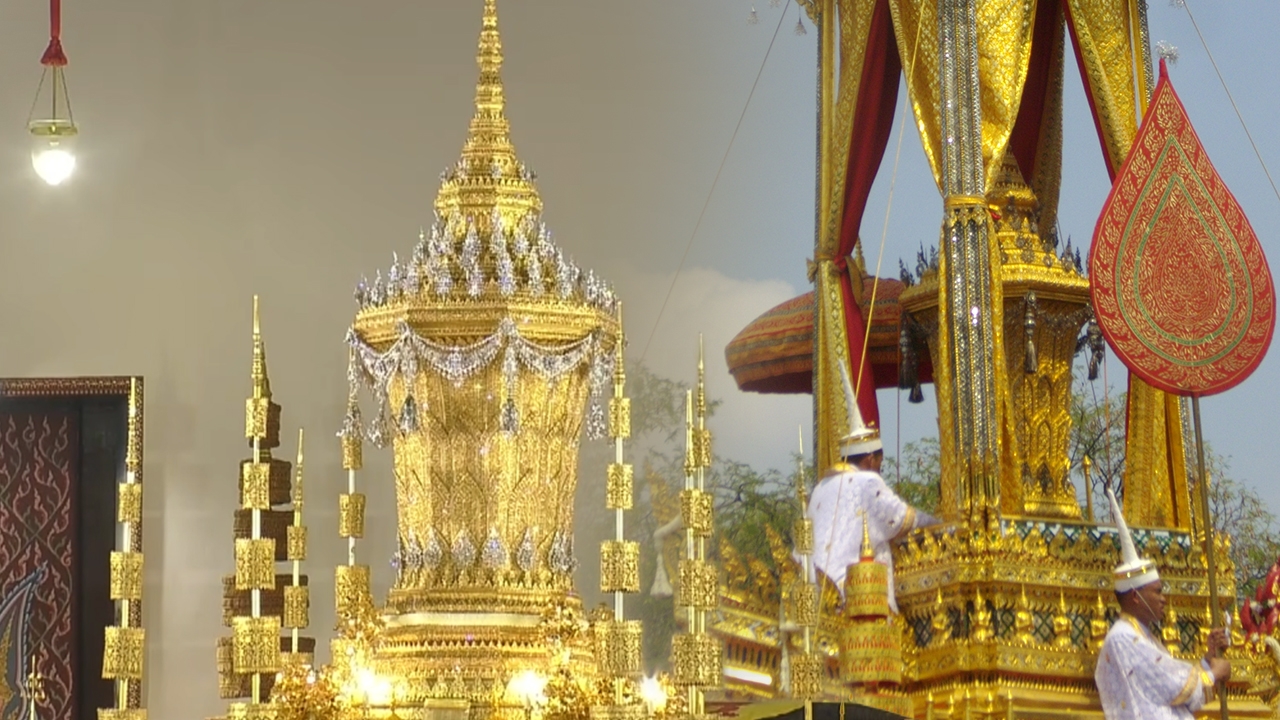
The Great Golden Funeral Urn, part of the royal regalia for over 200 years, is not merely a high art masterpiece but also a symbol reflecting deep love and mourning. It represents the ultimate tribute at the final stage of life of Her Royal Highness Princess Bajrakitiyabha Narendiradebyavati, Princess Rajasarinisiri Patcharamahawatcharathida.
A royal decree was issued to establish honors for Her Royal Highness Princess Bajrakitiyabha Narendiradebyavati, Princess Rajasarinisiri Patcharamahawatcharathida. The King graciously commanded officials to arrange a seven-tiered canopy around the funeral urn as a royal honor to be publicly recognized henceforth. The announcement was made on 13 June 2026, the 11th year of the current reign.
Moreover, His Majesty graciously bestowed the "Great Golden Funeral Urn of King Rama IX" for the royal coffin, along with granting the seven-tiered white royal umbrella (Chada) to shield the urn.

The Great Golden Funeral Urn is part of the highest royal regalia and honors of Thailand, with a history spanning over 200 years. Currently, there are three such urns preserved to continue this sacred royal tradition and to confer the highest royal honors. Each urn has its own historical background as follows.
Creation began by preparing raw materials intended for His Majesty's own funeral urn.
First use: In that year, His Royal Highness Princess Krom Luang Sri Sunthon Thep (a royal daughter) passed away first. Out of profound love and mourning, King Rama I commanded that this urn be used to house her coffin initially. This established an ancient royal tradition whereby the Great Golden Funeral Urn could be specially granted for the funerals of other high-ranking royals.

Creation: During the reign of King Rama V, as the original urn from King Rama I had deteriorated from long use, King Chulalongkorn graciously ordered Prince Praditworakan to redesign and reconstruct a new urn in 1900 CE.
Distinctive features: To uphold royal tradition, it was named "Great Golden Funeral Urn of King Rama V." The urn bears various elements reflecting English craftsmanship, such as lotus petal patterns around the urn resembling a sheath with artistic motifs. It exemplifies the exquisite and refined artistry of that era.

Creation: During the reign of His Majesty King Bhumibol Adulyadej the Great (Rama IX), the urns from King Rama I and King Rama V had severely deteriorated after long use. His Majesty graciously ordered the creation of a new Great Golden Funeral Urn between 1999 and 2000 CE.
First use: It was first used to enshrine the coffin of Her Royal Highness Princess Galyani Vadhana, Princess of Naradhiwas Rajanagarindra, at Dusit Maha Prasat Throne Hall.
Artistic features: This urn maintains the traditional octagonal shape with a rice sheaf-shaped tier as per ancient royal custom but possesses a unique and striking identity. It is intricately carved with detailed floral and leaf patterns on its sheath, representing a masterful fine art piece that reflects the preservation and expertise of contemporary royal artisans.
Although the three Great Golden Funeral Urns were created in different eras with varying artistic details, they share an invaluable emotional significance.
The Great Golden Funeral Urn is not merely a high art masterpiece but a symbol reflecting profound love, mourning, and the highest royal honor at life's final moment. The continuity and transmission of this sacred royal tradition inscribe the nation's deep bonds and mourning for posterity.