

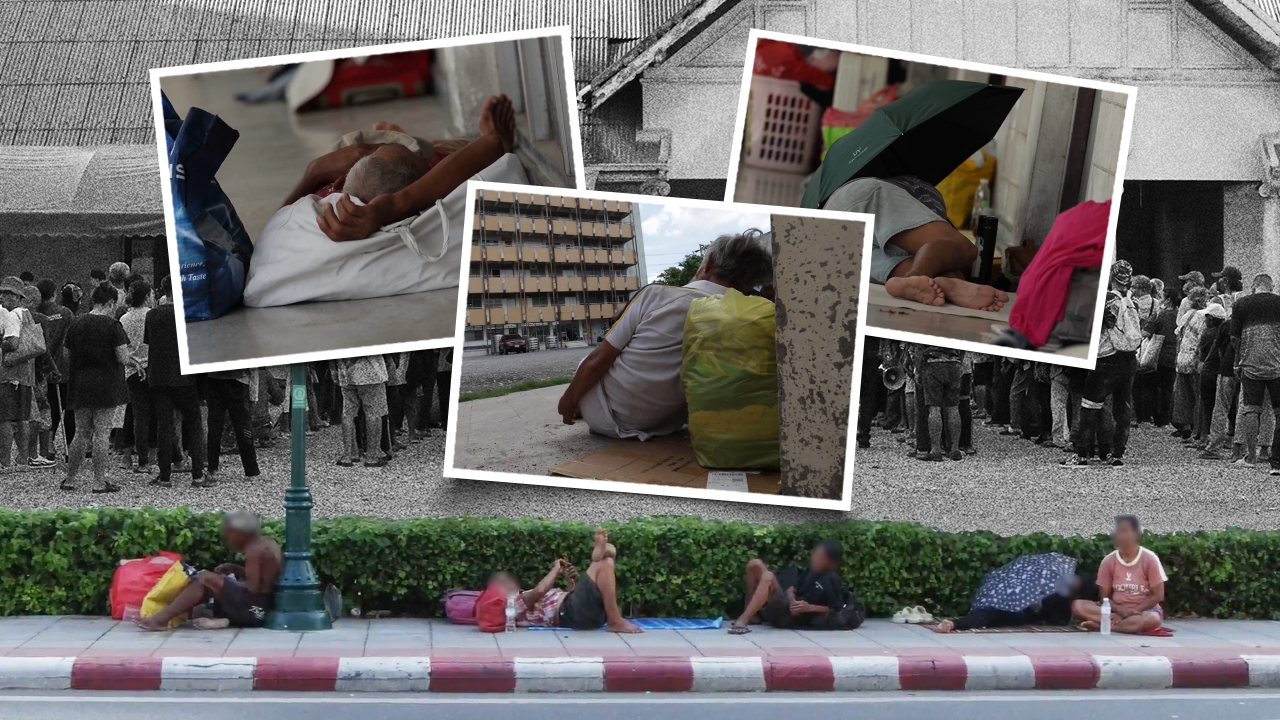
The Ministry of Social Development and Human Security revealed homeless statistics showing Bangkok ranks first with over half the country's total, exceeding 1,000 people. The report disclosed causes of street sleeping, challenges in solving the problem, and ongoing monitoring of 4 million vulnerable individuals at risk of losing their homes.
The Issue "Homeless people" are not simply a matter of lacking shelter, but represent an iceberg reflecting many vulnerabilities in Thai society, including economic inequality, severe poverty, fractures within families. This issue has become a major challenge that government, civil society, and citizens must collectively address and care for.
The Thairath Online special news team discussed approaches to addressing this issue with Ms. Ramrung Worawat, Director-General of the Department of Social Development and Welfare, Ministry of Social Development and Human Security.

Data from the Department of Social Development and Welfare, in collaboration with partner networks, conduct a nationwide homeless population count every three years. Reviewing data from the past five years reveals interesting trends.
In 2019, there were about 2,700 homeless people nationwide, which rose sharply to over 3,000 in 2021, marking the peak during the COVID-19 crisis. The most recent 2023 survey shows the total at 2,499 nationwide, with more than half—over 1,000—located in Bangkok. The statistics were gathered using the One Night Count method, a single-day sweep to avoid duplicate counting if homeless individuals move locations.
Areas where homeless people gather typically have basic resources to support survival, including places to sleep, eat, and access basic services. In Bangkok, the largest concentrations are around Sanam Luang, including Khlong Lot and Soi Sake, followed by Lumphini Park and Hua Lamphong train station. Some locations do not allow overnight stays indoors, so many are found sleeping on streets like Ratchadamnoen Road and around public parks.
Reviewing the law, the Act on Protection of the Destitute, B.E. 2557 (2014), defines “destitute persons” in a more diverse and complex way than commonly thought. Principally, they can be divided into two main groups.
The first group is “people who have a home... but whose home is not a refuge.” This group faces situations where their home can no longer serve as a foundation, possibly due to all family members having passed away or because the family is so fragile that mutual care is impossible. When “home” is no longer an answer or source of security, they are forced to leave and live in public spaces.
The second group is “rootless people.” This group never knew what a home was throughout their lives, mostly growing up in families living on streets or public areas from as early as they can remember, maturing in such environments and becoming the next generation of destitute persons.
Therefore, the condition of destitute persons manifests in various forms, not limited to any single group. They include individuals who previously had good social status, ordinary people, and those without educational or job opportunities.

"Fundamentally, everyone wants to be at home, but their home is not warm enough or conducive for a person to live in," Ms. Ramrung said.
Other causes include poverty, lack of employment, no income or overwhelming debt, leading them to flee to the city with the mindset of "taking their chances," while preserving their dignity that if life does not improve or income is insufficient, they refuse to return home.
Another key reason is domestic violence. Some may come from well-off families but lack warmth and have unresolved problems at home. They leave to live outside, find new friends and environments, hoping for greater happiness. However, that hope turns into risk as they face deteriorating conditions such as drug abuse, alcoholism, and crime cycles, which further prevent them from returning home.
Compassion and assistance also play a role; when people bring food, clothes, or essentials, it allows them to continue living even in public spaces.

At-risk groups potentially becoming new homeless persons, based on the Ministry of Social Development and Human Security's MSO Logbook database monitoring over 1 million vulnerable families (about 4 million people) nationwide, include:
Children of homeless people: Children growing up in public spaces with their parents, or pregnant mothers living in public areas, are likely and vulnerable to becoming permanently destitute if the government does not intervene promptly.
Destitute families: Families in communities where members cannot rely on each other, such as households with bedridden elderly, disabled individuals lacking caregivers, no income or jobs. Without support such as welfare payments or job assistance, these groups may become homeless.
Preventive work with these groups is the most crucial first step, especially for those “newly destitute persons,” who have lived outside homes for no more than two years. Early engagement, building relationships, and providing new quality of life opportunities are easier than allowing roots to deepen in public spaces.

Ms. Ramrung revealed that working with destitute persons requires dedicated social workers and social developers who engage in dialogue, understand, and build trust to identify root causes and real needs, leading to proposals for welfare and sustainable quality-of-life development, enabling them to stand up and reintegrate into society with dignity.
1. The Department of Social Development and Welfare must conduct field visits—not only to provide food but also to verify welfare issues, such as ID cards. If lost, they must assist in reissuing them to trace the origins of homeless individuals and develop future solutions.
2. There are institutions and shelters for destitute persons and centers to protect and enhance quality of life, offering refuge with food, shelter, clothing, healthcare, rights, and welfare, including vocational training and rehabilitation to support reintegration into society.
For example, Bangkok (BMA) collaborates with civil society networks to open Baan Imjai to care for and rehabilitate the lives of homeless people. This home serves those not yet ready to live independently but willing to come for showers, meals, and other services.
They receive vocational training based on their aptitudes, such as agriculture, cooking, and art, to build self-esteem, and cooperate with the private sector to promote employment. Some can work outside and return to the center at night to prepare for renting their own housing in the future.

"Reintegration into society does not mean everyone returns to their original home, but at least they can live with employers, cohabit with friends, and be part of society, having a home, income to rent safe housing, and engage in a profession," she said.
Ms. Ramrung disclosed the most challenging part of working with destitute persons is understanding them and gaining their openness and readiness for personal change.
"For someone to leave their home, they must have experienced the worst—love, warmth, and relationships are all broken. It's as if their legs were cut off before they leave," she explained.
She added that assistance to homeless people does not always succeed immediately; some eventually return to homelessness and require ongoing help. However, the percentage who return to the streets after sheltering is "very low." This is because the system does not emphasize confinement but freedom combined with quality-of-life development. Furthermore, if individuals are sent back home, officials must be confident they can coexist with their families and conduct continuous home visits after their return.

Regarding the definition of "Happy Ending" in solving homelessness, the Director-General categorizes success into four levels.
The initial success is when homeless individuals open up, share their real problems and needs, and consider officials among the first people they think of when facing difficulties.
The second success is when they enter the center and feel they have identity, dignity, dreams, and can choose careers according to their interests.
The third success is the cooperation of partners from government and private sectors concerning welfare rights and vocational activities.
The greatest success is when they have opportunities in society, can work, improve their quality of life, and live independently.
"Every human is born wanting good things—no one wants to be a criminal, neglect hygiene, or suffer mental health or addiction problems. Everyone aspires to be good but lacks opportunities," Ramrung urged society on the issue of homelessness.
Therefore, when encountering homeless people, do not judge or blame the government for not taking them away. Instead, view them with humanity. If you see vulnerable individuals needing help, call the free 24-hour social assistance hotline 1300 or the public health emergency line if they are ill.