

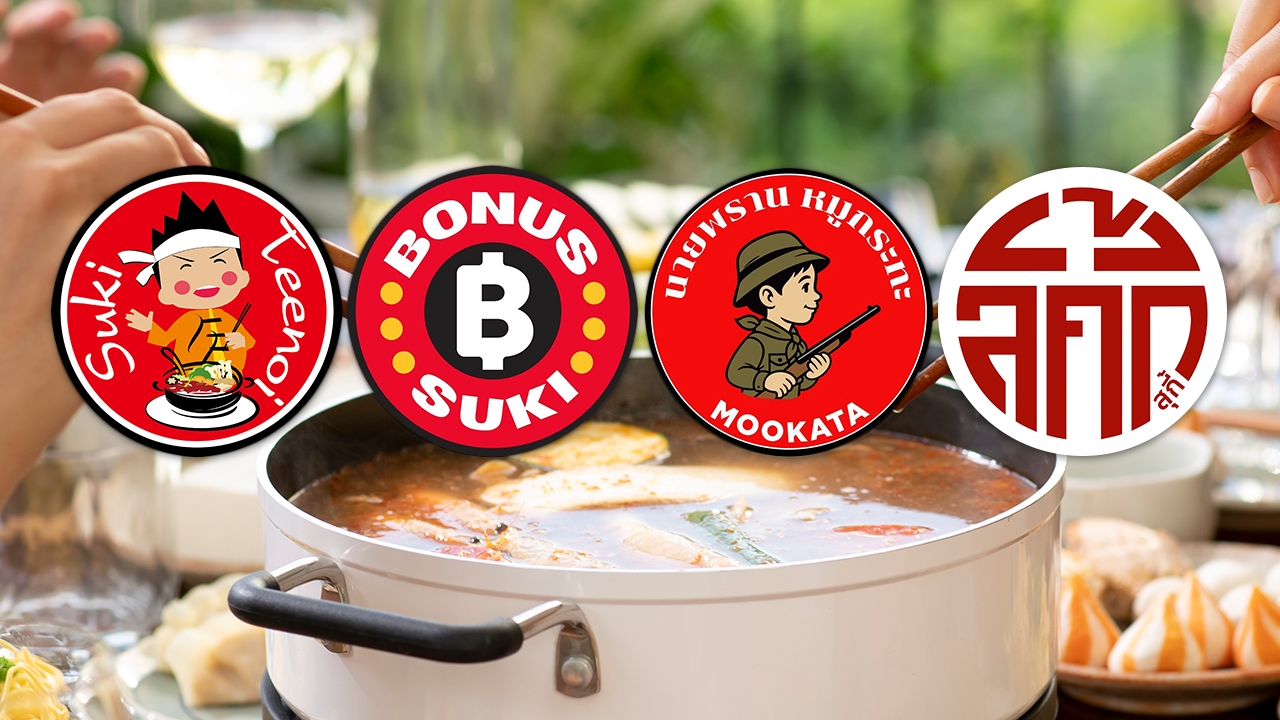
Thailand's hottest battlefield is undoubtedly the "buffet market for shabu, suki, and mugata," valued over 10 billion baht. Recently, this arena has intensified as the major player, Suki Teenoey, decided not to stay confined to shabu pots but jumped into the hot grill scene by launching a new brand, "Nai Pran Mugata," to challenge across category lines. Meanwhile, direct rivals Lucky Suki and the fast-rising star Bonus Suki are aggressively competing to grab market share.
Marketing strategies, strengths and weaknesses of each player, and an overview of what consumers gain from this price and service war.

Marketing strategy: Teenoey uses an economy of scale approach—more branches mean lower costs—and a 'late-night' model targeting night owls. Recently, launching "Nai Pran Mugata" leverages Teenoey's loyal fanbase and strong supply chain to enter the grill market, which Thai consumers crave almost as much as suki.
Strengths: very strong brand, standardized queue and ingredient management, dipping sauces that suit Thai tastes, and good value for money.
Weaknesses: long waits at some branches; as a newcomer to the grill market, Nai Pran Mugata must prove its dipping sauce flavor can compete with established players.

Marketing strategy: Lucky Suki positions itself in community malls and department stores with a premium, international image. It stands out by adopting technologies like robot food servers early on and offers diverse snacks such as fried items and dim sum to differentiate itself.
Strengths: comfortable, air-conditioned venues with convenient parking (due to mall locations), a wide variety of tasty snacks, and consistent quality fresh ingredients.
Weaknesses: prices including drinks and tax can be slightly higher than Teenoey's in some promotions; branch expansion is not as extensive as the market leader's.

Marketing strategy: Bonus Suki targets value-conscious consumers with an aggressive value-for-money approach, expanding a diverse food line that offers a feeling of "more than worth the price" to generate social media word of mouth. It continuously runs attractive promotions to capture customers who seek the best deals.
Strengths: diverse menu, good value for money, and special rotating items that keep customers excited.
Weaknesses: brand awareness is still lower than Teenoey and Lucky; branch management and quality control over the long term remain to be proven.

Brand | Strategic strengths | Main target groups | Primary locations |
Suki Teenoey / Nai Pran | Mass market, late-night, powerful management system | Young adults, working professionals, night partygoers | Standalone stores, large gas station areas |
Lucky Suki | Premium-mass, abundant snacks | Families, urban residents, office workers | Department stores, community malls |
Bonus Suki | Value-focused, social media buzz | Students, heavy eaters | Community neighborhoods, universities |
When giants clash and rising stars join the fight, the full benefits fall squarely on "consumers." We will see these phenomena:
Price wars may be limited, but the "value war" will heat up. No brand will drop prices below about 200 baht due to cost constraints, but they will compete by expanding food lines, upgrading beef, seafood, and snacks to a more luxurious level at the same price.
Mugata will move toward "standardization": With Nai Pran Mugata (from Teenoey's camp) entering this market, traditional mugata restaurants must adapt by improving cleanliness, air-conditioning, queue systems, and ingredient standards or risk losing to the industrial-scale operations of major players.
Convenience and innovation: We will see more stable queue apps, faster QR code ordering, and robot food servers becoming the minimum standard in all restaurants.
More diverse options to fit lifestyles.
For late-night lively dining, go to Teenoey / Nai Pran.
For mall visits with cool air and dim sum snacks, go to Lucky Suki.
For new experiences and wallet-friendly meals, go to Bonus Suki.
Teenoey's move into Nai Pran Mugata signals its ambition to dominate the grill and shabu market, but it cannot underestimate Lucky Suki's advantage of mall locations or Bonus Suki's freshness and flexibility.
The winner in this battle will not be the cheapest but the one with the strongest supply chain (able to buy cheaply and maintain consistent quality) and the best queue and service management. In an era of many options, if customers face long waits or poor service, they will switch to another restaurant immediately.