

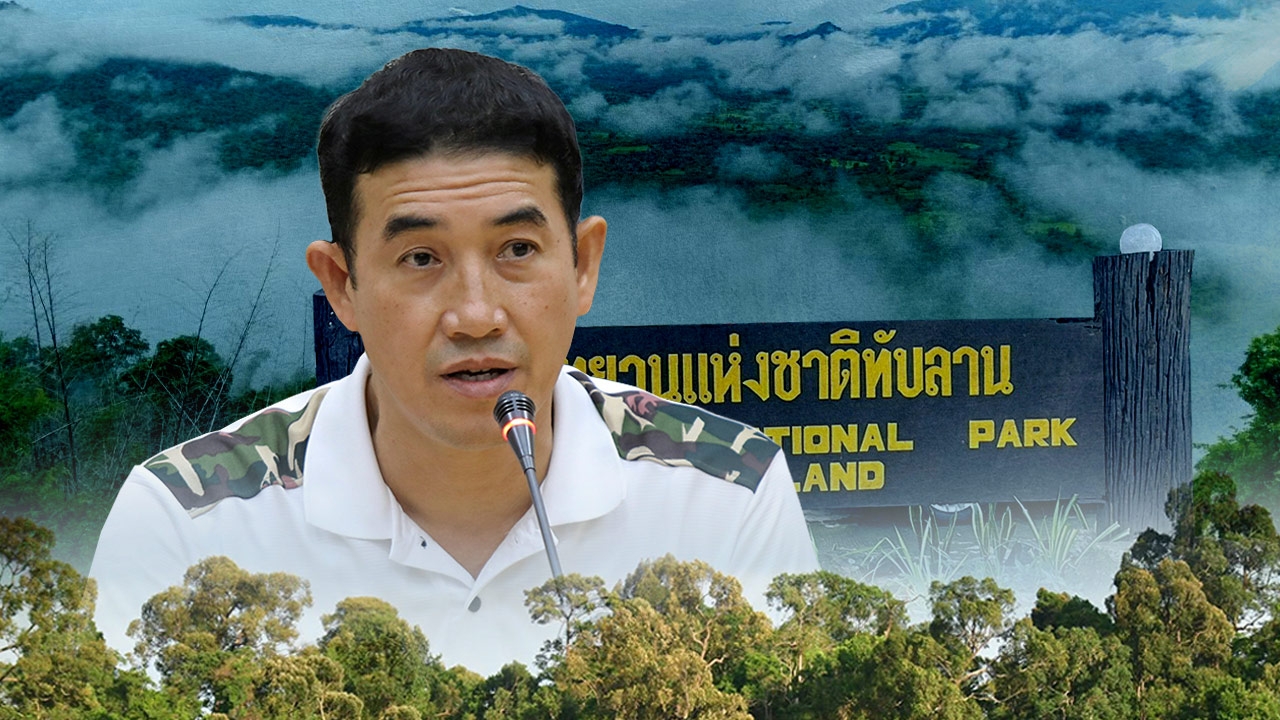
The Director-General of the Department of National Parks clarified the #saveThapLan issue, confirming there is no 'forest encroachment.' He announced plans to establish a central committee for strict rights screening to assist indigenous villagers who live there 'properly' and to grant them 'legal' status. He emphasized that investors and those with pending legal cases have no rights from the start.
Following the resolution by the National Park Committee under the Ministry of Natural Resources and Environment recommending a review of the 2023 Cabinet resolution on adjusting the Thap Lan National Park boundaries to clearly organize and classify the area, the land is divided into two parts: (1) Areas proposed for revocation from Thap Lan National Park boundaries, and (2) areas designated for potential park expansion.
The areas proposed for revocation are further divided into five groups:
Group 1: Areas overlapping with agricultural land reform zones covering about 50,000 rai, to be handed over to the Agricultural Land Reform Office (ALRO) for management.
Group 2: The Thai Samakki Model Village project area, approximately 8,000 rai, to be handed over to ALRO for management.
Group 3: Areas under security projects, including the Special Security Development Project (SSDP) and land allocation for poor farmers in degraded forest reserves, about 87,500 rai, to be handed over to ALRO.
Group 4: Resident areas outside ALRO and security projects, covering 109,000 rai, subject to rights verification under Section 64.
Group 5: State property used as a military training ground, covering 6,000 rai.
Meanwhile, the proposed expansion area of Thap Lan National Park covers approximately 86,966.29 rai.

This resolution has sparked diverse public opinions and campaigns against it, using the hashtag #saveThapLan. Concerns focus on possible impacts on wildlife and potential favoritism toward resort investors, with many celebrities like Sai Scot and Ingfa Waraha joining the campaign.
Mr. Atthapon Charoenchansa, Director-General of the Department of National Parks, Wildlife and Plant Conservation, Ministry of Natural Resources and Environment, told Thairath Online’s special news team that this issue must be viewed in its historical and original context. Before the park's declaration, the lands recently proposed for revocation had been allocated by the state as farmland to residents, who have consequently lost those rights and should be assisted.
However, assistance does not mean all those in these groups will receive rights. Eligibility must be verified. Those who lived in the area before should be helped. Recently, discussions have been held about establishing a joint central committee. This committee will prevent responsibility from falling solely on the Agricultural Land Reform Office, the Forestry Department, the National Parks Department, or any single agency. It will investigate rights and screen out unauthorized occupants, granting rights only to those originally residing in the overlapping ALRO, SSDP, and degraded forest reserve areas previously announced.
“If we do not solve this, these people will be abandoned. The idea of 'forest encroachment' is incorrect because no forest is being cut. We are resolving issues and organizing communities living in or near the forest by helping those living legitimately and excluding unauthorized people. We must not generalize, or those suffering will receive no solution, which is dangerous. Please do not spread misinformation.”

The Director-General confirmed this is not forest encroachment. The forest remains managed as before, with some areas incorporated into the park. These communities will receive proper land-use rights and state support for rehabilitation and infrastructure allocation, effectively bringing those “living properly” into “legal” status. Those who are unauthorized or have outstanding legal cases will not be granted rights or enter the screening process.
The central committee will conduct field investigations and enforce laws. Unauthorized occupants will face legal action. Rights investigations will rely on evidence such as aerial photos, living conditions, and witness testimony, making it straightforward to determine who lived there first. Once investigations conclude, announcements will be made, with opportunities for objections or appeals if errors occur.
“Currently, Group 4 is temporarily on hold. Many also want Group 2’s revocation paused. However, Groups 1, 3, and 5 will definitely have park boundaries revoked due to clear historical backgrounds. Still, revocation does not guarantee rights; eligibility will be further examined.”

The Director-General concluded that this process is a correct resolution to problems that the government has long pursued, setting standards for fairness and justice for the people. He stressed the sincere intention to assist citizens while conserving natural resources and the environment, with no plans to damage forest areas.
Regarding “forest buffer zones,” which cause public concern, he confirmed these zones exist. Communities adjacent to forests exercise caution in constructing buildings and land use, partly because villagers must be mindful of wildlife, such as wild elephants, venturing beyond forest areas.
“We assure the public that our actions are on the right path. Otherwise, similar problems nationwide could not be resolved. If other areas react negatively, no solutions would be implemented, leaving issues unresolved.”
The next step involves awaiting the Land Commission meeting resolution on 25 June 2024 GMT+7, followed by submission of resolutions and observations to the National Land Policy Committee and then to the Cabinet for further legal proceedings.