

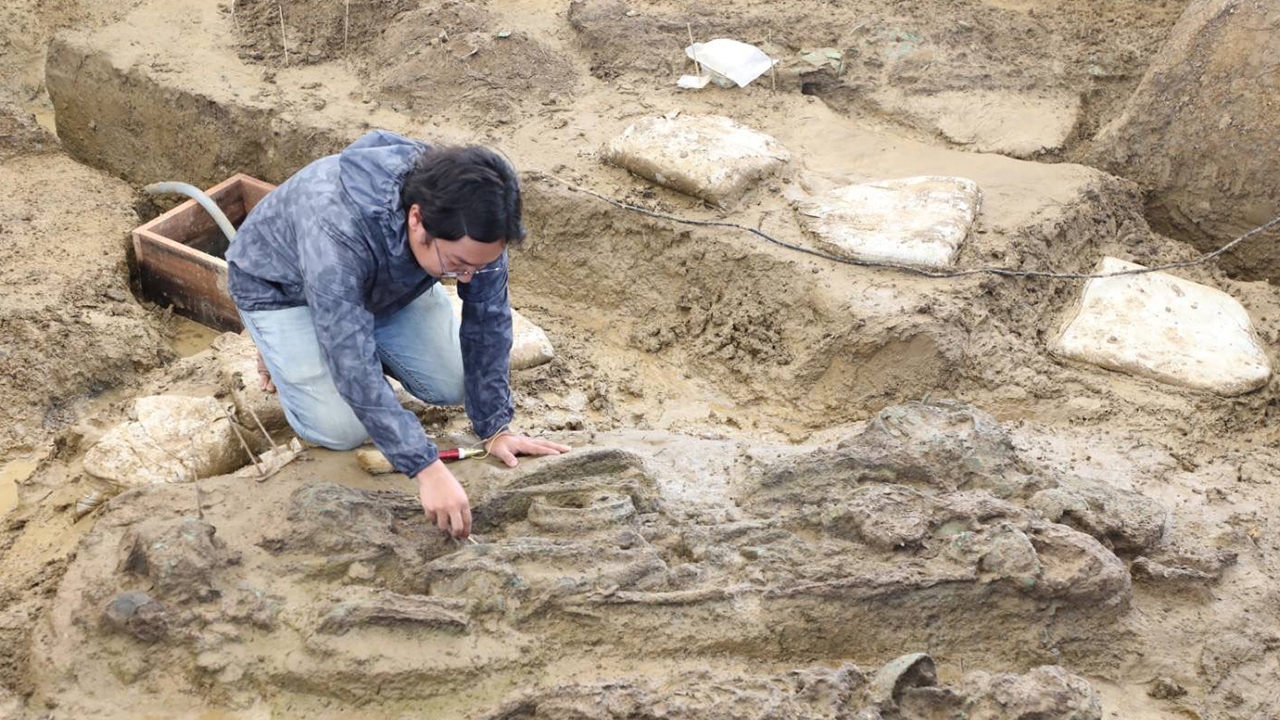
The Fine Arts Department has discovered new information at the ancient Don Yai Thong civilization site in Phetchaburi Province, uncovering gold ornaments and six bronze drums believed to date back to the late prehistoric period, approximately 1,500-2,000 years ago.
On 27 June 2026, Mr. Phanomboot Chantrachot, Director-General of the Fine Arts Department, chaired a press conference announcing the new findings at the ancient Don Yai Thong site in Phetchaburi and presented compensation of 50,000 baht to Ms. Kanang and Mr. Jen Petsud, the landowners. The event included a welcome speech by Mr. Chaipol Phutonglom, Deputy Governor of Phetchaburi Province, and participation from Ms. Thiwalrat Angkinan, Phetchaburi MP and Chair of the Parliamentary Committee on Religion, Arts and Culture, local officials, and media representatives at the Phra Thinang Ratchatham Sopha, Phra Nakhon Khiri National Museum. Afterwards, the group visited the Don Yai Thong archaeological site, where Ms. Kannika Premjai, a senior archaeologist from the Archaeology Group of the Fine Arts Office Region 1, Ratchaburi, briefed them on the operations.

The Director-General of the Fine Arts Department stated that the department, through the Fine Arts Office Region 1 in Ratchaburi, began excavations at the Don Yai Thong archaeological site on 9 February 2026. The objective was to recover and study archaeological evidence from the area where bronze drums were found in the rice field owned by Ms. Kanang Petsud in Village 6, Ban Don Plap, Samo Phlu Subdistrict, Ban Lat District, Phetchaburi Province. Early excavation results revealed fragments of the base rims of bronze drums and several earthenware vessels arranged nearby in relation to the drums.
As excavation deepened, another bronze drum was found face down in the soil, and crucial evidence emerged in the form of human skeletons buried nearby. Bronze vessels used in funerary rites were placed in various positions. Additionally, jewelry was uncovered, including glass beads, stone beads, gold rings, and gold bracelets, some still worn on the skeletons. These findings highlight the significance of the buried individuals and the beliefs associated with dedicating items in post-mortem rituals.

Following the discovery of the skeletons, archaeologists conducted detailed excavations to clarify burial patterns and found additional skeletons wearing bronze metal objects resembling vessels covering their heads, a rare and distinctive feature. They also uncovered important artifacts such as gold jewelry—rings, pendants, earrings—small earthenware vessels, bronze containers, and numerous beads. To date, nine human skeletons have been found at the site.
The most recent skeleton is believed to be that of a child under 12 years old, with a bronze object shaped like a gong placed on the torso. Four additional bronze drums were found, totaling six. Excavations will proceed to carefully clean the drums to study their characteristics and decorative patterns, as well as to analyze burial customs and the arrangement of offerings. Numerous fired clay lumps and intact herbivore jawbones from cattle or buffalo, including both upper and lower jaws found nearby, were also discovered. These animal remains are key evidence of animal burials associated with funerary rituals and offerings, indicating the animals’ significance, possibly as sacred community animals or for other important reasons requiring further study.

Next, the Cultural Heritage Information Technology Group will document the skeletons and excavation pits using 3D scanning before archaeologists from the Fine Arts Offices Region 1 (Ratchaburi) and Region 5 (Prachinburi), Fine Arts Department experts, and conservation scientists recover the skeletons and artifacts from the pits starting July 2026. A registry of artifacts will be created, and items will be sent to the Conservation Science Group at the National Museum Office for preservation. The excavation site will then be restored and returned to the landowners for agricultural use. Charcoal samples from the dig have been sent to the United States for scientific dating, with results expected in about three months.

Based on the styles of the bronze drums and artifacts found with the skeletons, it is inferred that this burial site dates to the late prehistoric period, approximately 2,000 to 1,500 years ago—prior to Thailand’s historical era. Continuous excavations show that the Don Yai Thong archaeological site is academically significant, reflecting past community rituals, beliefs, and social status, and holds potential for further research in archaeology, anthropology, and regional cultural history.
