

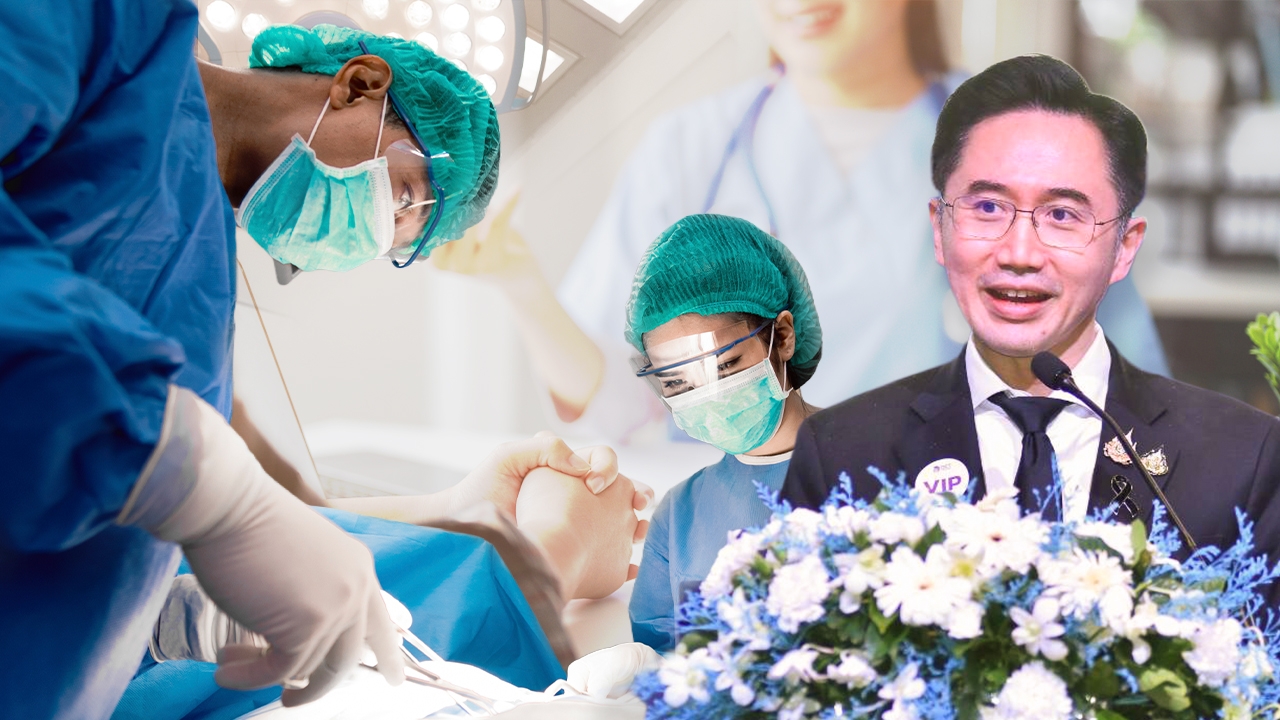
Yotsanan highlights medical AI as a new engine driving the country's GDP while addressing opposition to opening new medical faculties and producing an additional 20,000 doctors. He assures that studies support the plan and that doctors will be distributed broadly, emphasizing the need for sufficient doctors to meet demand. Wellness Economy
Today (30 June 2026), a meeting was held "SEA Health Summit 2026: AI in Health and Longevity" at the Napalai Grand Ballroom, Dusit Thani Hotel, Bangkok, with over 400 leaders from Thailand and the ASEAN region attending, focusing on the theme AI in Health and Longevity to drive health innovation in Southeast Asia. Distinguished guests, executives, and experts in medicine and technology shared perspectives and experiences.Revolutionizing public health! Launch of SEA HI Hub to position Thailand as the 'Switzerland of Healthcare')

Prof. Dr. Yotsanan Wongsawat Deputy Prime Minister and Minister of Higher Education, Science, Research and Innovation, chaired the opening and delivered a keynote titled “Thailand Health Tech: The Next Economic Engine,” aiming to elevate Thai medicine as a new growth engine driving the national GDP.
Regarding the plan to open additional medical faculties targeting 22,000 new doctors over 10 years and the opposition from some medical groups preparing to submit objections, Dr. Yotsanan explained that concerns stem from budget sufficiency and doctor distribution issues. He clarified that the government's plan is based on multiple studies and believes this will be the last increase before reaching balance.
The government will simultaneously generate revenue from medical technology as an economic driver while implementing the CPIRD program to produce doctors for rural areas, ensuring nationwide distribution and equipping Thai doctors to handle modern treatments.
“Today, as we aim to establish a Wellness Economy, having enough doctors to care for both Thai people and incoming tourists is essential. This is non-negotiable, but we must listen to all voices and be ready to adjust for the greatest benefit to Thailand.”
When asked about his earlier statement at Thammasat Hospital that after four years Thailand would see changes in medical AI, the Minister revealed that the four-year figure signifies policy continuity. Currently, several AI projects are underway and will integrate medical devices, the aging society, and data collection moving forward.

Prof. Dr. Yotsanan noted that many view Thailand as a key medical hub with the best medical ecosystem in ASEAN, and this opportunity can also drive the country's economy.
Regarding the economy, Wellness (well-being) and Longevity (long and healthy life) when grounded in science and supported by research, can significantly increase value — including medical devices, services, precision health (personalized care), facilitation of clinical trials, animal testing, telemedicine, dentistry, physical therapy, and rehabilitation medicine.
These connect to AI and deep data such as genomics and DNA. Such efforts require collaboration among multiple countries. Bringing in leading nations to invest in Thailand's health sector will expand GDP in high-value service sectors of Wellness and Longevity, becoming a crucial economic driver.
Regarding research funding, efforts are underway to make various sectors appreciate research's importance. Funding mainly comes from government and private sectors. Currently, the aim is to encourage more private sector research, while the government attracts major companies' R&D bases to Thailand to collaborate with universities and private entities. The government is also willing to negotiate large purchases to secure technology transfer back to the country.
On clinical trials, it was affirmed that these will be conducted with safety and regulatory compliance, based on Thailand's existing control frameworks. Improvements will be made to Clinical Trial Agreements (CTA) to enable faster approvals, possibly introducing a standardized, more transparent national format. Clinical trials are typically the final phase, with most devices and drugs already passing near-top standards. It is believed Thai people will access better medicines and devices at reasonable prices.

“We will use Wellness as the core, supported by Nature Tech—environmental technology, cell and gene therapy, medical devices, medicines, test kits, and herbal remedies—to build a comprehensive ecosystem.”
Dr. Yotsanan revealed that many private investors have entered clinical trial investments in Thailand and many more are interested. If trials conducted in Thailand can also be used domestically, it benefits the private sector by demonstrating market demand and attracting more R&D investment.