

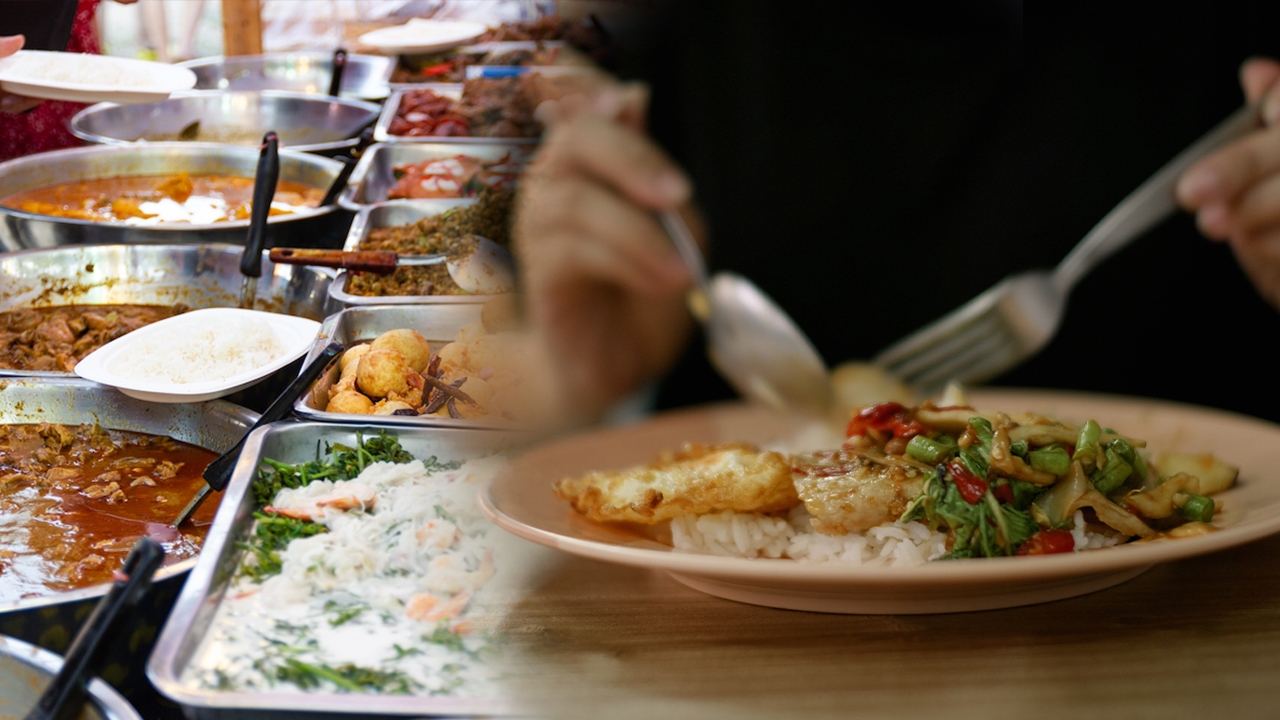
In an era where every direction shows signs saying “price adjustment,” leaving home has become a sweat-inducing challenge each morning for salaried workers and low-income earners. Surveys clearly show that the average price of fast food in Bangkok has soared beyond 50-65 baht. Recently, the Ministry of Commerce is preparing the “Thai Curry Rice Helps Thai” project to promote affordable menu items priced at 40 baht per dish for three months, providing a lifeline option for the public.
Beyond the future 40-baht price tags, the current reality is that Thais are carrying the burden of costs. Which raw materials cause curry rice vendors to shed tears?
Field investigations into markets and hidden costs faced by vendors reveal that key ingredients for ready-made meals have continuously risen due to market forces and environmental factors.
Chicken eggs (a common staple) have steadily increased, recently averaging as high as 6 baht per egg (sometimes rising by 6 baht per tray). This cost is driven by unavoidable soaring animal feed prices.
Meats and processed seafood products such as meatballs, Vietnamese pork sausage, and sausages—basic ingredients in stir-fried basil or chili paste dishes—have raised prices following increased energy and transportation costs.
Fresh vegetables and seasonings like chili, lime, as well as “coconut milk for curry” essential to curry and green curry dishes remain consistently high.
Hidden costs such as gas, electricity, and labor remain significant despite some drop in retail fuel prices. Ready-to-order food prices are hard to reduce because vendors face high "hidden costs" in running their businesses.

As living costs outpace wages, Thai consumer behavior has had to adjust alarmingly.
Salaried workers have cut back options—from ordering “crispy pork basil with fried egg and Chinese sausage” to just a single basil dish or switching to cheaper clear soup dishes.
Bringing home-cooked meals has become a rising trend among office workers to keep daily expenses under 100 baht.
Vendors bear the burden to the point of strain; many choose to “freeze prices,” accepting reduced profit margins to retain regular customers and prevent them from leaving.

The idea behind the “Thai Curry Rice Helps Thai” project, proposed by Deputy Prime Minister and Minister of Commerce Supachai Sutthammanusorn, is to recruit around 100,000 pilot network stores to jointly offer special menus like “two curries on rice for no more than 40 baht.”
To support vendors, the government will not impose or interfere with market prices but will provide direct subsidies for raw material costs to participating stores. The subsidy amount under consideration ranges from 3,000 to 10,000 baht per vendor, enabling them to lower prices to 40 baht without losses.