

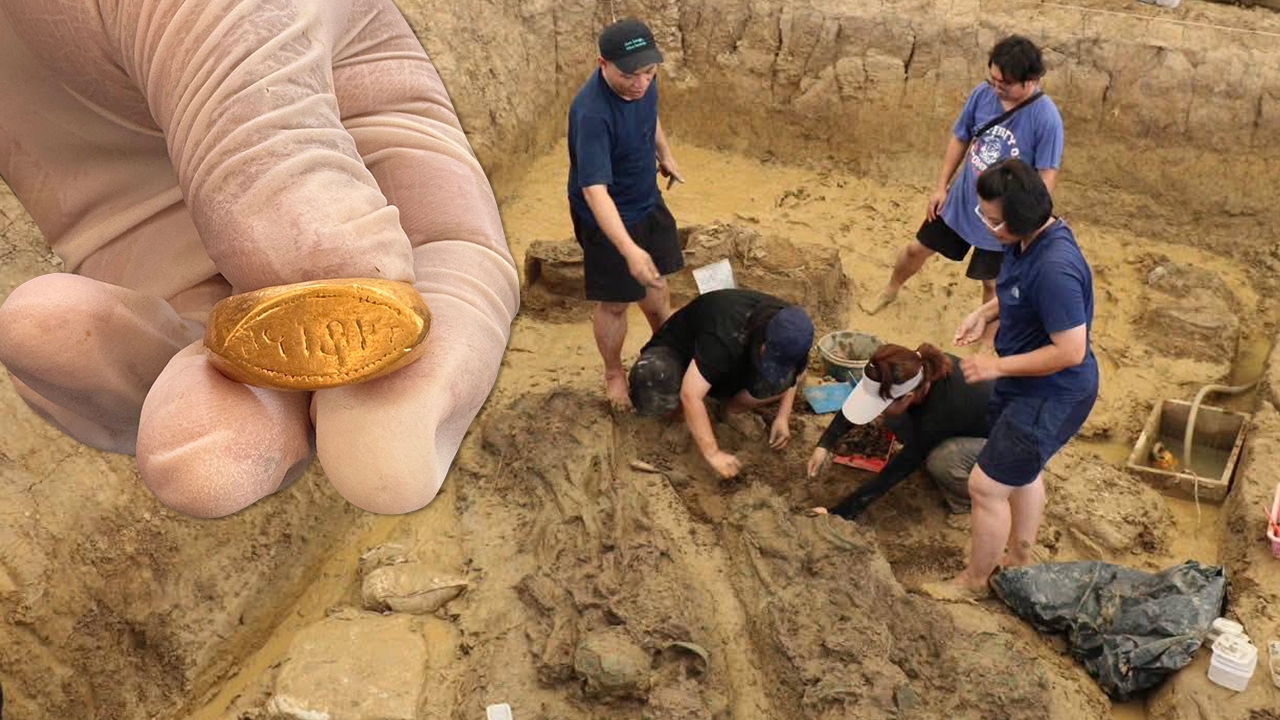
Solving a two-thousand-year-old mystery: the gold ring "Pusarakitsa" linking ancient trade routes in Phetchaburi, decoding overlapping burials and the ritual use of bronze head coverings on every skeleton found in the site.
The restoration began on 2 July 2026 when the Fine Arts Department Region 1 in Ratchaburi, along with a team of archaeologists, urgently recovered human skeletal remains and artifacts. The Don Yai Thong excavation site in Phetchaburi faced issues with groundwater, salinity, and humidity during the rainy season, accelerating the decay of bones and corrosion of bronze artifacts. All evidence was sent to the Science Center for Conservation, Fine Arts Department, for preservation and scientific study. This led to the discovery of a gold ring engraved with Brahmi script over 2,000 years old belonging to an ancient merchant named "Pusarakitsa," meaning "of Pusarakitsa." This crucial evidence could rewrite Thai history and reveals the mystery of overlapping burials and the ritual use of bronze head coverings on all skeletons, which still awaits full verification.

Thairath Online’s special news team interviewed Ms. Kannika Premjai, an expert archaeologist from the Fine Arts Department Region 1 in Ratchaburi, about the significance and hypotheses regarding the ancient gold rings engraved with old scripts, discovered worn on five skeletons in their anatomical positions.
Ms. Kannika Premjai revealed that linguistic experts have deciphered that one ring is inscribed in "Brahmi script" (ancient Indian) or old Pali, clearly stating the individual’s name as "of Pusarakitsa." Archaeologists thus hypothesize the ring functioned as a merchant's commodity seal belonging to the Vaishya class (merchant caste).
Comparing the script's style and evolution indicates an age from the 5th to 7th Buddhist centuries, approximately 1,900 to 2,100 years ago, predating the Dvaravati period (11th–12th Buddhist centuries) which most scholars have traditionally used to mark the start of Thai history. The discovery of this gold ring with a clearly spelled personal name is vital evidence pushing back the origins of Thai history significantly. The Brahmi script here served as a personal name marker rather than a formal religious text script.

Besides the gold ring, the excavation also uncovered a "mohorat drum," an artifact produced in southern China or Vietnam. These associated finds indicate that historical Thailand was a central hub of trade and maritime routes with diverse peoples engaging in commerce.
Currently, only small burial pits have been discovered, so it is not yet clear whether Don Yai Thong was once an ancient settlement or a trading station. The archaeological team plans further excavation and study in the following year.

Another point of archaeological interest is that all nine skeletons found wore "bronze metal head coverings," unlike other prehistoric sites where only some skeletons have such items. Additionally, the burials were arranged in overlapping clusters rather than in a normal flat alignment. The beliefs, funeral behaviors, and reasons for using bronze head coverings remain under detailed research.

The archaeological team plans to send artifacts for scientific age verification to confirm the inscription's dating. They will compare the shape and decorations to precisely date the mohorat drum's production. The skeletons will undergo detailed sex and age determination.
For those interested, the Don Yai Thong excavation site remains open to the public but is less complete than initially due to the removal of some remains and artifacts for cleaning and preservation. The Director-General of the Fine Arts Department intends to exhibit the valuable artifacts, including the gold ring and pottery, in a special exhibition in Phetchaburi for 3–5 days before moving them for further analysis and conservation.
