

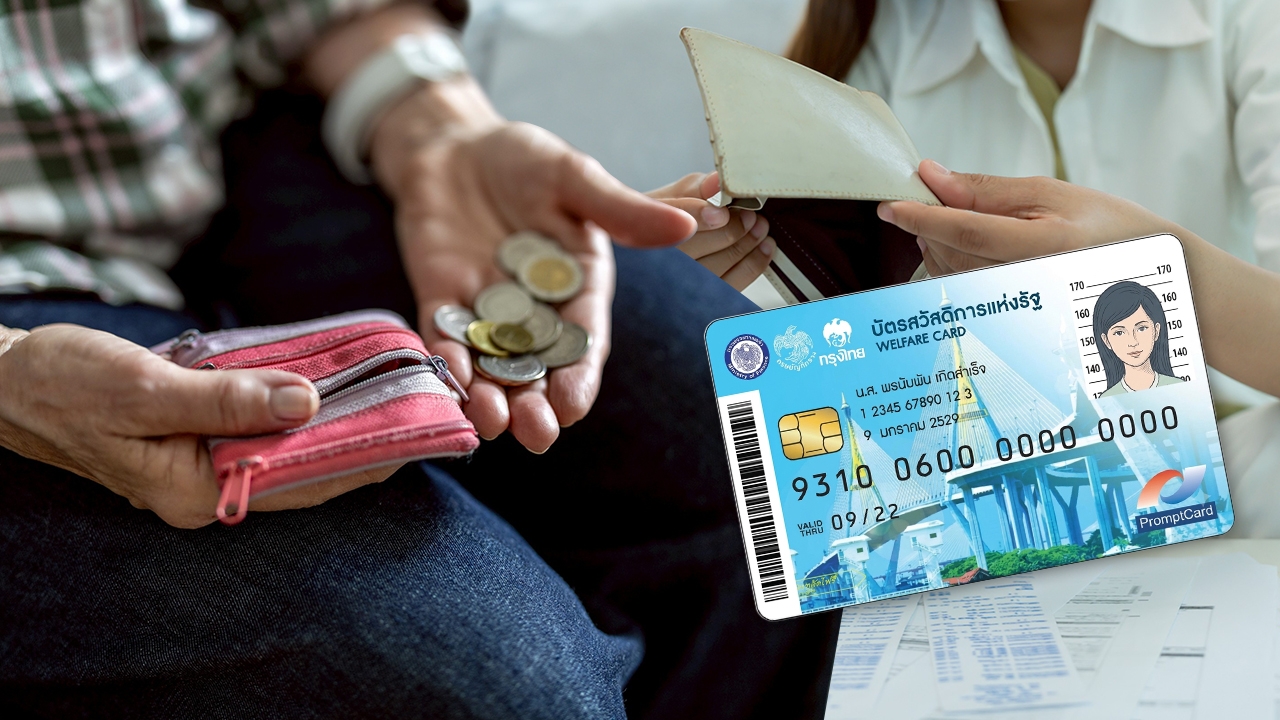
Conditions for the State Welfare Card “Personal income and debt” may not accurately reflect true poverty; experts argue household income criteria are more appropriate and recommend the government expedite database development and the appeals process.
Regarding the government’s opening of registration for the State Welfare Card or the 'poor card' in the new round from 4 to 21 June, with stricter screening criteria such as: not being a shareholder or director in a company; having income or paying others not exceeding 100,000 baht/year; assets (deposits or lottery savings) and debts with total loan amounts (excluding agricultural loans) not exceeding 100,000 baht; owning residential and agricultural land not exceeding 10 rai, and non-agricultural land not exceeding 1 rai; no vehicle ownership except motorcycles up to 300 cc, three-wheeled cars, four-wheeled hired cars, and agricultural vehicles limited to one unit per type, among others.
The Ministry of Finance announced eligibility results on 17 July, reporting 18.82 million applicants, with 9.51 million qualifying and 9.31 million disqualified. Over 2.7 million have filed appeals asserting true poverty. The most common disqualification reasons were vehicle ownership (41%) and loans exceeding 100,000 baht (19%), with 16% disqualified for other reasons. The government has opened an appeals process.
However, many appeals involve vehicles owned for many years that are no longer operational or cases where individuals are co-owners but not the actual owner. This has sparked debate on whether the new screening criteria based on debt and vehicle ownership truly measure poverty.

Thairath Online’s special news team discussed this issue with Dr. Somchai Jitsuchon, Research Director on Inclusive Development at the Thailand Development Research Institute (TDRI). He observed that the stricter criteria in this screening round reduced the number qualifying due to the government incorporating multiple databases, such as debt levels and asset holdings.
Regarding whether debt or ownership of land, buildings, and vehicles effectively measure poverty, Dr. Somchai said this is debatable. Supporters of these criteria may argue that having high formal debt indicates purchasing power, income above the poverty line, or the ability to support oneself, thus qualifying for credit. However, some financial institutions may not strictly enforce collateral requirements, such as for vehicle loans.
Opponents might argue that individuals with debt, even if their income exceeds the poverty line, may have responsibilities to support non-earning family members, such as elderly parents or young children.
Dr. Somchai believes the shift from household income to personal income as a screening criterion was a mistake. Because if an individual’s income exceeds the threshold and is disqualified, yet they actually have to support others in the household, they may still be considered poor.
Regarding over 41% disqualified due to vehicle ownership, many cases involve vehicles held for years that are no longer usable or individuals listed as co-borrowers but not owners or users of the vehicles.
Dr. Somchai suggests vehicle ownership data should be adjusted to reflect reality better. For cars bought many years ago, depreciation should be considered; for example, a car originally worth 500,000 baht that has been used for 10 years and is now worth only a few baht should be exempted accordingly.

Dr. Somchai noted that no screening system is flawless and will have some errors. If the government worries about exclusion or budget leakage due to screening errors, it must urgently improve databases to be as complete and up to date as possible, and meanwhile maintain a good appeals system.
“This is a challenging task worldwide. One helpful approach is a strong appeals process for cases lacking database support, allowing appellants to explain their circumstances. The Ministry of Finance then dispatches personnel and resources to verify these claims. Though demanding, this is necessary while screening systems remain imperfect.”
Dr. Somchai proposed supplementing database improvements with community mechanisms, involving local leaders who know residents well, such as village heads or public health volunteers, to assist in appeals verification. While some bias may remain, this can reduce workload and costs for central authorities.
Regarding whether the state welfare card system, which faces screening errors and leakages, can be modified to be more inclusive and solve these problems,
Dr. Somchai suggested it might take the form of a Negative Income Tax system, where those earning below a threshold receive targeted government support instead of paying income tax, effectively replacing the state welfare card policy.
However, for this to work, all Thai citizens must first enter the tax system, allowing the government to build a comprehensive database, possibly supplemented with asset information such as home and vehicle ownership for welfare eligibility considerations.
“Everyone should be required to file tax returns, not voluntarily, because otherwise high-income people outside the tax system will not join, depriving the government of tax revenue. Those filing returns would mostly be low-income earners, straining public finances due to high expenditure and limited revenue.”
Until Thailand implements a negative income tax, besides improving the welfare card’s screening databases, other measures could be combined, such as area-based approaches and decentralizing fiscal authority to local governments, while strictly monitoring corruption.

Following screening issues, on 20 July 2026, the Ministry of Finance plans to propose to the Cabinet to relax rules on old cars and motorcycles, and non-regular students, extend the appeal deadline to 20 September 2026, and aims to restore rights to successful appellants by 1 October 2026.
Mr. Siripong Angkasungkiat, Deputy Minister of Transport, stated that complaints revealed many people remain registered as owners of unusable vehicles, old vehicles not deregistered, lost vehicles, vehicles sold but not transferred, and cases where names were fraudulently used to register vehicles, causing registry data to mismatch reality and leading to disqualification.
The Ministry of Transport proposed exempting vehicles over 20 years old and motorcycles over 15 years old from ownership criteria, and allowing two motorcycles under 300 cc under financing to be exempt from disqualification. The Department of Land Transport will assist in verification and compiling data for appeals.
For non-regular students under the Department of Learning Promotion and non-formal vocational education, disqualification will not be based solely on student status; the Ministry of Finance will consider other factors. The public is assured there is no need to drop out, as other criteria will also be reviewed.

Mr. Winij Wisetsuwanphum, Director of the Fiscal Policy Office, said that income qualification checks used dynamic withholding tax data, revealing irregularities and major fraud schemes.
Some employers or businesses set up fake employees using ordinary citizens’ names to claim tax deductions and evade taxes, causing innocent citizens to appear as registered income earners and lose welfare card eligibility unknowingly. The government is committed to receiving complaints from victims and taking decisive action on two fronts: prosecuting those who fraudulently used citizens’ names and rapidly restoring state welfare card rights to affected individuals.