

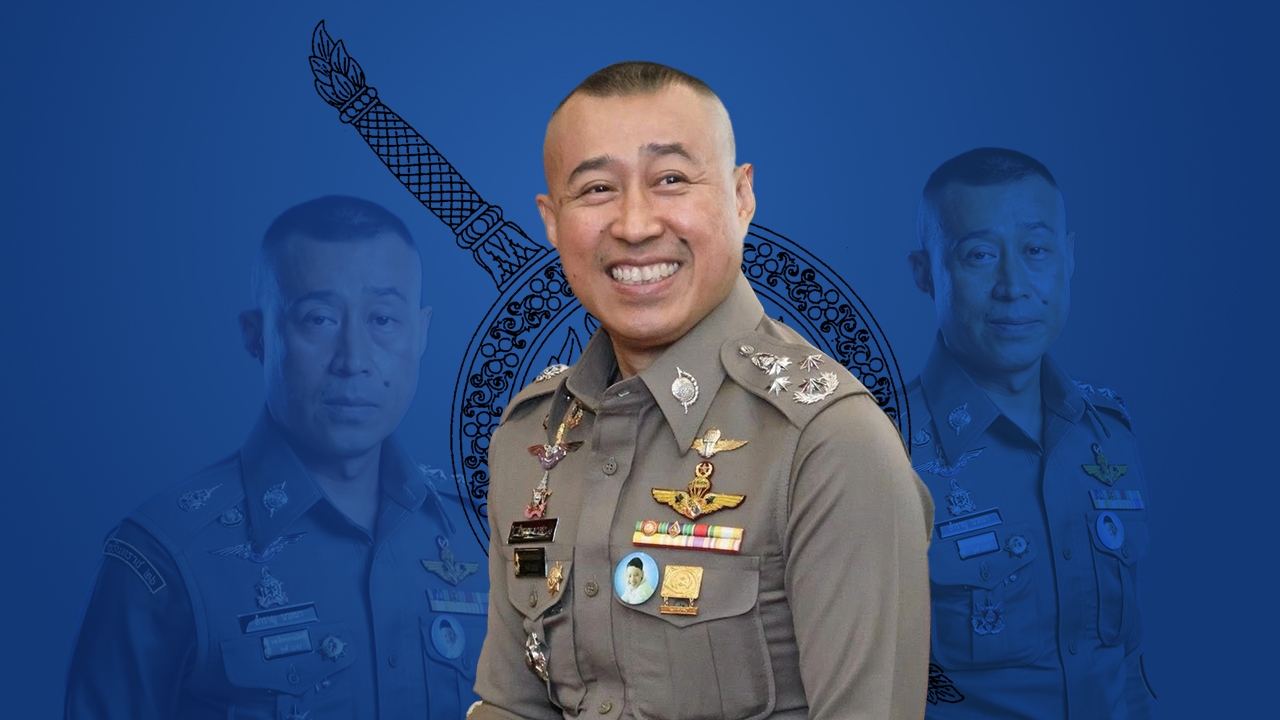
Incoming national police chief “Big Rarn” is preparing to hold power for seven years. Experts see this as a double-edged sword—either an opportunity for police reform and policy continuity or a chance for entrenched corruption and establishing a long-term political power base.
Following the meeting of the Police Commission on 22 July 2026, where Prime Minister Anutin Charnvirakul unanimously approved the appointment of the 16th national police chief, “Big Rarn”, Police General Samran Nuanma, effective 1 October 2026, the focus is not only on his suitability but also on his remaining service years, which allow Big Rarn to hold power for as long as seven years, raising a major societal question: is this a move to establish a long-term political power base?
Thairath Online’s special news team interviewed Associate Professor Police Lieutenant Colonel Dr. Krisanapong Putrakul, a criminologist and deputy member of the National Police Policy Committee for organizational development, to analyze this issue. He offered the perspective that although no one has previously had such a long remaining service period, the key factor is not just the number of years but also the national crime management policies.

From Associate Professor Police Lieutenant Colonel Dr. Krisanapong’s viewpoint, ascending to the position of national police chief with a seven-year tenure is a "double-edged sword" deserving close attention.
On the positive side, it allows for continuous policy implementation, enabling commanders and most police officers to work efficiently with clear policies that are not frequently changed. It is undeniable that Thai bureaucratic systems often shift policies with leadership changes—sometimes focusing on drug suppression, then switching to rehabilitation, or community policing. A seven-year term offers a chance to concretely address public concerns.
On the negative side, such a long tenure risks opening opportunities for corruption or favoritism toward certain groups, depending on oversight mechanisms by the public, media, and relevant agencies. Under the 2022 National Police Act, the prime minister retains supervisory power over the police, including nominating and rotating positions. Thus, political power and interests inevitably come into play, increasing the risk of political interference.
Therefore, if politics is clean and corruption-free, the police organization will also benefit. Conversely, if politics leans toward corruption or neglects policy, the bureaucracy and police are likely to follow suit.
"Power must come with accountability. Wherever power exists without oversight, it tends to be misused and fail to serve the public good."

When asked about concerns over “prime location police stations,” or stations in areas dense with entertainment venues that could become hotspots for corruption and extortion under long-term power holders, Associate Professor Police Lieutenant Colonel Dr. Krisanapong added that any agency with enforcement authority—police, customs, interior ministry, land department—can be vulnerable to corruption, depending on the control and monitoring systems in place.
Prime location stations are not typically assigned to ordinary officers; their commanders usually have political backing or support from high-ranking generals. How the new police chief with such a long tenure will address these issues to ensure transparency remains to be seen through policy announcements and actual work.
Regarding former candidate “Big Joke,” who was blocked in the past, the professor said it is difficult to answer because each candidate has their own life circumstances and timing.
Given that “Big Rarn” has experience across all key police dimensions—station-level work, crime prevention and suppression, and investigation—which are crucial for solving public problems, his initial policies are expected to focus on tangible crime reduction at the local level. However, there are five key areas to watch and urgently reform to prevent the police organization from becoming a political tool:
1. Decentralization: The police system must decentralize enough to allow officers in each area to work closely with local communities.
2. Public Participation: Engage the public in policy-making, oversight, and monitoring of police work in new forms, ensuring representation from all sectors, including grassroots and middle-class citizens, to participate in supervision.
3. Support Welfare and Equipment: Promote transparency by adequately providing work equipment to prevent police from relying on or "seeking sponsors" from gray-area businesses, which often leads to reciprocal favors and corruption.
4. Enhance Professionalism: Develop the police organization’s knowledge and professionalism and emphasize the use of technology to aid operations.
5. Establish Justice and Good Governance: Ensure justice for both the public reporting crimes and police officers regarding appointments and transfers, adhering to principles of good governance.
The full seven-year tenure of “Big Rarn,” Police General Samran Nuanma, is a significant opportunity to reform the police into a reliable public institution and a critical test of whether he will be used merely as a key player to build a political power base in the Blue Era. From 1 October, the outcome will become clear.