

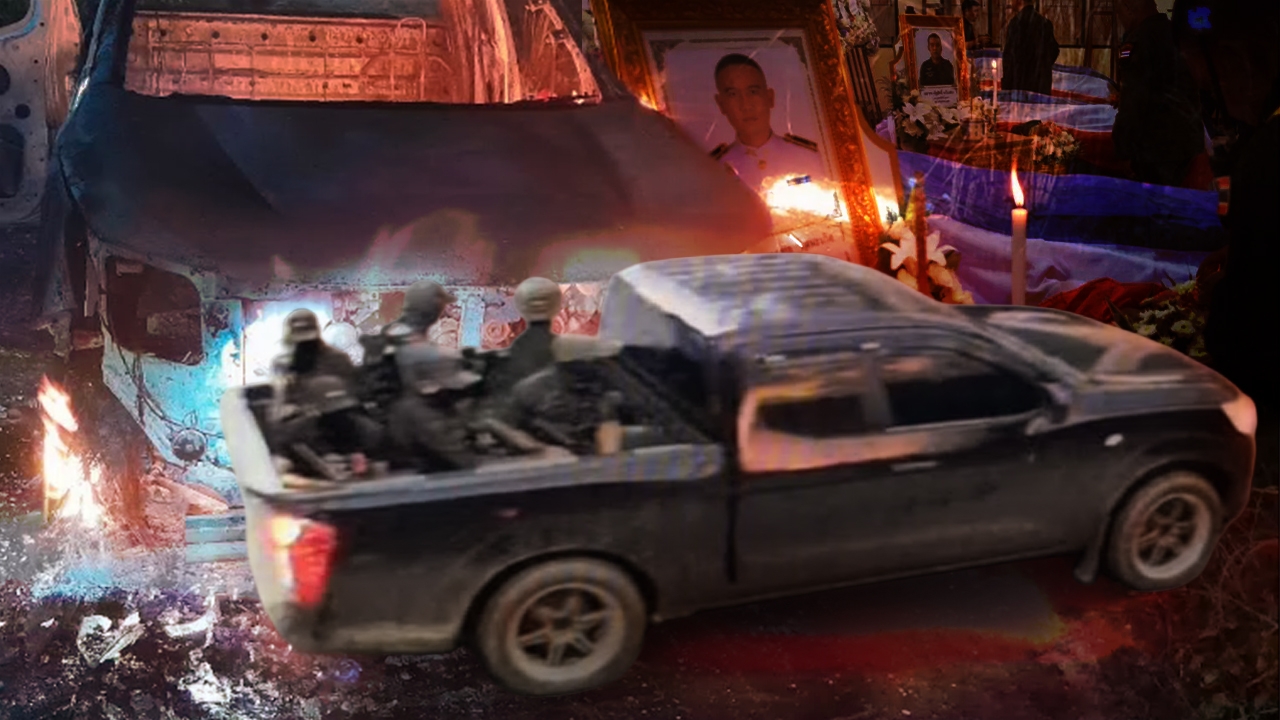
An in-depth analysis of the Narathiwat shooting that killed five rangers reveals that security sources believe the attackers deliberately chose a location with CCTV to generate news and spread fear, coinciding with August, a significant month for the southern insurgency movement.
On 22 Jul 2016 at 18:45, assailants opened fire and threw pipe bombs at the Bukeh Sami checkpoint in Village No. 7, Tanyongmas Subdistrict, Ra-ngae District, Narathiwat Province, resulting in five rangers killed and six civilians injured (read more:Summary of the Bukeh Sami checkpoint attack: nine attackers stole five guns and left over 100 spent shell casings scattered.)
Security sources revealed that preliminary investigations suggest the attackers were violent insurgents led by Mr. Maseafi Timo and Mr. Abdulla Mase operational leaders active in four districts: Ra-ngae, Janae, Si Sakhon, and Rueso.
Most recently, on 24 Jul 2016, Maj. Gen. Yod Awut Phungpaet, Commander of the Narathiwat Task Force, declared martial law over Narathiwat Province to pursue and arrest the perpetrators, granting authorities absolute and decisive powers, including immediate use of weapons under principles of necessity and proportionality.
Meanwhile, Prime Minister Anutin Charnvirakul described the incident as atrocious and brazen, emphasizing the need for security agencies to reinforce personnel and act decisively.

On the other hand, Police General Samran Nuanma, Deputy National Police Chief, the incoming 16th National Police Chief, believes that three consecutive violent incidents in Narathiwat—the car bomb at the old police station on 21 Jul, the attack killing five rangers on 22 Jul in Ra-ngae, and the shooting of a road construction foreman on 23 Jul—are linked.
Authorities have identified the suspects and are preparing arrest warrants for those involved in the three areas, with some warrants already issued. The next step focuses on prevention, with related agencies in the three southern border provinces being urged to take action.
The Thairath Online special news team contacted local security sources to uncover the background behind recent unrest in the three southern border provinces.
Sources indicated that the incidents are operations to instill fear. They are publicity efforts by insurgent groups; it is observed that attackers often include individuals resembling ordinary civilians who film or photograph during attacks. These are actually the movement’s media operatives collecting images for information operations (IO) specifically in the three provinces. Moreover, they select attack sites with CCTV to enable authorities or media to disseminate the footage.
“They publicize by ensuring CCTV captures the event, such as in a case where attackers on motorcycles fired while riding three abreast, deliberately targeting locations with CCTV. The insurgents feel victorious when footage is recorded.”
Regarding the targets of these attacks and IO efforts, sources say the insurgents aim to create fear locally and divide civilians from state authorities, focusing on two main groups. The first group is officials native to the three southern border provinces, who are Muslim and speak Malay, and the second group is civilians participating in government activities, whom the insurgents want to intimidate to discourage involvement.

August 1 is historically significant for the insurgency in the three provinces, marking the anniversary of the arson attack on 36 schools in Yala, Pattani, Narathiwat, and Songkhla in 1993. It symbolizes the start of armed resistance aimed at destroying institutions seen as eroding Malay identity. Authorities are closely monitoring movements and unrest during this month.
Sources further revealed that a major insurgent operation is possible this August. However, given recent leadership changes within the movement, attention is on whether this year’s approach will differ from previous years.
Currently, the insurgency’s activities continue to escalate, including recruitment, indoctrination, public displays in the three provinces, political actions, adopting Malay dress and language, and emphasizing shared ethnicity, language, and religion to foster group identity.
“Factional division persists. If emphasis on shared ethnicity, language, and religion ceases, the insurgency might end. But as long as these are stressed, an end is unlikely, even if violence temporarily subsides.”