

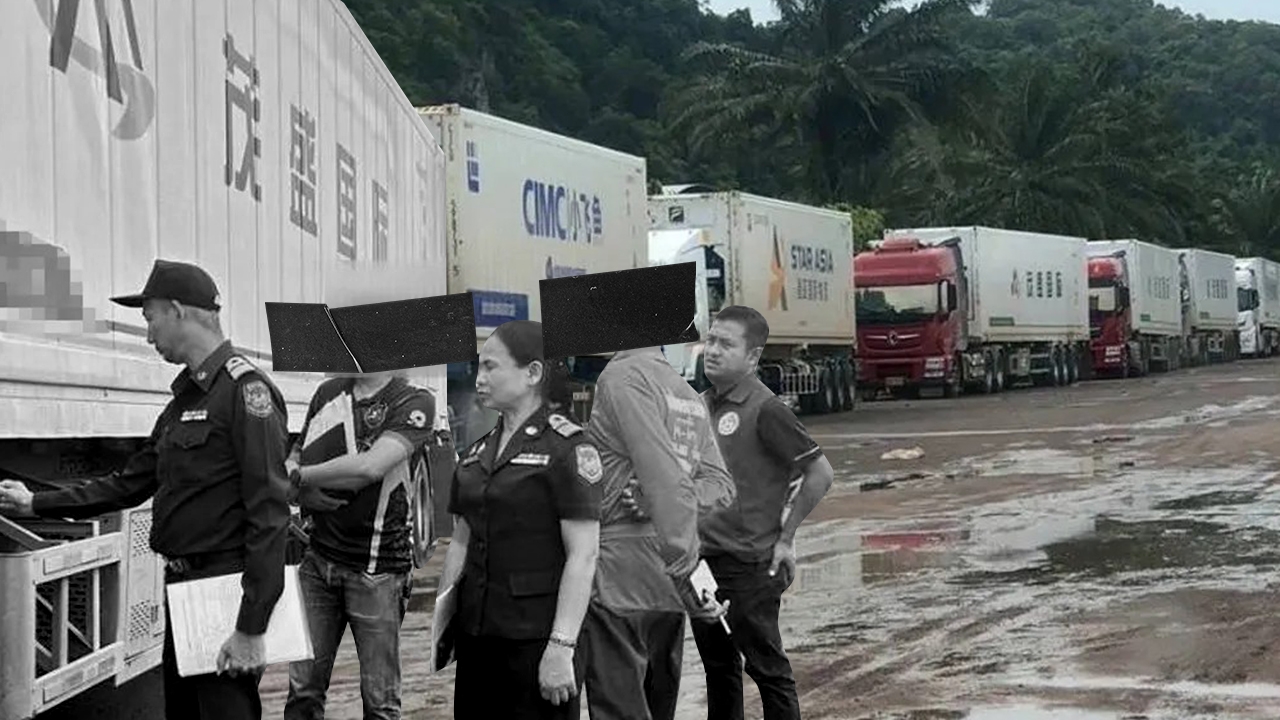
An in-depth examination of the issue involving "Chinese trucks" running off their designated routes down to southern Thailand, ignoring Thai laws by avoiding checkpoints and lacking GPS devices. The President of the Transport Federation exposes loopholes in international agreements, revealing Chinese trucks abusing rights and undercutting transport prices to the detriment of Thai operators.
Earlier in July 2026, reports emerged of relevant officials inspecting and intercepting "Chinese-registered trucks" at a fruit market in Lang Suan District, Chumphon Province. These trucks were found collecting fruit from packing houses to export to China via the Chiang Khong checkpoint in Chiang Rai Province. This constitutes running outside the designated routes under the Greater Mekong Subregion (GMS) economic cooperation framework and violates Thai laws, including bypassing weight-check stations and lacking GPS installation (Read more:Transport authorities intercept Chinese trucks illegally running south, seize five vehicles in Chumphon violating GMS rules)

Thairath Online's special reporting team discussed this issue with Mr. Thongyu Kongkan, President of the Land Transport Federation of Thailand. He revealed that annually, tens of thousands of Chinese trucks operate in Thailand, some legally and others illegally.
China's transport within Thailand occurs under the Greater Mekong Subregion (GMS) economic cooperation framework through the Cross Border Transport Agreement (CBTA) Early Harvest phase, covering six countries: Thailand, Myanmar, Laos, Cambodia, Vietnam, and China (specifically Yunnan Province and Guangxi Zhuang Autonomous Region). Trucks must use designated border points and routes only, prohibited from deviating or stopping to unload goods in other countries.
The specified routes in Thailand include the North-South Economic Corridor (NSEC), East-West Economic Corridor (EWEC), and Southern Economic Corridor (SEC), covering northern, central, northeastern, and eastern regions. Each country is allocated a quota of 500 truck licenses; China has fully utilized its quota, while Thailand has registered about 200 trucks so far.
Mr. Thongyu pointed out the current problem with Chinese trucks is their operation outside the designated GMS routes, extending down to southern Thailand, notably in Lang Suan District, Chumphon Province, an area with year-round fruit production. Additionally, these trucks violate Thai laws such as skipping weight-check stations, lacking GPS devices, and not having the required third-party insurance for trucks.

There is also the issue of Chinese companies nominating local entities in Laos, leveraging another cooperation framework, the 1999 Thailand-Laos bilateral road transport agreement. Although it sets border points and routes, it does not limit the number of trucks allowed.
Meanwhile, Thai trucks operating in Laos face restrictions due to Laos' COVID-19-era regulations since 2020, prohibiting vehicles and drivers from crossing into Laos. Although Thailand lifted these restrictions in 2022, Laos has not, creating obstacles for cross-border transport. Furthermore, Laos imposes varying fees at different checkpoints without standardization, adding costs and complications to cross-border trade.
The Land Transport Federation President noted that the influx of Chinese trucks impacts Thai transport operators in multiple ways. First, they compete directly with Thai operators for freight contracts.
Second, they engage in dumping—undercutting prices to outcompete Thai operators. This drives transport rates down because Thai operators cannot run round trips or "carry goods both ways," as Chinese trucks often do not allow Thai operators to haul cargo back, resulting in no return freight income and financial losses. This undermines Thailand's logistics system indirectly.
"Sometimes prices are cut by nearly 100%. For example, if a Thai operator charges 200,000 baht per trip, a Chinese truck might charge 90,000 baht. Since Chinese trucks have cargo outbound and inbound, two trips at 90,000 baht total 180,000 baht, while Thai operators only earn on one leg."
Third, there are concerns regarding security and safety. Trucks violating regulations by avoiding checkpoints or lacking GPS might facilitate illegal cargo smuggling.

To resolve these problems, the Land Transport Federation President proposed the government cancel the 1999 Thailand-Laos bilateral agreement, initially made when Laos was landlocked, but now Laos is land-linked, serving as a key transit and economic corridor for neighboring countries.
In response to concerns that cancellation might affect cross-border trade, Mr. Thongyu said the federation has urged the government to form a committee to study the pros, cons, and impacts on geopolitics, society, economy, investment, and cross-border trade.
They also proposed that Thailand establish "regional checkpoints" to collect additional fees for interregional transport, reducing disadvantages compared to neighbors like Laos, which charges varying fees at checkpoints, or Myanmar, which collects fees from both central government and ethnic groups. This would also improve inspection of trucks passing each checkpoint.
Meanwhile, until clear measures are implemented, relevant agencies must enforce laws equally for trucks of all nationalities and rigorously apprehend those running off designated routes.
"If trucks are found running off-route, they must be suspended from continuing, and cargo unloaded—not merely fined 5,000 baht at origin and destination then allowed to proceed to China. Relevant agencies, including highway police, the Department of Land Transport, and immigration, must cooperate."
Mr. Thongyu expressed concern about corruption and bribery, warning the government, "Do not allow Chinese interests to buy enforcement power from officials."