

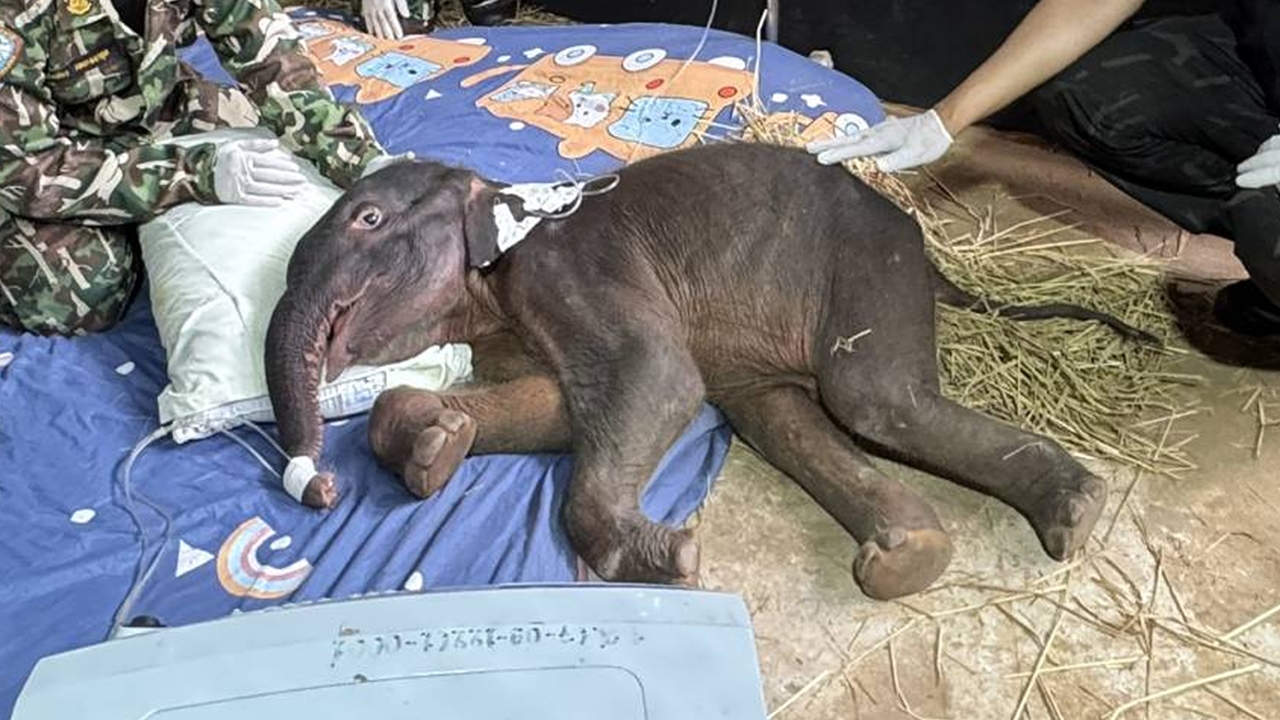
Inbreeding and natural disasters accelerate wild elephant calves getting lost from their herds, revealing two reasons why they often do not survive. This reflects the loss of "Jiw Saiyok," a wild elephant calf separated from its herd. Veterinarian "Mor Lot" analyzes that this usually happens to first-time mother elephants and calves aged 2-3 months.
On 30 Jul 2016, "Jiw Saiyok," a wild elephant calf lost near Nam Noi Stream, was found by villagers and officials. The calf had a leg injury and was feeding on roots and rocks. Veterinarians and staff monitored its health closely for six days before it died from acute kidney failure. It was the second wild calf this year to become separated from its herd.
According to statistics from the Department of National Parks, Wildlife and Plant Conservation, 2-4 elephant calves get lost annually, mostly during the rainy season or periods of unstable weather. These calves often suffer complications from herpes virus disease, which has a 60%-70% mortality rate.

Calf separation from herds occurs throughout forest areas nationwide, possibly signaling underlying issues. Thairath Online's special team asked veterinarian Phattharaphon Maneeon (Mor Lot), head of wildlife health management at the Department of National Parks, about the rising number of lost calves. Mor Lot identified two main causes for the situation as follows.
1. Infection with herpes virus disease.
This mostly affects calves aged 1–10 years. It is a contagious disease with severe impacts and a high mortality rate. Affected calves show fatigue, foot pain, and slower movement, causing them to lag behind the herd. They are often found alone seeking humans or officials without herd support.
2. Separation due to natural living conditions.
This includes incidents from forest fires, dry or rainy seasons, such as landslides causing calves to fall. Calves foraging outside forest areas may fall into pits when entering communities. Injuries from snares also cause separation. Additionally, wild elephants face inbreeding problems, leading to many calves being born with congenital disabilities.

In the case of Jiw Saiyok, veterinarians identified two causes. After testing showed no herpes virus, they confirmed the separation was due to a natural accident. It is believed the calf was walking near the river during rainfall, fell in, and was swept by the current, hitting branches or rocks. This caused muscle breakdown, releasing chemicals into the bloodstream that overworked the kidneys, resulting in acute kidney failure.
There have been several successful cases of rescuing and treating lost calves, with staff providing care until the calves are strong and safe enough to be released back into the forest. Some calves that cannot return to the wild continue to be cared for until maturity.
Most lost calves are aged 2-3 months or still nursing, as their bodies are weak and small. Wild elephants often cross rivers or mountains, and calves in remote areas lack sufficient caution, leading to accidents and separation. First-time mother elephants also lack experience in caring for calves.
Currently, unpredictable natural disasters, climate change, and weakened genetics are three key factors causing more frequent calf separations. Each calf may have different hidden injuries or diseases.

Mor Lot explained that when a lost wild calf is found, the first step is to try to return it to its herd. If the herd does not accept it and the calf is weak or injured, treatment begins. Care is meticulous and intensive, including feeding milk every 2-3 hours, keeping warm, and treating wounds until weaning. This involves 100% human care, or sometimes combined care by humans and foster mother elephants. After weaning, a decision is made whether to continue care or release the calf back to the wild.
Mor Lot emphasized that injuries caused by natural living conditions, whether directly or indirectly from humans, require urgent rescue and rehabilitation. Losing one elephant means losing irreplaceable genetic material. If environmental diseases or epidemics occur amid weak genetics and immune systems, the risk of extinction is very high.
Under climate change, not only humans but also wildlife are affected. The survival of wildlife indicates the future survival of humans.