

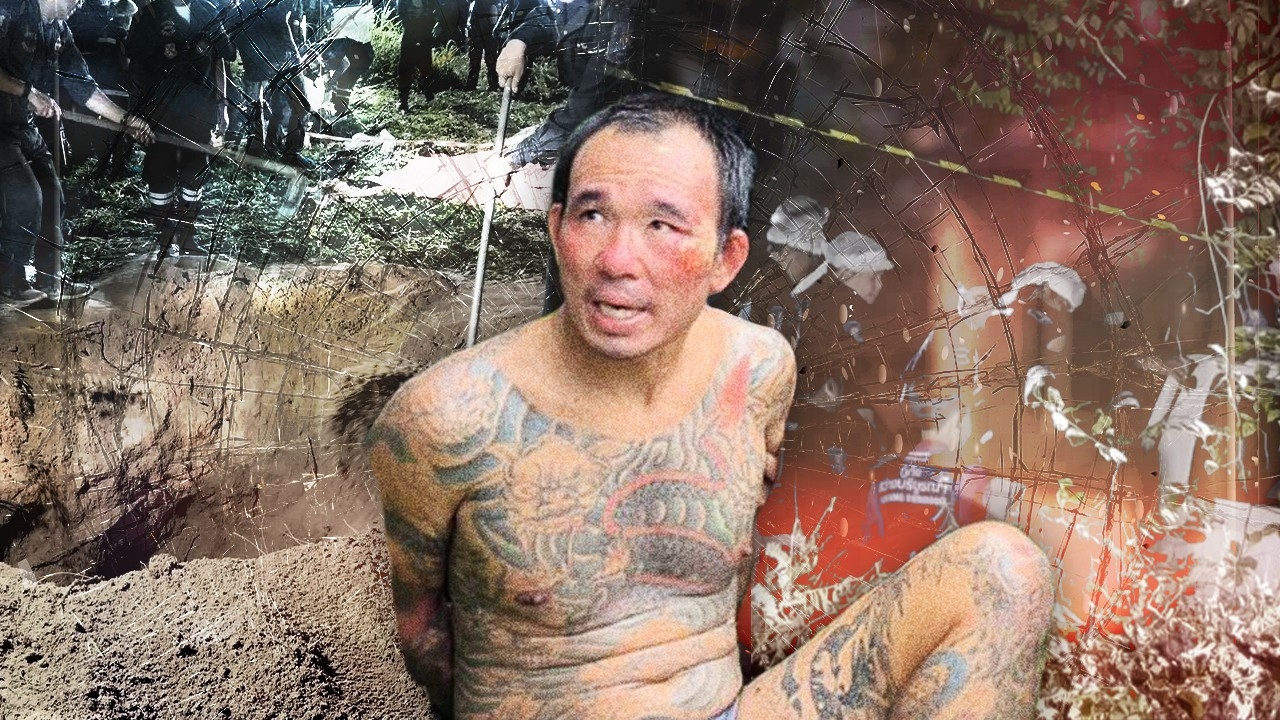
A criminologist decodes the case of "Ai Pong," a remorseless serial killer possibly fitting the "psychopath" profile—lacking empathy and failing to see others as human beings, reflecting mental disorders shaped by environmental factors.
The disappearance of two Russian siblings led police on a manhunt that uncovered the involvement of... "Ai Pong and Ai Thong" who have a history of repeated offenses and imprisonment. It was found that the victims were not only the two Russian siblings but extended to five brutally murdered and buried individuals, including a whole family—parents and child—killed despite no personal conflict, with the perpetrators claiming the motive was purely for financial gain.
This case sparked Thai society to question the legal and justice systems, asking why individuals with serious criminal records are released only to reoffend. Calls have intensified for swift legal action and the implementation of the death penalty due to the inhuman brutality of these crimes.
At the same time, questions arise about the mindset of the perpetrator: how can someone commit such cruelty without prior conflict or hatred, merely for robbery? Why is there no remorse, no sympathy for the victims, no sadness or fear of punishment? The perpetrator seems unable to comprehend loss, feels no guilt for their actions, and why are such killers increasingly visible in society?

Assoc. Prof. Dr. Thanandsak Bawornnantakul, criminologist and former lecturer in criminology and justice at Mahidol University, explains that some offenders may exhibit mental symptoms or latent psychotic disorders, often termed "schizophrenia." They are called psychotic killers, but the severity varies depending on each individual's life circumstances and experiences.
However, it is important not to misunderstand this classification as a form of protection or a human rights excuse to reduce or avoid punishment. Many other factors must be considered, and it should be understood that people with schizophrenia do not necessarily act like the stereotypical "mad person." . Psychotic killers may be anyone—neighbors, coworkers, lovers, or strangers on the street—who appear harmless. Such killers are cold-blooded, brutal, often able to blend into society without standing out, making them hard to detect and arrest. They do not appear insane; externally, they seem normal, but their actions reveal their disturbed inner psyche.
In the case of a brutal killer like Ai Pong, Assoc. Prof. Dr. Thanandsak believes that based on his behavior and crime planning, he likely suffers from schizophrenia or, in criminological terms, is a psychopath (Psychopath). Criminology has sought to understand the motives behind such killers, notably through psychologist Hervey Cleckley's work in The Mask of Sanity, which describes individuals who appear normal, intelligent, charming, and articulate, arousing no suspicion. Yet beneath this facade lies an emptiness devoid of genuine emotional feeling—a profound mental impairment.
These individuals are like "knowing the words but not hearing the music." This means they understand concepts such as love, sorrow, or morality but never truly experience their emotional meaning. Consequently, they lack empathy, guilt, or shame, boldly harming others or exhibiting destructive behaviors without distress. Their cruelty stems from a disruption in the empathy circuit—they see no value in human life and disregard the consequences of their crimes, often committing savage, unfeeling, and extremely cruel acts, viewing others as less than human. Some even take pleasure in others' suffering, feeling negative emotions that drive them to commit acts others would not.

This reflects a process called dehumanization, where viewing others or animals as non-living entities enables violent or harmful behavior. The mental state of such killers involves biological brain development, with reduced activity in reasoning centers and heightened raw emotions like anger and fear. Psychologically, this leads to a lack of empathy—indifference, unawareness, or numbness to others' pain—resulting in a ruthless, unfeeling mindset commonly labeled as "Cleckley Psychopath."
In contrast, normal individuals process experiences with brain mechanisms involving understanding and reasoning. For example, road rage often arises from perceiving inappropriate behavior by other drivers, leading to anger that may escalate unless diffused by apologies or polite gestures. When empathy is intact, violent responses can be averted. But those lacking empathy may see themselves as threatened or inferior, making violence more likely, and over time this response becomes normalized.
However, in those with schizophrenia, a mental defect called psychopathy (Psychopathy) is characterized by absence of remorse, inability to understand others' feelings, lack of empathy, and no sense of pity or guilt. Such individuals cannot relate to others as normal human beings with thoughts and emotions.
Besides mental impairment, it is believed that social environment plays a formative role, such as growing up in abusive, violent, or inhumane settings during childhood, leaving deep psychological scars. Children raised amid violence often become emotionally numb, normalizing brutality. This environment leads to a decline in empathy, which may be temporary or permanent.
The likelihood of violent acts depends on individual and situational factors. Crucially, when empathy diminishes—when one fails to see others as human—it becomes easier to commit cruel or brutal acts. Such dehumanization has appeared in cases like the Rwandan genocide or the Holocaust, where victims were labeled "cockroaches" or "pests" to justify extreme cruelty.

Applying these ideas to Ai Pong's actions, social accounts from relatives, friends, and acquaintances indicate that he grew up in an abusive household where his father inflicted physical and emotional harm, with the father also mistreating family members, causing deep psychological wounds.
As an adult, Ai Pong repeatedly committed crimes and was imprisoned multiple times, becoming accustomed to the violent prison environment, showing no remorse or fear of consequences. His crimes against the Russian siblings and the family were carried out with ruthless brutality, without any sign of guilt or restraint.
Moreover, Ai Pong exhibits no reflection on the severe impacts of his actions on others, the country's reputation, or society. When arrested, he showed a straightforward, calm demeanor with no remorse or sympathy for his victims or the damage caused. When asked if he regretted any of his crimes, he did not respond but appeared to convey, "I do not regret anything; what happened, happened."
While in prison, he lives normally—eating and sleeping well, indifferent to suffering, exhibiting apathy. Thus, he fits the profile of a psychopathic or schizophrenic killer (Psycho Killer). The extent and chronicity of his condition require further assessment by mental health professionals.