

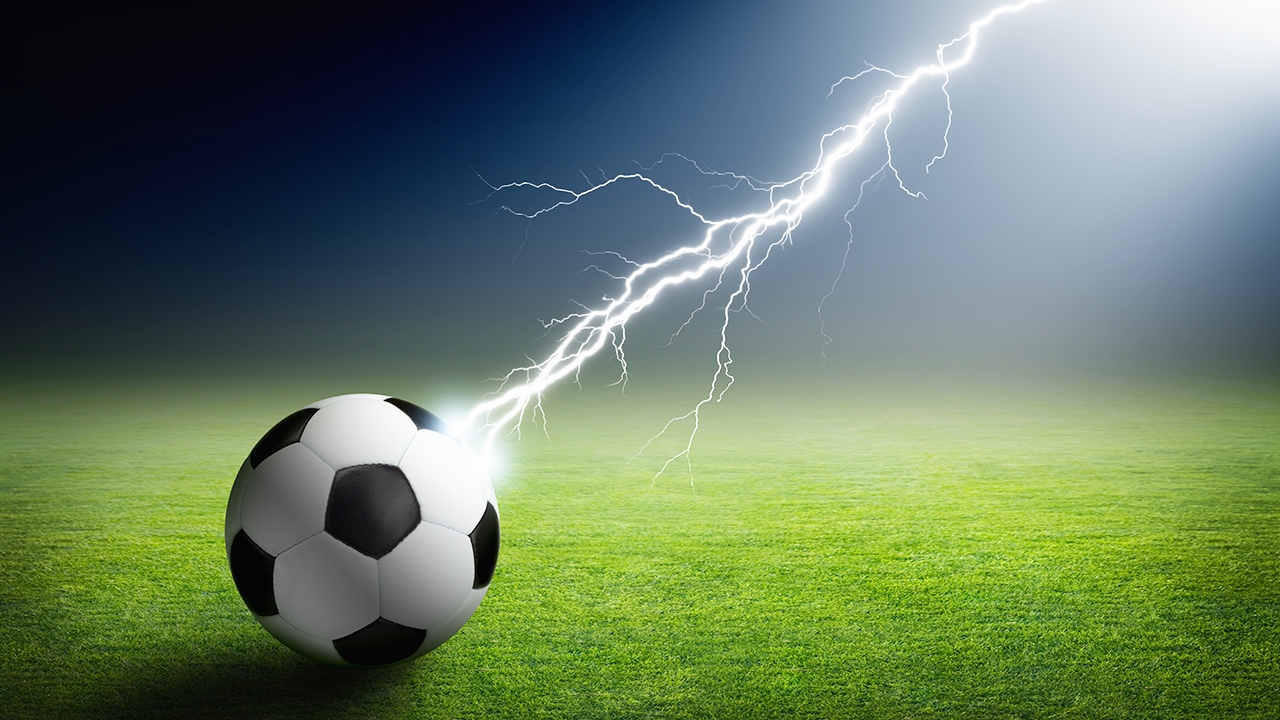
Lightning striking in the middle of a football field: 5 risk factors for players struck by lightning, the danger radius, and prevention methods. Have you ever wondered why news about "lightning striking football fields" occurs frequently, and why footballers running in open spaces become lightning targets, even when there are tall light poles or nearby buildings around the field?
Scientific causes analyze the lightning radius affecting people nearby, along with lightning prevention methods that event organizers and athletes must know to ensure maximum safety during competitions.
Lightning incidents are not just bad luck but are based on scientific and meteorological principles, with main contributing factors as follows.
1. Football fields are open spaces. Sports fields are flat areas without obstructions, causing electrical charges from storm clouds to seek the shortest path to the ground.
2. Players are the tallest points (Upward Streamer). While playing football, standing players become the "tallest points in the area by comparison," causing their bodies to release positive charges that attract negative charges from the clouds.
3. Sweat and moisture. Players' bodies soaked with sweat containing sodium salts, combined with rain-wet grass, serve as excellent conductors that reduce the electrical resistance of the skin.
4. Metal on the body and equipment. Metal studs under cleats, goalposts, or jewelry all act as lightning attractors.
5. Underground water systems. Sprinkler systems and metal pipes beneath the football field can conduct electricity effectively underground.

The danger of lightning is not only from direct strikes but also from high-voltage currents of tens of millions of volts that can affect others at a distance via two main forms.
1. Ground current — the most dangerous.
When lightning strikes a point on the field, the electric current spreads outward from the center along the wet ground in a circular pattern, with a danger radius of 10 to 30 meters.
Why do multiple people lose consciousness simultaneously? This is due to the phenomenon called step voltage. When players run, their left and right feet are apart, creating a voltage difference; current flows into one foot, passes through the body/heart, and exits the other foot, potentially causing sudden cardiac arrest or fainting across the team.
2. Side flash.
Lightning can strike taller objects such as goalposts, benches, or light poles, then "jump" to people standing nearby within 1 to 2 meters immediately.
The impact extends to spectators, substitutes, or referees who can easily be injured by currents running through wet ground or by touching metal fences around the field.

To prevent casualties, both event organizers and athletes should follow these safety measures.
1. Follow the "30-30 rule."
If the time between seeing lightning and hearing thunder is less than 30 seconds, it means the storm is within 10 kilometers and play must be stopped immediately and everyone evacuated from the field.
After hearing the last thunderclap, wait at least 30 minutes before returning to the field.
2. Seek shelter in safe places.
Safe places include fully enclosed concrete buildings or vehicles with metal roofs (Faraday cage effect).
Avoid large trees, light poles, benches near the field edge, metal equipment, and never lie flat on the ground.
3. Emergency survival posture (Lightning Crouch).
If trapped on the field and unable to escape, perform the Lightning Crouch.
Squat low with your head down and hands covering your ears.
Keep both feet close together tightly to reduce the effect of step voltage.
Balance on your toes to minimize body contact with the ground (lying flat on the ground is strictly forbidden).