

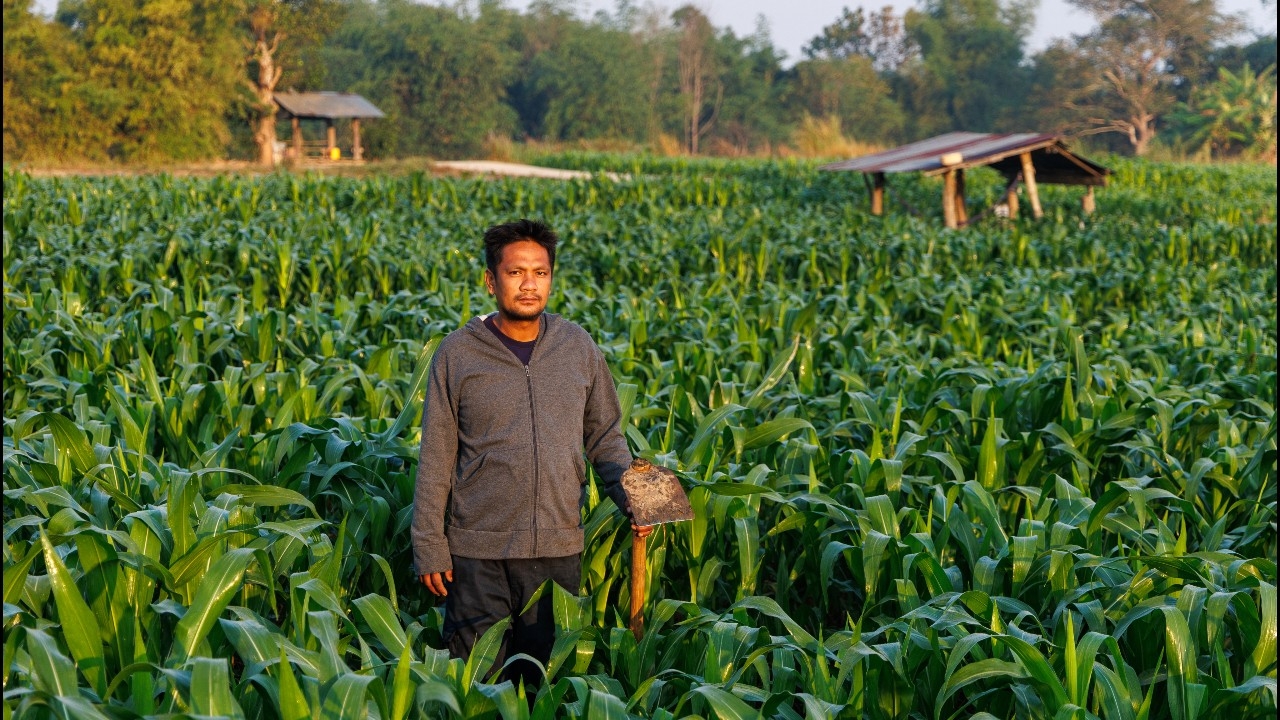
"When I see my mother's smile because her son has returned to be the same person again, all my exhaustion disappears." ,
Kavee Kaenchanthong, 37, a farmer and volunteer with the Give Hope group, works to educate about Harm Reduction and connects substance users in the community with drug treatment services.
I was born and raised in Mae Kasa, Mae Sot District, Tak Province. Drugs like methamphetamine, cannabis, and heroin are easily accessible here—they're everywhere. But as a child, I never got involved with drugs because my group of friends was all anti-drug. If anyone used drugs, the friends would reject them. Since I was in that group, I stayed away from drugs as well.
I started using substances as an adult, around 32 or 33 years old. At that time, I was working very hard—cutting sugarcane, driving, hauling cane to the factory. Some days I left home at 5 a.m. and got back at 2 or 3 a.m. Sometimes I returned the next morning. I barely got any sleep.
I'm the eldest child. My father was often ill, and my mother couldn't handle the work alone. My siblings were still studying. I had to pay for the truck installments, take care of the house, look after my parents and siblings. I thought I was the strongest person in the family, so I had to carry everything.
The first time I tried opium, a coworker said to me, "Try it. It relieves pain and soreness. And it won't show up in a urine test." At that time, I didn't think it was to get high. I thought it would help me work better and finish without pain or fatigue. But after using it repeatedly, I got addicted.
At first, I used opium, but it was troublesome—you had to boil it and make a fire. Then I found heroin, which was easier: just dissolve and use. It got heavier and heavier. What started as a way to keep working became something I couldn't work without.
The problem began when I ran out. Without heroin, I wouldn't go to work. My body would writhe in agony—stomach pain, muscle pain, joint pain, bone pain. But even a little use would lift all the suffering away, like removing the whole world from me.
I tried to quit on my own 20 to 30 times. I was determined to stop cold turkey, lying at home telling myself I wouldn’t use today or tomorrow. But after one day, the next was unbearable, and I had to find drugs again. I was disappointed in myself, but nothing could help me then.
I was once the one earning money for the family, but then the money started disappearing on heroin. The truck payments began to fall behind, even though I’d never missed them before. The money meant for the truck and household I secretly took to buy drugs. At first, I thought using a little wouldn't hurt, but the amount kept increasing daily. The household's money kept disappearing.
My mother kept warning me, "You're grown now. It's not good to ruin yourself at this age. It's still not too late to turn back." I wanted to change, for my mother, father, and siblings. But I couldn't quit.
I wanted to get treatment but was afraid—worried about having a bad record at the hospital. From childhood until then, I had no bad record, no arrests, nothing. I was scared to walk into a hospital, but I still tried to find information about hospitals that could treat heroin addiction.
In the end, my mother and siblings took me. I found out that Thanyarak Hospital in Chiang Mai treats heroin and opium addiction. I told my mother. That night, she called my siblings, and one came to take me to Chiang Mai on 17 October 2024. I still remember that day.
At the hospital, they gave me methadone. The first 14 days were for detoxification, and the next 14 days involved activities—playing sepak takraw, pétanque, music. I stayed there for 28 days and had time to reflect on everything—if I hadn’t gotten involved with drugs that day, my life wouldn’t have reached this point.
When I returned, I was afraid and had learned my lesson. I didn't want to go back to that life. When I meet young people still using drugs, they ask, "Brother, you're back. Want to keep using?" I tell them, "No more. I'm scared. You all should stop, too. If anyone wants to quit, I can take you. I know where to go."

Nowadays, I help care for substance users in the community. I distribute clean equipment to those still using needles. If anyone wants treatment, I help them get there, contact services, and accompany them. Some aren't ready to quit yet; we can't force them. But if they keep using, I urge them to use clean equipment to avoid HIV, hepatitis, or other diseases. When they're ready to quit, I'm ready to take them.
Some don't understand why we distribute clean needles to drug users. I don’t support drug use. I just don’t want them to get sicker. If they quit drugs one day, they should only have to overcome addiction, not diseases from sharing needles.
I've taken about 5 or 6 young people for treatment. Some improved after returning, some relapsed. That’s okay. I tell their parents, "If it doesn’t work this time, I’ll take them again. Quitting isn't a one-time thing."
I see substance users as sick people, not crazy or demons. They were once good people. Everyone addicted wants to quit; no one wants to be trapped in this cycle. If we help them, they regain their lives, their parents get their children back, and society gains a restored member. Every time I see my mother's smile when she gets her old son back, all my exhaustion fades away.
Note: This story is based on a direct interview with an experienced individual who volunteers with the Give Hope group in Tak Province. He supports substance users in the community through connecting health services, providing information, and non-stigmatizing care.