

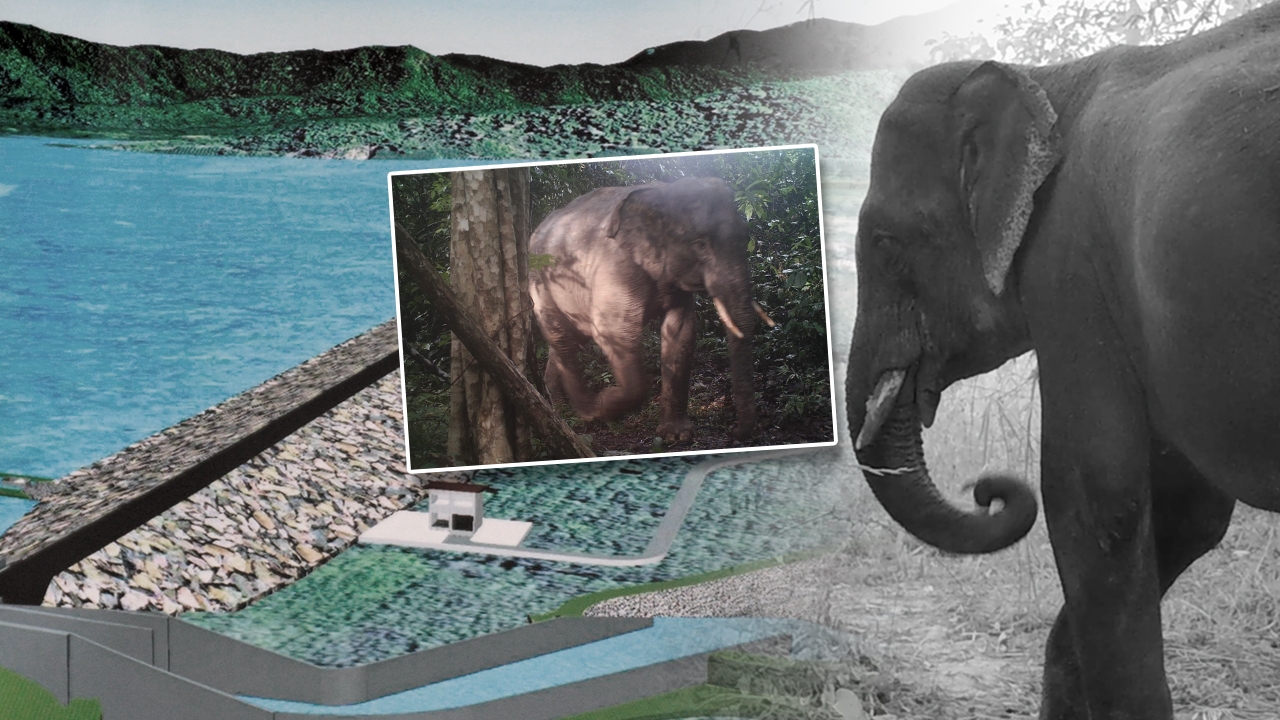
The Cabinet has approved the progress of the Khlong Wang Tonot Reservoir project. The Seub Nakhasathien Foundation is preparing to file an administrative lawsuit, stating that the EHIA is inconsistent with the facts and expressing concern that the Khao Sip Ha Chan forest will be submerged, pushing wild elephants into community areas. - Supporting capital interests over farmers, paving the way for cutting conservation forests nationwide.
On 5 Aug 2026, the Cabinet resolved to approve the Ministry of Agriculture and Cooperatives, through the Royal Irrigation Department, to proceed with the Khlong Wang Tonot Reservoir project in Chanthaburi Province. The project has a budget of 7.2 billion baht and a 7-year plan (Fiscal Years 2027–2033) to increase water resource security in the eastern region, meeting rising water demands from the public, agriculture, industry, and development within the Eastern Economic Corridor (EEC).
The reservoir will have a capacity of 99.5 million cubic meters, supporting irrigation for over 87,700 rai. The government emphasized that the project must comply with laws and environmental measures to balance development with natural resource conservation.

However, the project has faced opposition because it is located within Khao Sip Ha Chan National Park and Khun Song Reserved Forest, impacting more than 11,982 rai of forest area combined.
There are concerns that the true beneficiaries may not be the public or agricultural sectors, with questions raised about whether the water will primarily serve industrial uses such as Data Centers.
On 13 Aug 2026, Mr. Danucha Pichayanan, Secretary-General of the National Economic and Social Development Council (NESDC), denied that the project aims to supply water to Data Centers, stating it is to meet increased water demands in industry and expanding durian orchards.
Thairath Online special team discussed this issue with Mr. Panudet Kerdmali, Chairman of the Seub Nakhasathien Foundation. The foundation has continuously opposed the Khlong Wang Tonot Reservoir project. In June 2026, it filed a lawsuit with the Administrative Court to revoke the approval of the Environmental and Health Impact Assessment (EHIA) report for the reservoir and requested a temporary injunction to suspend the use of the EHIA for revoking parts of Khao Sip Ha Chan National Park.
The foundation points out that the report is inconsistent with facts and will cause severe damage to nature, especially the 6,191 rai of Khao Sip Ha Chan National Park affected. This area is a vital and rich forest, part of the ecological corridor connecting five eastern provinces, between Khao Ang Rue Nai and Khao Soi Dao wildlife sanctuaries, crucial for addressing wild elephant issues. The area hosts seven large mammal species, each with relatively high population densities.

Mr. Panudet revealed that after the EHIA was approved in 2021, researchers from the Department of National Parks studied the Khao Sip Ha Chan forest and found conflicting data in three main areas.
The first issue is the study of the ecosystem and forest type in the area. For example, the EHIA states that about 70% of the reservoir area is mixed deciduous forest, while the Department of National Parks’ research confirms it is dry evergreen forest. These two forest types have different tree species and surveyed timber volumes that do not match.
The second issue concerns wildlife data in the EHIA. The EHIA reports about 20-30 elephants in the area, mostly transient. However, data from the Department of National Parks and the Phetchaburi Innovation Office, with long-term monitoring identifying individual elephants, shows two groups: a resident group of about 70-80 elephants and a migratory group moving between Khao Ang Rue Nai and Khao Soi Dao wildlife sanctuaries, totaling over 100 elephants. Other important wildlife, such as gaur and hornbills, were not recorded in the EHIA.
The third issue relates to land use conditions. The Department of National Parks acknowledges that this area was formerly logged under concession but has since been partly restored through reforestation. About 30% of the reservoir construction area has been restored and contains many tree species used by elephants and other wildlife as food. Destroying this will affect the ecosystem, including wildlife habitat and food sources.
Because the initial EHIA data are incorrect, mitigation measures like reforestation are ineffective. The Department of National Parks has stated there is insufficient area under its responsibility to plant compensatory forest at the required scale. Despite efforts to provide information, the department has not received cooperation from related agencies, especially the Royal Irrigation Department and the National Environment Board.
“Our concern is the inaccurate data, which affects environmental impact analysis and mitigation measures that do not reflect the reality on the ground. This is why we filed the lawsuit and oppose the Cabinet’s rush to approve the project before the data has been mutually accepted by the Department of National Parks and the Royal Irrigation Department.”

Mr. Panudet expressed concern that the area for reservoir construction is a lowland part of Khao Sip Ha Chan National Park and a critical habitat for wildlife, especially "wild elephants." If it becomes a reservoir, elephants cannot move to other parts of the park because those areas are steep, unsuitable for habitation, and already occupied by resident elephants in Khao Ang Rue Nai or Khao Soi Dao.
Currently, the area is not heavily affected by wild elephants, but if they lose habitat and food, there is a risk they will enter community areas, damaging crops and threatening local safety.

Regarding whether the Khlong Wang Tonot Reservoir will solve local water issues for agriculture and expanding industry, Mr. Panudet said the project originated in 1992 during a drought with no large water storage, affecting farmers. Although water shortages still occur briefly, three reservoirs with a total capacity of 209 million cubic meters already exist in the Khlong Wang Tonot watershed, but local residents still lack water access.
To allocate water for agriculture, clear data on agricultural water needs is necessary. Existing reservoirs could be rehabilitated to improve storage efficiency and irrigation systems upgraded. If new construction is required, smaller reservoirs avoiding forest areas and matching actual water demands would suffice and reduce costs.
Discussions revealed that long-time local Thai durian farmers already have their own water systems, such as ponds or groundwater, understanding the impact of water shortages. Therefore, the issue likely concerns new orchards, particularly those established by external investors pressuring authorities for irrigation water.
There is also the question of whether the project primarily targets industry or agriculture. At previous forums, it was mentioned that water might be used for Data Centers.
"When developing projects like this, agriculture or local community benefits are often cited as justification, but other hidden interests may exist."

Mr. Panudet updated that the foundation plans to file a new lawsuit to revoke the EHIA approval because previously the Administrative Court said no administrative order existed to consider. Now, with the Cabinet's approval, this constitutes an administrative order. Affected parties, especially local residents, will join the lawsuit.
The lawsuit aims first to obtain a court injunction to halt project progress using the flawed EHIA report, and second, to hold accountable those who approved the process.
There is concern that if this project is completed, it will set a precedent for building dams in conservation areas nationwide, including World Heritage sites like Dong Phayayen–Khao Yai Forest Complex, where dozens of projects await approval, mainly to supply water to the EEC.
"The government should not insist on unlawful processes. If the intention is truly to help local people, there are more appropriate and less costly alternatives. The voices of genuine local farmers, many of whom in Chanthaburi do not want this project, should be heard. There is also distrust in the environmental and water management process. The government must take this seriously and reconsider."