

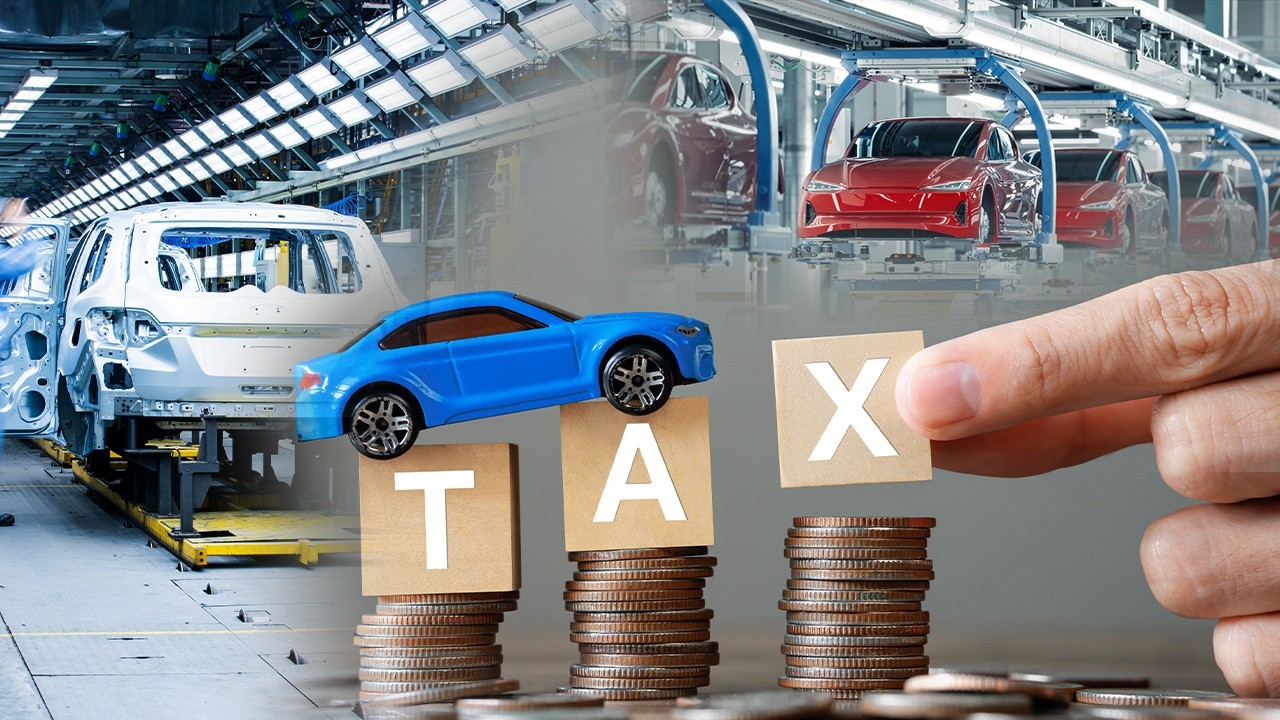
Experts agree on overhauling vehicle taxes before it’s too late, advocating for equal treatment of electric vehicles (EVs) across all manufacturers without abandoning combustion engine cars, to protect Thailand’s supply chain and workforce. They note Thailand still holds advantages over Indonesia.
Last week, debate arose regarding Thailand’s automotive industry after Indonesia's Finance Minister announced an invitation to Toyota, the Japanese automotive giant, to relocate its production base from Thailand to Indonesia, offering to grant requested incentives.
Meanwhile, Mr. Supakorn Rattanawaraha, Deputy Managing Director of Toyota Motor Thailand Co., Ltd., commented to Thairath Online news team on the matter, urging the Thai government to revise its tax structure for fairness and equality. He pointed out that Thailand’s automotive industry currently faces excise tax issues, especially concerning imported vehicles sold domestically.
Supakorn explained that imported electric vehicles pay a low import tax rate of just 8% and receive a government subsidy of 50,000 baht per vehicle under the EV 3.5 policy. This effectively means imported EVs almost avoid taxation, whereas domestically produced vehicles pay full taxes. This situation directly harms local manufacturers and causes significant tax revenue losses for the government (read more:Supakorn, Toyota’s leader, urges the government to protect Thailand’s automotive base and block exploitative financial maneuvers through legal and tax loopholes)
Recently, Deputy Prime Minister and Finance Minister Aekniti Nitithanprapas revealed he has ordered an expedited revision of the vehicle excise tax structure to ensure fairness and encourage domestic manufacturing, aiming to finalize the review by September 2026.
Aekniti stated this excise tax restructuring aims to create fairness and equality, eliminating discrepancies among countries with free trade agreements (FTAs) that enjoy lower customs duties on imports than others.
Therefore, excise tax is a tool to ensure domestic fairness and could increase Thailand’s tax revenue by leveling the playing field between importers of complete vehicles and manufacturers who invest seriously in production bases in Thailand.

Thairath Online’s special team discussed this issue with Dr. Nanarit Pisalyabut, a senior public policy and economic researcher at the Thailand Development Research Institute (TDRI). He views the current global trend as electric vehicles (EVs), including hybrids, becoming a major global industry. Thailand should support all types equally rather than favoring any specific one, and must revise product classification criteria to avoid unfair advantages or disadvantages.
Meanwhile, regarding combustion engine vehicles, or fuel-powered cars, Thailand should position itself as the last surviving manufacturer in this market segment (Last Mile Standing) as the world and competitors transition to EVs. This supports those still using traditional systems and sustains parts of the combustion vehicle supply chain that generate significant value.
“We shouldn’t abandon any path; this approach benefits both sides. We should leap to new technologies—be it EVs, hybrids, or others—without restricting competition. At the same time, we must not leave behind the old sector, since some consumers adapt slowly.”

Dr. Nanarit agrees that restructuring vehicle excise taxes is appropriate, focusing on maximizing benefits for investors and Thailand.
Regarding tax fairness, there are two aspects. First, equal treatment among EV manufacturers, where all brands should face the same tax rates or those using domestically produced parts should receive lower rates than importers.
“If imports are cheaper, who will manufacture in Thailand? Therefore, the government must ensure imports are more expensive than domestic production by any means.”
Second, fairness between EV and combustion engine manufacturers, which requires balance. Tax policies should apply two criteria: the Polluter Pays Principle, taxing higher pollution vehicles more—already in use—but also consider the country’s broader benefits beyond environmental gains.
The other criterion is that vehicle types providing benefits through employment and domestic supply chains should also receive subsidies, possibly via BOI criteria. The government must weigh these two factors to achieve fairness, considering both environmental and economic benefits.
“From an environmental view, EVs have an advantage, which is appropriate. But economically, do they have an edge? Combustion vehicles generate significant employment and supply chain benefits and should also gain advantages. Otherwise, EVs must increase their contributions to match this, which currently they do not. So, a balance is necessary. If Thailand abandons combustion vehicles entirely, it loses these economic benefits. We might gain a better environment but at the cost of people’s livelihoods.”

Dr. Nanarit identifies two cautions in this tax restructuring. First, fiscal prudence, since Thailand’s limited budget restricts subsidies. If subsidies are replaced by tax reductions, government revenue declines. Careful, cost-effective implementation is essential.
Second, international relations, as policies affecting foreign ties require government effort, especially with China, which supports its own manufacturers. In past disputes, China has responded directly or indirectly. Thailand must ensure its policies are principled and properly managed.

Regarding Indonesia’s invitation to Thai combustion vehicle manufacturers to relocate, Dr. Nanarit believes this is unlikely. Besides manufacturers confirming no relocation plans, Thailand holds natural advantages. Thailand’s natural advantages include lower exposure to natural disasters compared to Indonesia and other regional countries, and superior transport connectivity to neighboring nations.
Also, manufacturers invest in Thailand due to a large domestic car market—around 700,000 to 800,000 vehicles—and relatively good infrastructure, such as roads. Given these advantages, the government should preserve them and avoid creating excessive disparities in benefits.
“Thailand’s advantage in combustion vehicle production has been shrinking as EVs gain domestic market share and government policies create competitive imbalances. Manufacturers aren’t asking for special privileges, only equal competition. The government should prioritize this because fair competition benefits consumers and supports SME growth and employment through supply chains.”

For engines up to 3.0 liters:
- CO2 emissions up to 100 g/km: 13% tax
- CO2 emissions 101-120 g/km: 22% tax
- CO2 emissions 121-150 g/km: 25% tax
- CO2 emissions 151-200 g/km: 29% tax
- CO2 emissions over 200 g/km: 34% tax
Engines over 3.0 liters or luxury/supercars pay 50% tax.
For engines up to 3.0 liters:
- CO2 emissions up to 100 g/km: 6% tax
- CO2 emissions 101-120 g/km: 9% tax
- CO2 emissions 121-150 g/km: 14% tax
- CO2 emissions 151-200 g/km: 19% tax
- Pure electric range of at least 80 km per charge: 5% tax
- Pure electric range under 80 km per charge: 10% tax
- Engines over 3.0 liters: 30% tax
- Passenger EVs taxed at 2% (reduced from 8%)
- Electric pickup trucks taxed at 2% (previously exempt with 0% tax)