

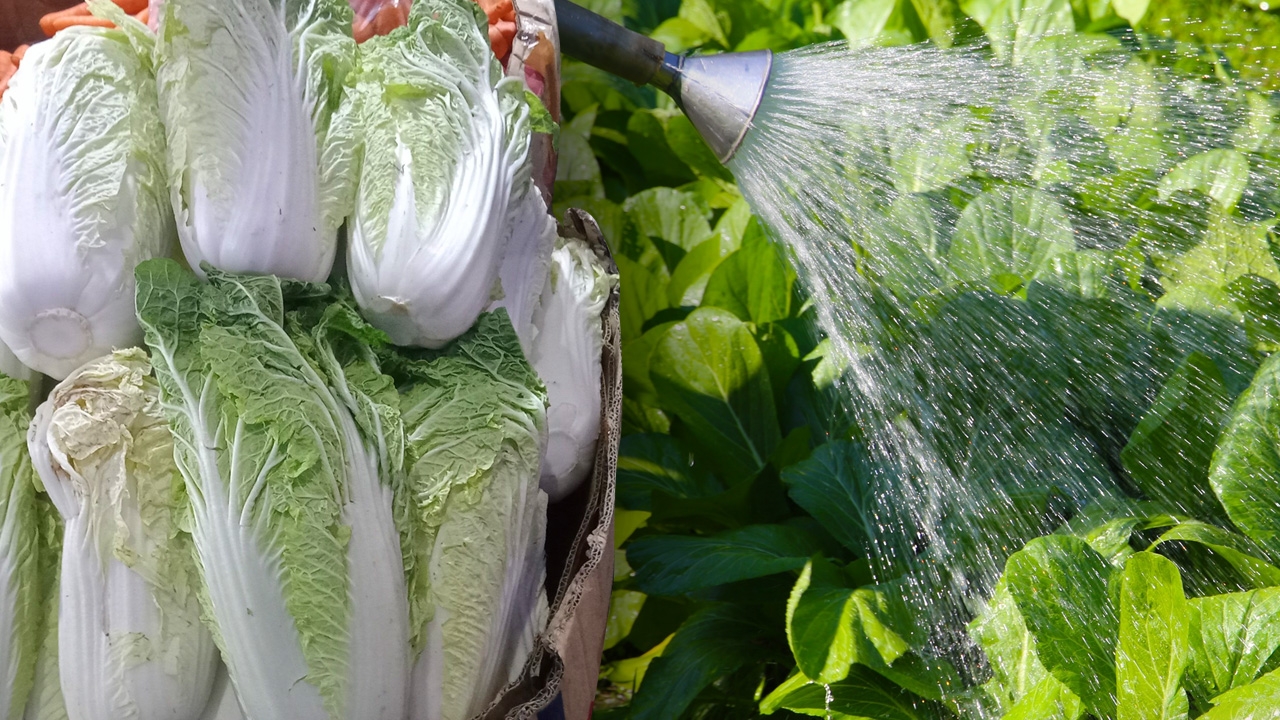
Thai or Chinese vegetables: how to choose fresh, safe produce and know its origin. Here are 8 methods to identify vegetables that carry no risk of chemical residues. News reports about vegetables from China entering the Thai market have led many consumers to question where their daily vegetables come from and how to select them with confidence in freshness, safety, and value.
Professor Dr. Puangrat Kaewlom from Chiang Mai University explains that Thailand is in a tropical zone with relatively high temperatures and monsoon influences. In contrast, China is vast, covering cold, temperate, high mountain, and subtropical zones, providing suitable areas for large-scale production of cool-weather vegetables.
During winter, especially in northern Thailand and highland areas, many vegetables can be grown such as Chinese cabbage, cabbage, cauliflower, broccoli, carrots, celery, peas, sweet peppers, and various salad greens. Produce in this season is usually of good quality and abundant in the market.
However, in summer and the rainy season, high temperatures and humidity make it difficult to grow many cool-weather vegetables, especially in lowland areas. In Thai summers, vegetables may grow slowly, fail to form heads, flower early, and be smaller. During the rainy season, continuous moisture and rainfall increase risks of plant diseases and leaf spotting, reducing yield and raising care costs.

Vegetables that become harder to cultivate during hot and rainy seasons include:
Cauliflower, broccoli, certain cabbage varieties, and Chinese cabbage.
Head lettuce or iceberg lettuce, carrots, and celery.
Peas, sweet peppers, beets, and some types of spinach.
Although these vegetables can still be grown in highland areas, greenhouses, or controlled environments in Thailand, quantities may be limited and costs higher. If consumers see large amounts of these vegetables out of season with large size, uniform shapes, and relatively low prices, they should check labels or ask about origins, as these are likely imports from climates better suited for their growth.
Data from Chiang Khong Food and Drug Checkpoint states that major imported vegetables passing through include Chinese cabbage, cabbage, broccoli, chili peppers, and cauliflower. Other economic vegetables from China found in Thai markets include garlic, onions, carrots, potatoes, ginger, and some mushrooms. These are produced in large quantities, preserved, and transported well, allowing year-round availability in Thailand.
Consumers should select vegetables based on the point of sale, as Thai vegetables sold in supermarkets usually have labels with product information, whereas fresh market vegetables are often sold unpackaged without labels. Checking vegetables from these two sources requires different approaches.
1. Choose vegetables according to the season.
Knowledge of seasonal cycles is a basic tool useful in both supermarkets and fresh markets. Winter is when Thailand, especially the north and highlands, can produce cool-weather vegetables well. In summer and rainy seasons, choose vegetables suited to hot, humid climates such as Thai cucumbers, long beans, winged beans, loofah, pea eggplants, okra, morning glory, ivy gourd, winged bean leaves, climbing wattle, cha-om, cha-plu, holy basil, sweet basil, and lemon basil.
If buying cool-weather vegetables in summer or rainy seasons, especially large, uniformly shaped ones sold in large quantities, consumers should verify or inquire about their origin before purchasing.

2. Choose native and local vegetables.
Native vegetables are well adapted to Thailand's hot, humid climate, so they can be locally grown naturally, require simple care, and are less likely to be imported than temperate economic vegetables. Choosing native vegetables is an easy way to support Thai farmers, reduce transportation distance, and increase dietary variety.
Examples of native and local vegetables include ching da leaves, cha-plu, cha-om, ivy gourd, climbing wattle, sweet leaf bush, wild sweet leaf, yanang leaves, climbing wattle, acacia, sesbania flowers, senna leaves, winged beans, pea eggplants, Thai cucumbers, loofah, okra, holy basil, sweet basil, and lemon basil. Consumers should select those naturally available and in season for their area.
When buying native vegetables from supermarkets, read labels for farm name, production area, packing date, and certification codes. When buying from fresh markets without labels, ask vendors about the village, subdistrict, or district of origin and whether produce comes directly from farmers or from wholesale markets.
Native vegetables harvested nearby may have irregular shapes and sizes or natural marks but should be fresh, not wilted, slimy, rotten, or have abnormal odors. Consumers should not rely solely on appearance but consider freshness, origin, and vendor reliability together.
Choosing native vegetables not only helps avoid dependence on imports but also conserves plant genetics, local food wisdom, and creates markets for farmers growing diverse crops instead of monoculture.
3. Conduct simple traceability checks yourself.
When buying from supermarkets, fully read labels—not just the vegetable name and type—considering the following information:
Farm or farmer's name.
Subdistrict, district, and province of production.
Name of the packer or distributor.
Harvest date, packing date, or best-before date.
It is important to distinguish between “produced by,” “grown by,” and “packed by,” since the packing company may not be the grower. If the label only lists the packer without the farm or production area, traceability is limited.
Consumers can search the farm name online, on social media, or Google Maps to verify if label information matches the real production site, and check links to farm data, farmers, and valid certifications, rather than relying solely on product promotional pages.
When buying from fresh markets, most vegetables lack labels, so consumers must ask sellers directly:
Which farm or area the vegetables come from.
The subdistrict, district, and province of production.
Whether the seller gets produce directly from farmers or via wholesale markets.
When the vegetables arrived at the stall.
Whether visiting the farm is possible and how to get there.
Answers like “from Chiang Mai,” “from the highlands,” or “from the big market” are insufficient. Buyers should choose sellers who can clearly specify the area or farmer group and provide consistent information. Regular vendors offer the advantage of enabling consumers to inquire, follow up on quality, and report problems. If a seller cannot specify the vegetable origin, consumers should consider buying from more transparent sources. Google Maps can confirm real locations but does not guarantee safety or organic status, so consider this along with labels, certifications, and producer reliability. If the seller cannot provide origin details, especially for cool-weather vegetables sold out of season, consumers may prefer other transparent sources.

4. Check certification marks and systems.
For vegetables in supermarkets, look for certification marks on labels, checking certification codes and validity periods. Do not judge by the mark's image alone. Common standards in Thailand include:
Organic Thailand certifies that production meets Thailand's organic agriculture standards.
PGS (Participatory Guarantee System) is a community-based organic certification involving farmers, consumers, businesses, and local partners, agreeing not to use chemicals.
GAP or Q-GAP certifies good agricultural practices, field management, water, inputs, chemical use compliance, and record-keeping.
Vegetables at fresh markets may lack labels on bundles, but sellers should be able to name the farmer group, farm, or certification systems the farmers participate in. If they claim GAP, organic, or PGS vegetables, consumers can request photos of certificates, member lists, or producer group information.
5. Consider freshness, not just appearance.
Fresh vegetables should have natural color, leaves not wilted or slimy, minimal bruising or rot, firm stalks or stems, and no fermented, rotten, or pungent odors.
Beautiful, large, and insect-free vegetables do not necessarily mean safer produce. Conversely, holes in leaves are not proof of organic cultivation. Consumers should assess freshness along with season, origin, and certification.
At fresh markets, observe the entire pile, not just the top pieces. If the top looks fresh but the bottom has standing water, slime, or rot, storage may be improper. In supermarkets, check inside bags for excessive moisture droplets, bruising, or hidden rot.
6. Compare prices considering season and origin.
Vegetable prices fluctuate with season, production volume, weather, transport costs, and production systems. Imported vegetables may be cheaper at times due to large-scale production, whereas out-of-season Thai vegetables may cost more with lower yields. Consumers should not compare price per kilogram alone but also consider freshness, edible portion, shelf life, origin, and certification. If price differences are small, choosing local vegetables with known origins supports farmers and keeps money circulating in communities.
If vegetables that usually have high costs are priced unusually low, consumers should read labels or inquire about origins before buying. Price alone should not be the sole purchase criterion.
7. Observe shelf life from regular purchase sources.
Vegetable shelf life depends on type and variety, freshness at harvest, temperature, humidity, packaging, and cooling systems, so fixed day counts cannot distinguish regular, organic, or chemically treated vegetables. Consumers should observe and compare the same vegetable type stored similarly by noting purchase date, source, and when wilting or rot begins. If vegetables from the same store repeatedly spoil unusually fast, it may indicate poor freshness or storage.
Conversely, if vegetables remain unnaturally fresh and firm for a long time without refrigeration or emit strong pungent odors, consumers should stop buying from that source.
8. Build relationships with trusted sellers.
In supermarkets, choose products with complete labels, contact channels to producers, and complaint or return systems for issues.
At fresh markets, buy from vendors who know the farmers or producer groups, can explain vegetable origins, and welcome consumer feedback. Regular purchases allow monitoring of consistent quality and mutual accountability.